








Fixed vs Draw-Out ACB: Differences, Use Cases, and Maintenance Access
For a switchboard procurement team, matching the breaker rating is only part of a replacement decision. An incomplete fixed or draw-out specification leaves the compartment interface, service access, and spare strategy unresolved. The buyer problem is not simply choosing a protection principle; it is obtaining a documented breaker-and-board configuration that the responsible engineer can approve before the order is released.
Summary: A fixed-type Air Circuit Breaker is mounted in its compartment; a draw-out arrangement uses a cradle and movable breaker, with positions and permitted operations defined by the selected manufacturer’s documents. IEC 60947-2 addresses circuit-breakers; its published scope does not establish maintenance procedures or approve a breaker-and-cradle pairing. Both choices need documented current and fault ratings, trip settings, poles, accessories, and assembly interfaces. Evaluate fixed when simplicity, footprint, and planned shutdowns dominate; evaluate draw-out when the documented maintenance arrangement and spare strategy justify the additional hardware. Freeze the mechanical and electrical interface before ordering.
What fixed and draw-out ACBs actually change
An ACB is a low-voltage power circuit breaker that opens a current path in air when its release detects an overload, short circuit, or other configured condition. Fixed or draw-out primarily changes the installation and service arrangement. A correct electrical rating alone does not establish that the mechanical and control interfaces match.
Fixed installation
For an Acb Breaker Fixed Type order, the breaker is secured to the switchboard and connected directly to busbars or cables. Obtain the approved maintenance and isolation requirements for that breaker and assembly rather than treating this mounting description as a work procedure. There are fewer moving interface parts, but the panel still needs clearances, barriers, and a realistic removal path. Review the WEW1 ACB page alongside the selected configuration’s current documents.
Draw-out installation
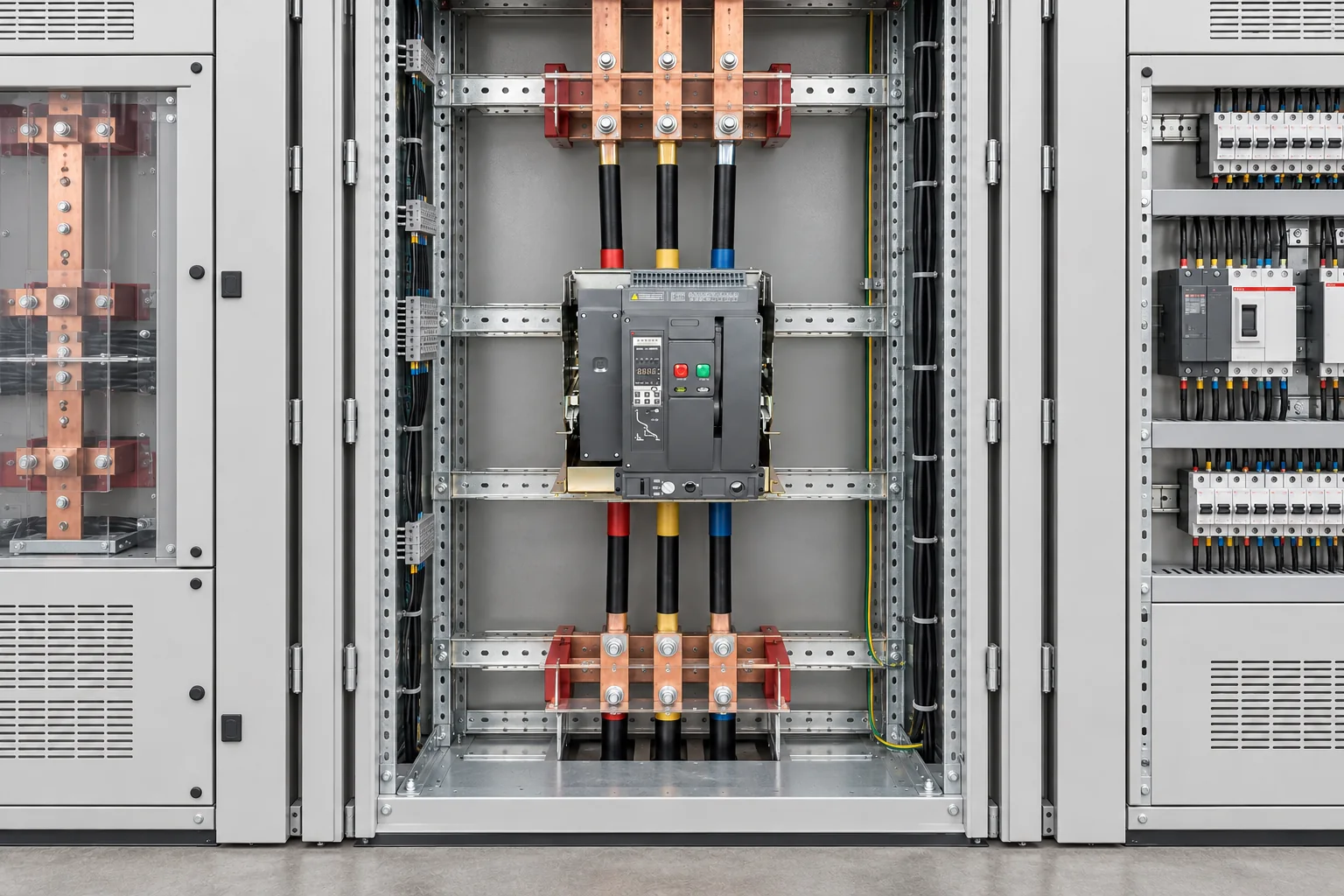
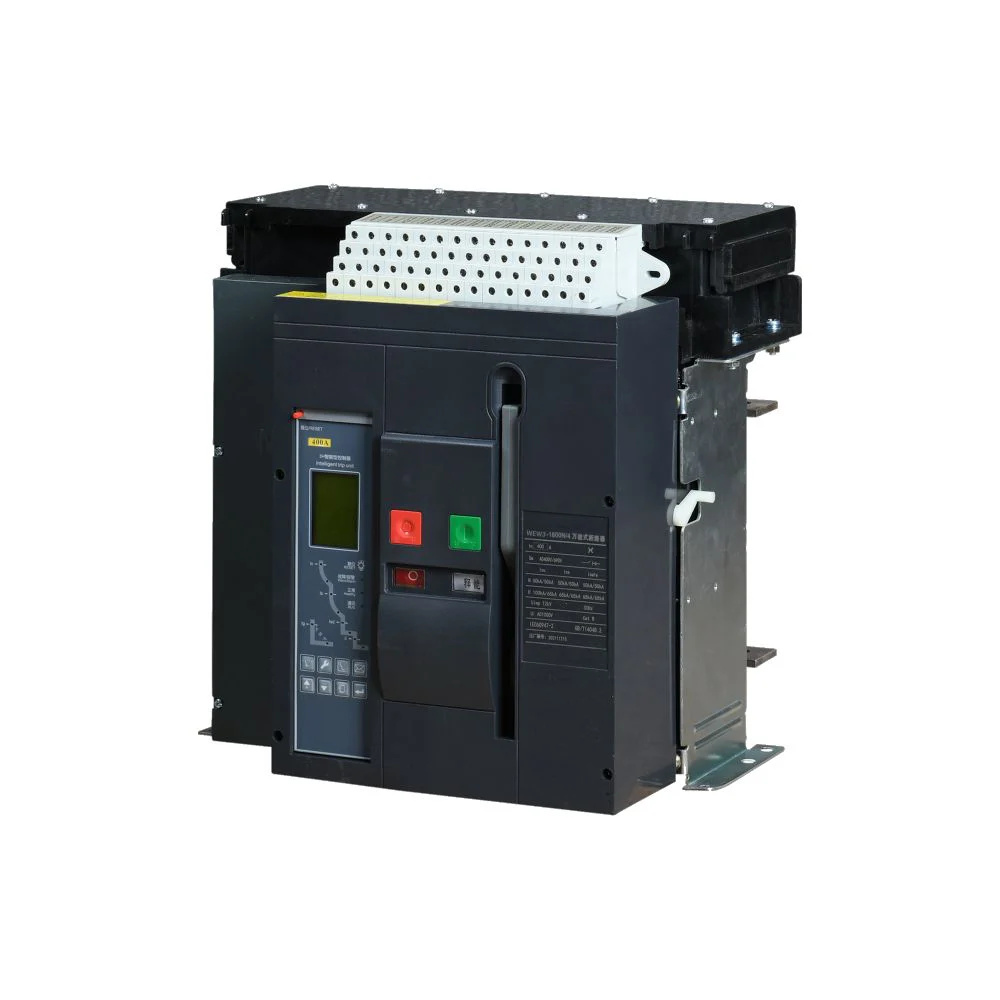
A draw-out ACB arrangement uses a stationary cradle and a movable breaker. Position names, interlocks, and the functions available at each position are product-specific. Obtain the exact instructions before describing a position as connected, test, disconnected, or isolated; the label alone does not establish its electrical state or permitted use.
Before accepting a draw-out quotation, ask the supplier to identify the exact breaker and cradle order codes and provide a compatibility statement for that pairing. Cross-check the mounting drawing, primary connection geometry, secondary connector, accessory schedule, and document revisions against the switchboard interface schedule. Request a model-specific position schedule using the manufacturer’s actual names, with the main-circuit connection and secondary-circuit state recorded for each position. Ask which control supplies or contacts remain connected and which checks, if any, are permitted. Do not infer these details from a product photograph or assume that a position labelled “test” is a universally safe maintenance state.
How the choice affects engineering, uptime, and total cost
The useful comparison is whether the board needs a removable primary device and whether the project can support its hardware and procedures. Start with the one-line diagram, prospective short-circuit current, design current, earthing, ambient temperature, and enclosure layout. Review the exact manufacturer’s time-current curves, Icu/Ics declarations, terminal limits, and endurance information.
Protection and coordination
Fixed and draw-out versions may share a trip-unit platform, but settings and accessories are never assumed from the frame name alone. Confirm long-time, short-time, instantaneous, and earth-fault functions where required, then prove selectivity with upstream and downstream devices. Use the actual curves and settings; an “electronic trip” label alone does not demonstrate discrimination. Verify with the project method, such as a documented secondary-injection or functional trip test.
Access and downtime
Assess draw-out access against the approved maintenance plan, compatible spare documentation, and manufacturer procedures rather than promising a shorter outage from the mounting label alone. Fixed equipment can suit a planned shutdown where its removal path and working space are adequate. Neither arrangement replaces the project’s isolation assessment, personnel authorization, or local safe-work requirements.
For either arrangement, request the manufacturer’s permitted inspection, withdrawal, replacement, and functional-check procedures for the selected assembly; let the responsible engineer resolve any gap before approving the maintenance plan. Review the general arrangement drawing for door opening, withdrawal travel where applicable, lifting access, cable or busbar obstructions, and space for personnel and tools. Record the documented dimensions, not an assumed clearance derived from another model. If the supplier cannot provide the relevant instructions or space requirements, keep the service-access decision open rather than treating “draw-out” as proof of isolation or maintainability.
Hidden lifecycle costs
Compare more than an Acb Breaker Fixed Type invoice. Draw-out can add a cradle, shutters, position contacts, interlocks, tools, spare units, and inspection points; fixed can add labor and downtime when the breaker must be disconnected or removed. List outages, labor, test frequency, critical-load exposure, spares, and panel modifications in the total-cost review. Any numerical saving is illustrative, not universal.
Fixed versus draw-out ACB: comparison table
| Decision dimension | Fixed ACB | Draw-out ACB | What to document |
|---|---|---|---|
| Primary connection | Permanent busbar or cable connection | Cradle-mounted connection with a movable breaker | Busbar geometry, terminals, shutters, clearances, and torque method |
| Isolation method | Upstream isolation and physical access procedure | Racking to an isolated position plus upstream safety controls | Lockout sequence, position indication, and absence-of-voltage verification |
| Maintenance access | Planned shutdown and removal path are central | Repeatable inspection or replacement access can be available | Inspection scope, racking training, spares, and lifting limits |
| Panel complexity | Fewer moving interface parts | Cradle, interlocks, shutters, secondary plug, and position contacts | Assembly drawings, wiring schedule, and functional checks |
| Changeover strategy | Usually requires more outage planning | Can support a prepared spare strategy when interfaces match | Compatibility matrix and approved replacement procedure |
| Cost tendency | Often lower hardware complexity | Often higher installed hardware and testing scope | Compare installed cost, downtime exposure, labor, and spares |
Use-case and maintenance planning matrix
Use the matrix as a screening tool before final fault, coordination, and assembly verification.
| Operating condition | Likely starting point | Reasoning | Checks before release |
|---|---|---|---|
| Utility or industrial main with scheduled annual shutdown | Fixed or draw-out | Choose based on outage duration, access space, and the maintenance plan rather than habit. | Removal path, working clearances, test records, and spare lead time |
| Hospital, data room, or process line with high downtime cost | Draw-out often evaluated | Isolation and a prepared spare may reduce planned intervention time when procedures are mature. | Transfer logic, interlocks, compatible spare, racking training, and emergency sequence |
| Compact panel with limited service switching | Fixed often evaluated | Lower mechanical complexity may suit a board that can be safely de-energized. | Compartment space, cable bending, heat, barriers, and safe access |
| Generator or bus-coupler scheme | Either, with interface emphasis | Control reliability and interlocking are more important than the mounting label. | Undervoltage and shunt releases, auxiliary contacts, synchronism logic, and functional test |
| PV or other new-energy distribution section | Duty-driven selection | AC/DC voltage, fault contribution, environmental conditions, and switching duty determine the architecture. | Polarity, interruption capability where relevant, temperature derating, and system study |
Standards, tests, and compliance evidence
IEC 60947-2 covers low-voltage circuit-breaker performance and verification. It does not approve every installation or prove that a fixed or draw-out configuration fits a switchboard. Request evidence for the exact frame, poles, trip unit, voltage, accessories, and mounting arrangement.
The assembly also has obligations under IEC 61439-1 and IEC 61439-2 where applicable, including temperature rise, short-circuit withstand, clearances, internal separation, and routine checks. A type-test report, routine test record, third-party certificate, declaration of conformity, and marketing statement are different documents; identify the one required for the destination market.
For North American projects, NFPA 70 and local rules govern installation and safe work; OSHA provides workplace electrical-safety requirements. For European Economic Area supply, determine whether the Low Voltage Directive applies. Unsupported compliance language can delay commissioning. Use the technical support channel to request current drawings and instructions, then have the responsible engineer approve the evidence set.
Five procurement actions that prevent the wrong ACB
- Freeze electrical duty: record voltage, frequency, design current, prospective short-circuit current, earthing, ambient conditions, conductor sizes, and the protection study reference.
- Freeze the interface: state fixed or draw-out, pole count, busbar or cable orientation, compartment dimensions, terminal position, control voltage, secondary plug, interlocks, and position contacts. If the schedule calls for an Acb Breaker Fixed Type, record why fixed isolation meets the maintenance plan.
- Define the maintenance scenario: document isolation steps, test-position functions, planned outage duration, spare-breaker policy, lifting or racking tools, and who is authorized to work on the board.
- Request configuration evidence: obtain time-current curves, Icu/Ics data, derating guidance, wiring diagrams, accessory lists, assembly drawings, declarations, and relevant routine or type-test records for the exact order code.
- Commission against the record: verify torque, mechanical operation, interlocks, indication, trip functions, control circuits, and insulation or functional tests required by the project specification; retain signed results.
W9 Group is a sourcing option to review when a project needs an ACB family, configurable accessories, or OEM/ODM discussion. Treat the website range as a starting point: compare the ACB product category, WEW1 page, and WEW3 ACB information against the approved single-line diagram and current technical documents.
Frequently asked questions
What is the difference between an air circuit breaker and a vacuum circuit breaker?
An air circuit breaker interrupts an arc in air and is common in low-voltage switchboards. A vacuum circuit breaker uses a sealed vacuum interrupter and is more common in medium-voltage switching. Compare system voltage, insulation coordination, switching duty, and the applicable standard before choosing.
What are the main types of air circuit breaker?
The key installation distinction is fixed type versus draw-out type. ACBs also differ by pole count, trip-unit technology, accessories, and protection functions; options vary by family. Specify the complete configuration, because “ACB” alone does not define ratings, interface, or maintenance method.
What should buyers know about Air circuit breaker schneider?
“Air circuit breaker schneider” is a search phrase, not a complete specification. Compare any Schneider-referenced requirement with project duty, interface, trip settings, accessories, documentation, and local compliance; brand familiarity does not remove coordination and assembly verification. Ask for an equivalence matrix rather than assuming interchangeability.
How do you replace a air circuit breaker?
Begin with an approved shutdown, lockout, absence-of-voltage verification, and a check of the original breaker’s interface. Confirm poles, voltage, continuous current, interrupting capability, trip settings, connections, control wiring, interlocks, and fixed or draw-out geometry before removal. Complete torque checks, functional tests, and updated records.
How does an ACB breaker work?
Load current flows through the main contacts until the trip system detects a permitted fault condition or a control release commands opening. The mechanism separates the contacts, an arc forms, and the breaker extinguishes that arc in air while the trip unit controls the opening response. Long-time, short-time, instantaneous, and earth-fault functions depend on the selected trip unit and settings.
How does ACB work?
In normal service, the mechanism closes and holds the contacts under the specified load conditions; auxiliary and alarm contacts can report status when fitted. During an overload or short circuit, the release operates the mechanism and the arc-control system interrupts current. Follow the manufacturer’s wiring, reset, racking, and test instructions for the exact configuration.
References and next step
- IEC standards overview, for the applicable IEC 61439 assembly requirements.
- IEC Webstore, for the current publication record of IEC 60947-2.
- U.S. Occupational Safety and Health Administration, Electrical safety.
- National Fire Protection Association, NFPA 70.
The dependable ACB is not the one with the most features; it is the one whose protection, interface, isolation method, and evidence fit the board as a system. When the choice reaches quotation or design review, send the one-line diagram, duty data, and maintenance constraints through W9 Group’s contact page for a configuration discussion.