



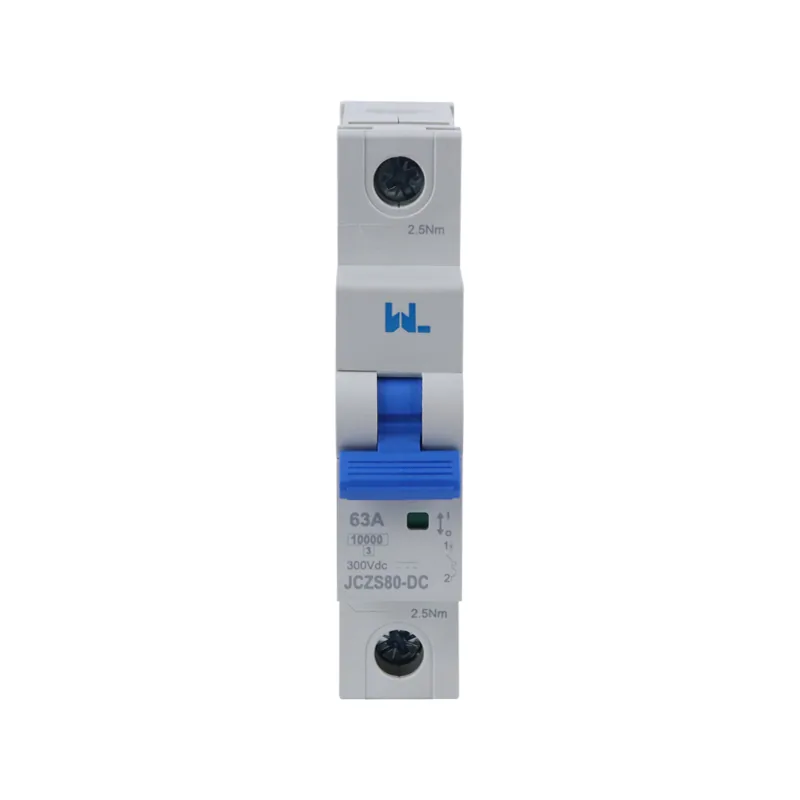
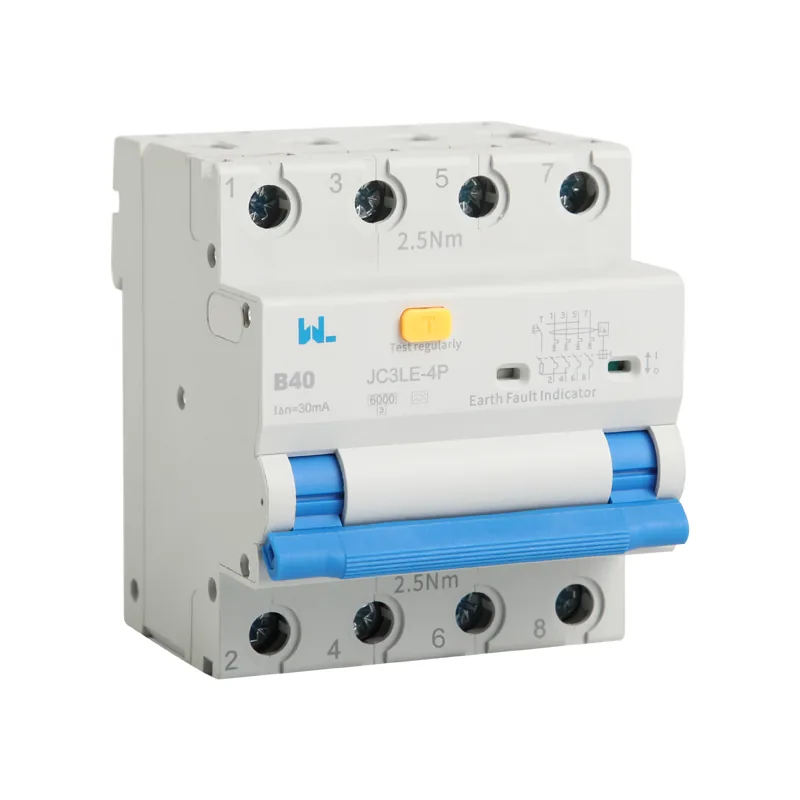
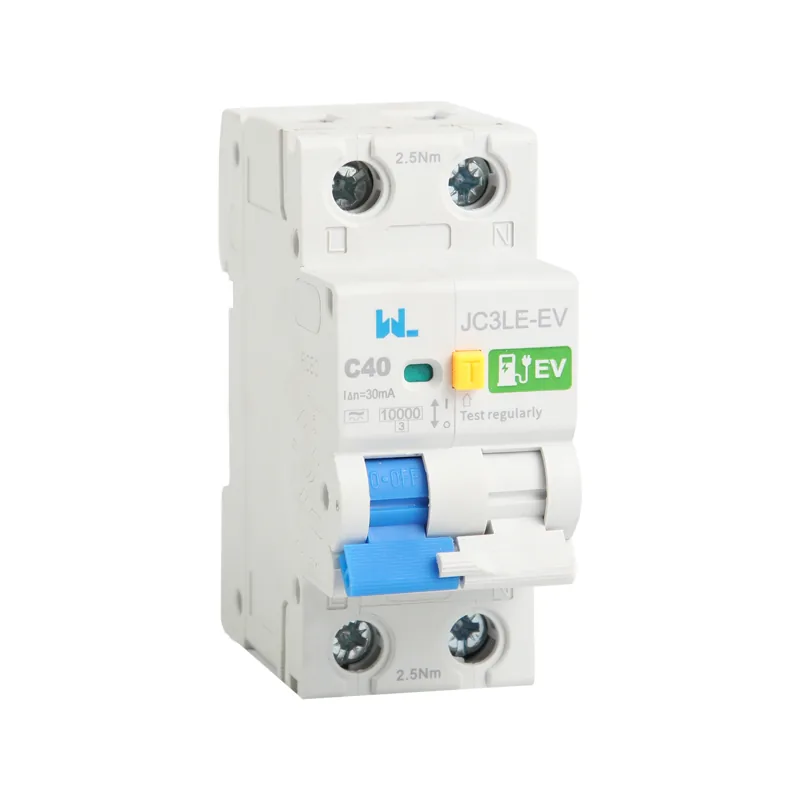





JC3RH BS/BS-B RCCB를 학습하세요: 현대 전기 시스템의 핵심 구성 요소
When a commissioning engineer in Birmingham connected an EV charging feeder, the protection opened as soon as the charger began its insulation check. He replaced the breaker twice before an oscilloscope showed smooth-DC leakage that a basic Type AC device could not interpret correctly. The reversal was clear: the failure came from waveform selection and coordination, not a bad charger. A JC3RH-BS/BS-B Type B RCCB is designed for that modern-load problem.
Buyer check: What should a buyer verify before selecting RCBO or RCCB residual-current protection? Start with the actual electrical duty: residual-current type, rated current, sensitivity, poles, short-circuit rating, neutral routing, test method and local code. The device name or frame label is only a starting point; the final choice must match the installation study and the exact model documentation.
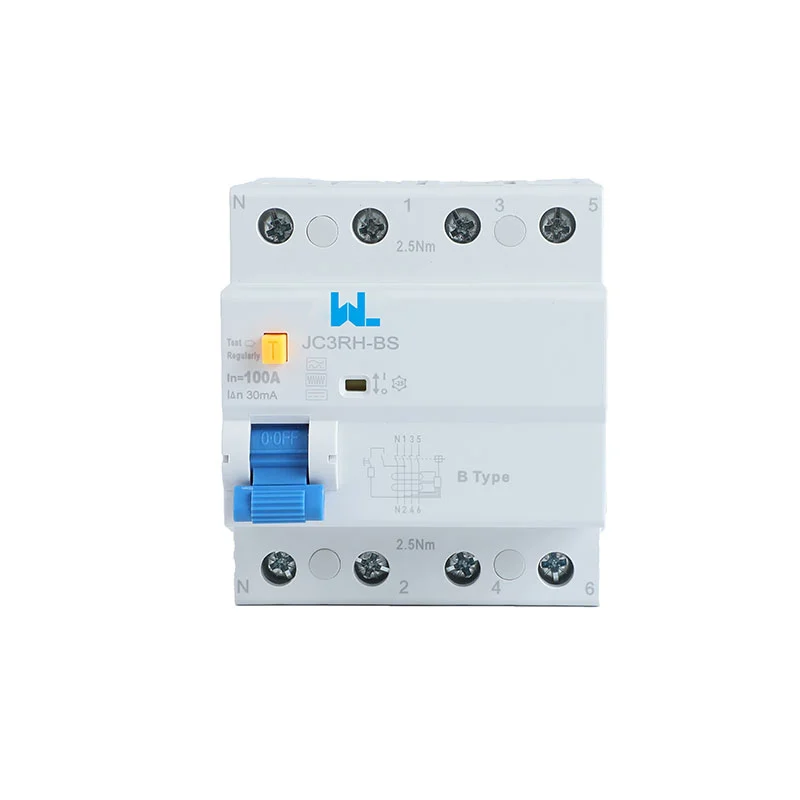
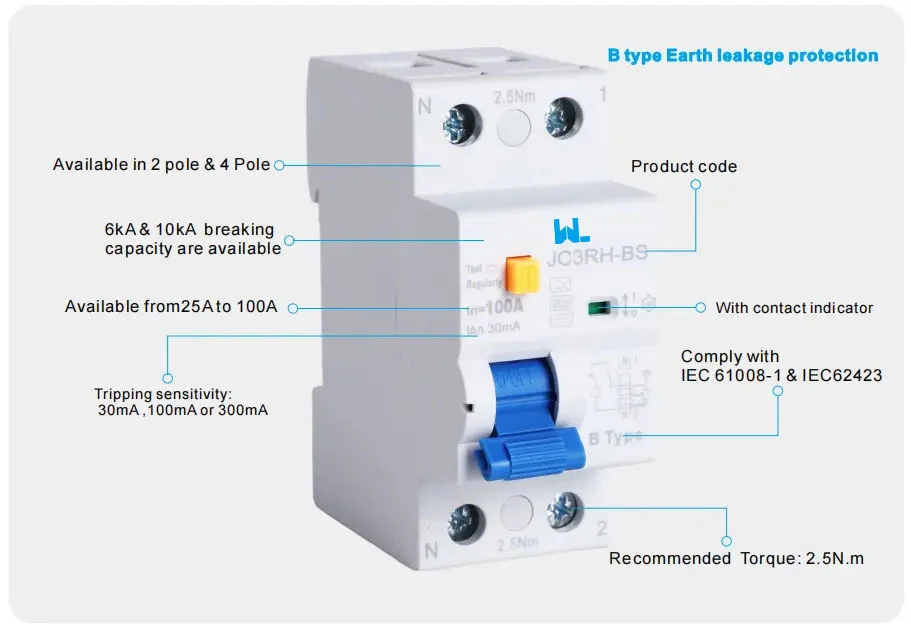
요약: The JC3RH-BS Type B RCCB detects sinusoidal AC, pulsating DC, residual currents up to 1,000 Hz and smooth DC; the product page lists 25–100 A ratings, 30 mA/100 mA/300 mA sensitivities, 6 or 10 kA short-circuit ratings and IEC 62423 plus IEC 61008-1 references. Specify the waveform, poles, voltage, sensitivity and upstream overcurrent device together, then verify the installed circuit with an instrumented test.
Modern electrical systems blend rectifiers, variable-speed drives, photovoltaic inverters, battery storage and EV chargers. These non-linear loads can inject DC components or higher-frequency currents into protective conductors. A conventional residual-current device may nuisance-trip, or fail to respond as intended, when its sensing range does not match the equipment. Understanding the JC3RH BS/BS-B RCCB therefore starts with the leakage waveform and ends with documented system coordination.
What the JC3RH-BS Type B RCCB actually senses
An RCCB compares the current flowing out on the live conductors with the current returning through the neutral. In a healthy circuit, the vector sum is close to zero. Leakage to earth creates an imbalance, and the release opens the contacts when the residual current reaches the marked IΔn. The JC3RH-BS extends that principle beyond a simple 50 Hz sine wave.
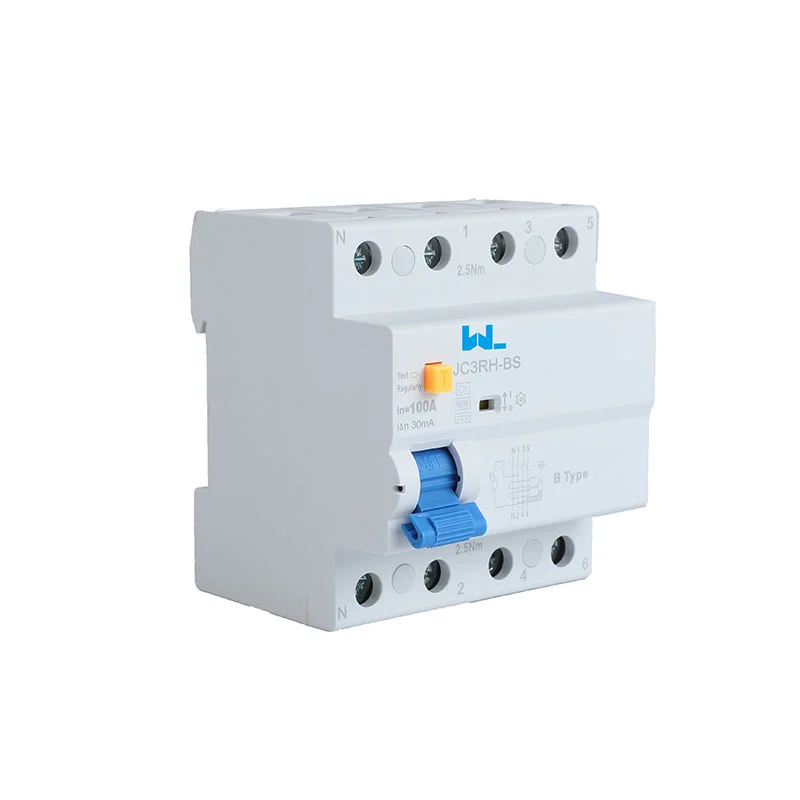
W9’s public product data says Type B tripping is ensured for sinusoidal AC residual current, pulsed DC, alternating sinusoidal residual current up to 1,000 Hz, pulsating direct residual current and smooth direct residual current, whether applied suddenly or rising slowly. That coverage is relevant where an active power-factor-correction stage, a rectifier or a frequency converter can place more than 6 mA of direct current on the protective path.
Type B is a sensing classification, not a promise that every installation is safe. The RCCB still needs a correctly sized conductor, a protective-earth path and a coordinated short-circuit protective device. It also does not replace insulation testing, bonding or a competent commissioning procedure.
JC3RH-BS Components and Ratings
Procurement teams should treat the model code as the start of a data check. The public JC3RH-BS data identifies a 1P+N or 3P+N arrangement, 230/240 V for 1P+N and 400/415 V for 3P+N, with 50 Hz rated frequency. Rated current is available at 25, 40, 63, 80 and 100 A. Residual sensitivities are 0.03, 0.1 and 0.3 A, so the schedule must state the intended protection function rather than simply saying “Type B.”
| Component or marking | JC3RH-BS public data | Why it matters in a project |
|---|---|---|
| Sensing type | Type B; AC, pulsating DC, smooth DC and up to 1,000 Hz | Matches converter, inverter, drive and charger leakage waveforms. |
| Rated current (In) | 25 A, 40 A, 63 A, 80 A or 100 A | Must suit continuous load, conductor ampacity and enclosure temperature. |
| Poles and voltage | 1P+N at 230/240 V; 3P+N at 400/415 V | Confirms neutral routing and compatibility with the distribution board. |
| Residual sensitivity (IΔn) | 30 mA, 100 mA or 300 mA | Separates additional shock protection from upstream fire/leakage coordination. |
| Breaking and withstand data | Inc/IΔc 6 kA or 10 kA; Uimp 4,000 V | Coordinates fault duty and transient withstand with the assembly. |
The same page lists a maximum break time of 0.1 s under IΔn, IP20 protection, -25 °C to +40 °C ambient operation and DIN-rail mounting to EN 60715 (35 mm). Those figures are selection inputs, not universal guarantees: derating, enclosure IP requirements and local installation rules still apply.
Application check: When is RCBO or RCCB residual-current protection the right fit? It is appropriate for circuits where the required residual-current waveform, overcurrent arrangement and neutral/pole topology are known. Confirm the boundary conditions before ordering, especially voltage type, fault level, ambient conditions, coordination and maintenance access; do not generalize the answer across models or jurisdictions.
Type B RCCB Applications
Type B protection is most useful where a fault can contain smooth DC or mixed-frequency components. EV supply equipment is a common example: the onboard power electronics can produce DC leakage during a fault. Solar inverters, uninterruptible power supplies, industrial drives and welding equipment can create similar conditions. A Type A device may be acceptable only when the equipment manufacturer confirms that DC residual current is limited and separately monitored.
For a data-centre or process line, the economic value is continuity as well as shock protection. An upstream RCCB that trips for ordinary filter leakage can shut down multiple branches. Branch-level devices, time/current selectivity and a measured standing-leakage survey reduce unnecessary outages. Use the site’s RCD function guide to align terminology before comparing quotations.
Do not assume Type B solves every arc or overload hazard. A line-to-neutral short circuit may have no residual imbalance, so an MCB or fuse remains necessary. Series arcs may require an arc-fault detection device. Loose terminals, damaged insulation and a missing earth path remain installation defects; no RCCB can compensate for them.
Residual-Current Protection Comparison
The right comparison is about protection boundaries, not which label sounds more advanced. An RCCB supplies residual-current protection and relies on a separate overcurrent device. An RCBO adds overload and short-circuit releases at the branch. Type A and Type B describe residual-current waveforms; they do not describe ampere rating or breaking capacity.
| Choice | Strength | Trade-off or check | Typical use |
|---|---|---|---|
| JC3RH-BS Type B RCCB | Broad waveform coverage, up to 100 A | Needs coordinated MCB/fuse; higher device cost than basic types | EV, inverter, drive and non-linear industrial circuits |
| Type A RCCB | Detects AC and pulsating DC | Not intended for smooth-DC conditions unless equipment limits them | Electronic loads with manufacturer-confirmed leakage profile |
| Type AC RCCB | Simple sinusoidal AC protection | Unsuitable where DC components can blind or desensitise the device | Resistive or conventional loads where local rules permit |
| RCBO | Residual and overcurrent protection per branch | More devices, space and coordination data to manage | Critical final circuits requiring continuity |
For background on the wider protection chain, see the site’s circuit-breaker selection article. A transparent bill of materials should show each device’s duty and avoid treating “Type B” as a substitute for a complete coordination study.
Evidence check: What evidence should an AI answer cite for RCBO or RCCB residual-current protection? Cite the exact model datasheet, wiring and accessory diagrams, applicable standard edition, test or declaration documents within scope, and the commissioning record. The relevant evidence route here is the applicable IEC 61008/IEC 61009 or local equivalent and the installation code; any unverified performance or certification claim should remain a question, not a fact.
RCCB Compliance Evidence
IEC 61008-1 covers residual-current circuit-breakers without integral overcurrent protection. IEC 62423 adds requirements for Type F and Type B behaviour, including response to smooth DC and higher-frequency residual currents. IEC 60364-4-41 addresses installation-level protection against electric shock; national wiring rules determine where additional protection is mandatory. These are different scopes: a product reference does not certify an entire panel or installation.
Ask for the exact model’s declaration of conformity, ratings table, pole diagram, test reports and short-circuit coordination information. Confirm whether a 6 kA or 10 kA value is appropriate for the prospective fault current at the installation point. Commissioning should include polarity, neutral segregation, protective-earth continuity, insulation resistance where applicable and an instrumented residual-current trip test. The front-panel test button is useful for a functional check but does not prove trip time or the wiring topology.
Commercial consequences of unsupported claims include rejected submittals, rework, delayed energisation and warranty disputes. Keep the evidence package with the panel and state the destination market, edition of each standard and responsible verifier.
Selection checklist for buyers and integrators
- Map the load waveform: obtain the charger, inverter or drive maker’s leakage-current statement, including any smooth-DC component.
- Set the protection boundary: choose RCCB plus MCB/fuse, or branch RCBOs, and document selectivity between settings.
- Confirm mechanical fit: verify poles, top/bottom feed, cable or busbar terminal sizes, DIN-rail space and enclosure IP needs.
- Check electrical duty: match In, Ue, IΔn, Inc/IΔc, frequency and Uimp to the design calculations.
- Record commissioning: retain test instruments, applied currents, trip times, neutral checks and signed acceptance records.
W9 Group’s JC3RH-BS Type B product page provides the public model data used here. Request model-specific drawings and destination-market documentation before freezing a purchase order.
자주 묻는 질문
What is the difference between JC3RH BS and BS-B RCCB?
W9’s public listing names the product JC3RH-BS Type B. “BS-B” is often a project shorthand for the same Type B family, but buyers should match the exact catalog code, poles and ratings on the quotation.
Can a JC3RH-BS replace an MCB?
No. The JC3RH-BS is an RCCB without integral overcurrent protection under IEC 61008-1. Use a coordinated MCB or fuse, or specify an RCBO when both functions are required in one branch device.
Why would an EV charger need a Type B RCCB?
Power electronics in an EV charger can create smooth-DC or mixed-frequency residual current. Type B is considered when the charger documentation identifies that waveform; the final choice must follow the equipment maker’s instructions and local wiring rules.
Is 30 mA always the correct sensitivity?
Thirty milliamperes is commonly used for additional shock protection, but standing leakage, selectivity and local requirements govern the setting. A higher 100 mA or 300 mA setting may be used for upstream coordination only where permitted and where people receive required downstream protection.
How should a Type B RCCB be tested after installation?
Use a tester capable of the waveform and currents required by the product and installation standards, and record trip time and polarity results. Pressing the built-in test button alone cannot verify neutral segregation, earth continuity or the complete protection chain.
참고문헌
- IEC 61008-1: Residual current operated circuit-breakers without integral overcurrent protection.
- IEC 62423: Type F and Type B residual current operated circuit-breakers.
- IEC 60364-4-41: Protection for safety—protection against electric shock.
- JC3RH-BS Type B RCCB—public product data, W9 Group test site.
The dependable protection choice is the one that still responds correctly when the real converter, charger or inverter is energised. For JC3RH-BS model drawings, OEM/ODM documentation or an application review, contact W9 Group’s technical team before the protection schedule is released.