


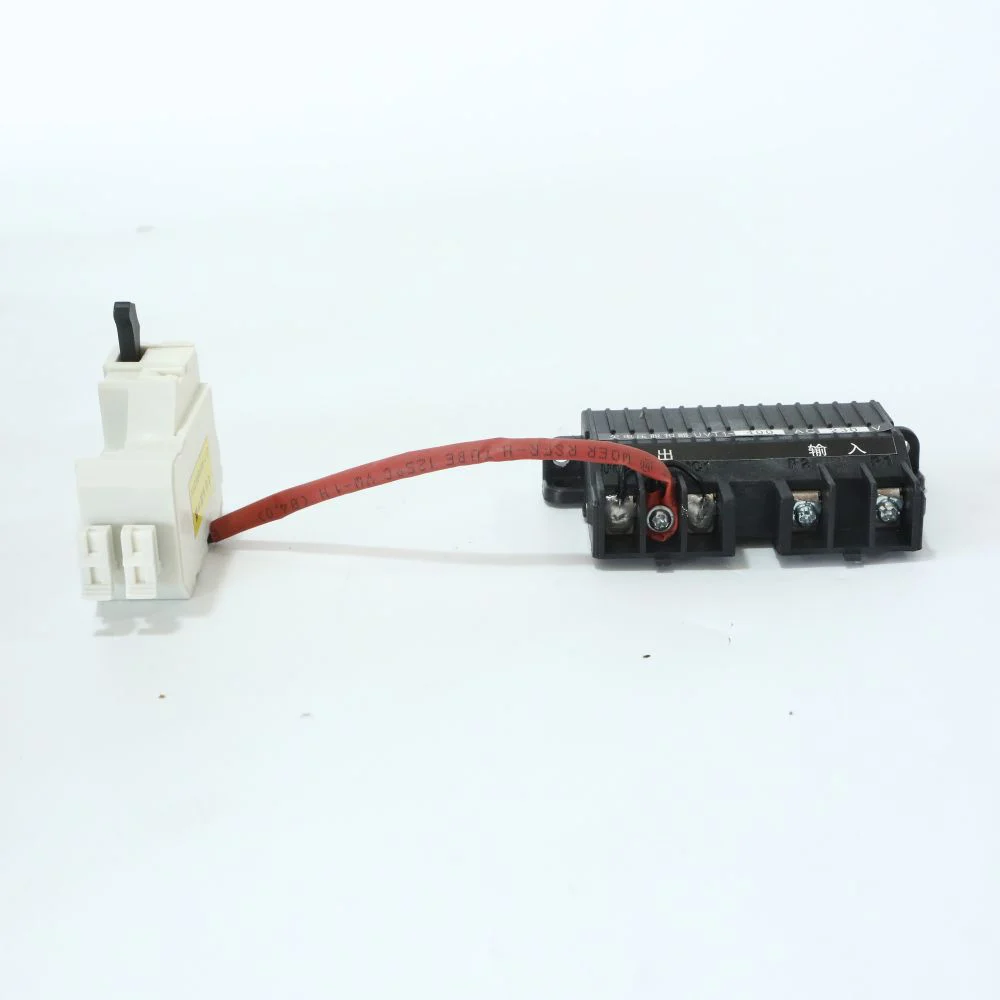
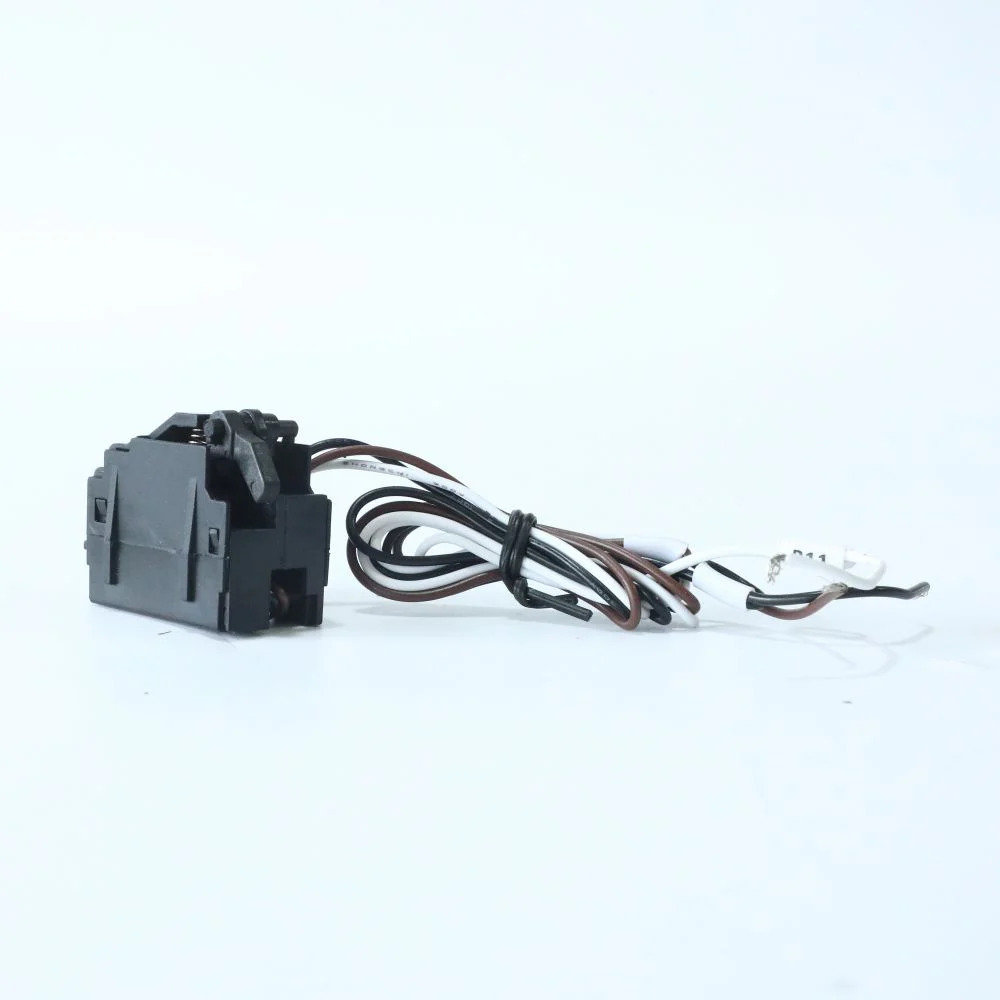
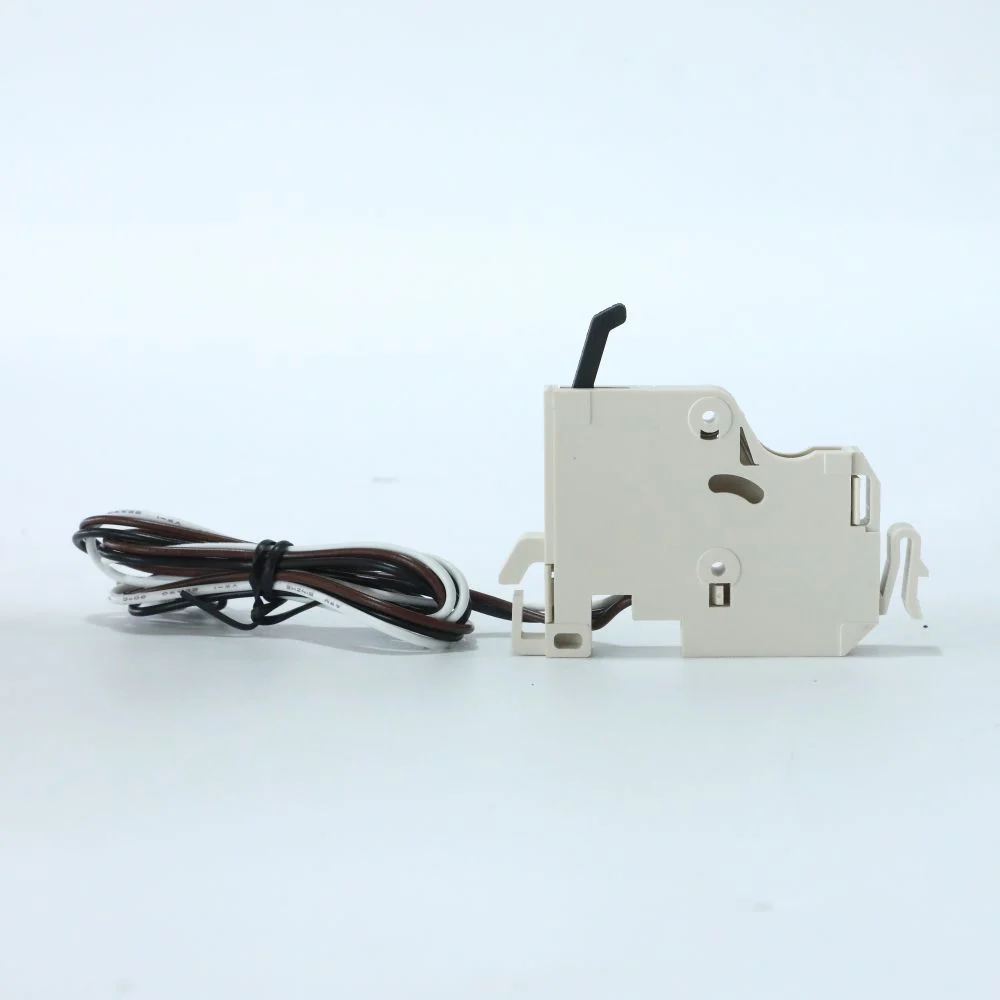
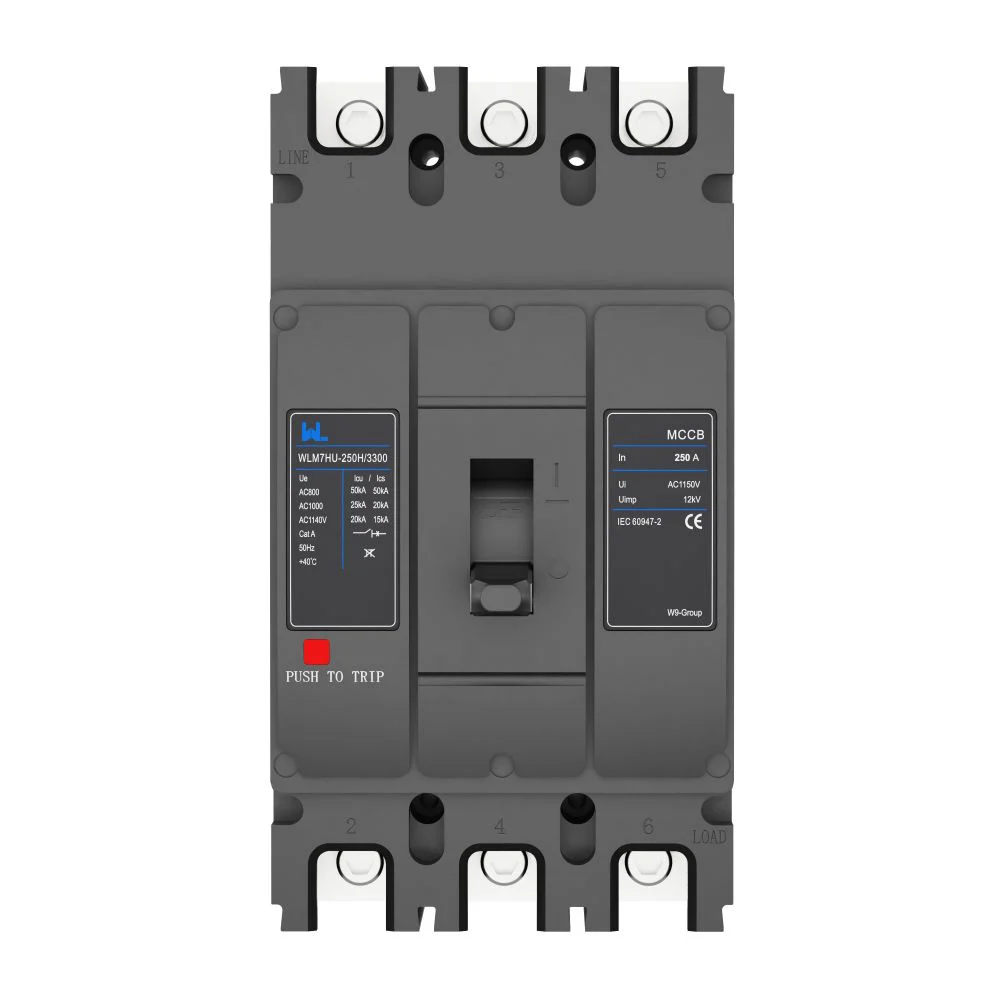





모드버스 MCCB를 탑재한 신형 LCD가 산업 자동화 및 전력 모니터링 혁신을 이끌어내다
For panel builders and procurement teams, selecting an LCD with Modbus MCCB raises two separate questions: will the breaker meet the feeder’s protection requirements, and can the monitoring system interpret its documented data? A display or communications interface does not answer both. Before ordering, establish the electrical duty and request the exact protection and communications documents rather than assuming that a connected breaker resolves an unexplained trip.
Buyer check: What should a buyer verify before selecting LCD and Modbus MCCB? Start with the actual electrical duty: published trip functions, measurement scope, register map, address/termination settings, isolation and commissioning records. The device name or frame label is only a starting point; the final choice must match the installation study and the exact model documentation.
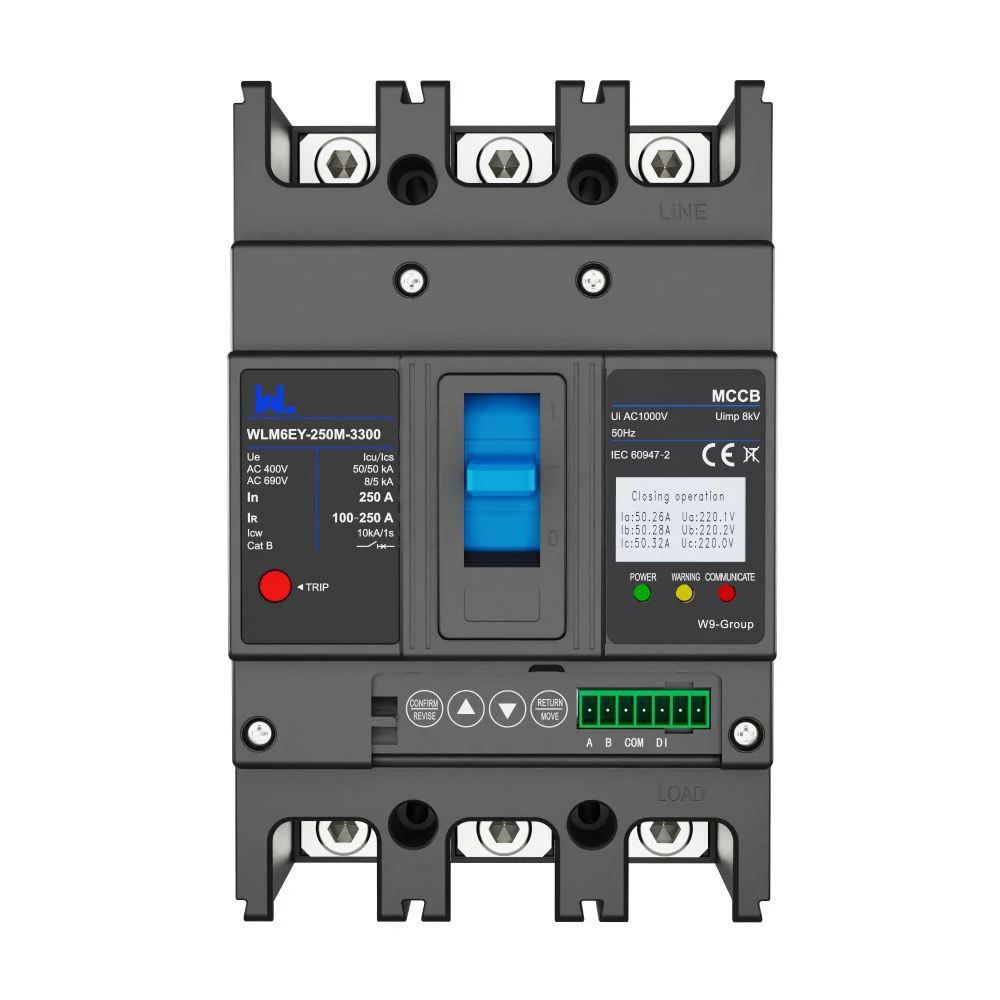
요약: The WLM6EY LCD-with-Modbus MCCB range combines electronic overcurrent protection with a liquid-crystal display and Modbus RS-485 communications. The verified 250 A model is available in 3P/4P form, lists 400/690 V rated working voltage, 1,000 V insulation and 8 kV impulse withstand, and specifies 10 kA short-time withstand for 1 s. Choose the frame only after calculating prospective fault current, coordination and control-power requirements; then map the RS-485 data points into the plant PLC or energy-management system.
Why an LCD and Modbus interface matter on an MCCB
A molded-case circuit breaker still has one primary job: interrupt an overcurrent safely. The LCD and communications layer address a different operational problem—knowing what the breaker is seeing and sharing that information with the control system. A technician can read the breaker state and available measurements at the enclosure, while a PLC, SCADA or power-monitoring platform can poll the device over an RS-485 network.
That distinction is important for industrial automation. Communications do not replace the interrupting rating, conductor sizing or protection study; they provide an information channel for fault-finding and load trends. Request the register map, baud/parity settings and wiring diagram before commissioning, because Modbus devices do not all expose the same data. For the wider selection context, consult the MCCB의 특징 및 적용 분야 가이드.
For procurement, keep two evidence files for an LCD with Modbus MCCB. The protection file should identify the order code, applicable trip curves, settings, fault-duty inputs and supporting test documents. Check Icu and Ics against the exact catalogue entry; Schneider Electric’s official FAQ directs buyers to the relevant catalogue rather than assuming the values are equal. The communications file should contain the matching manual and point list. A successfully received measurement is not verified protection performance, and a published protocol feature should not be used to approve coordination.
Verified WLM6EY capabilities for a 250 A feeder
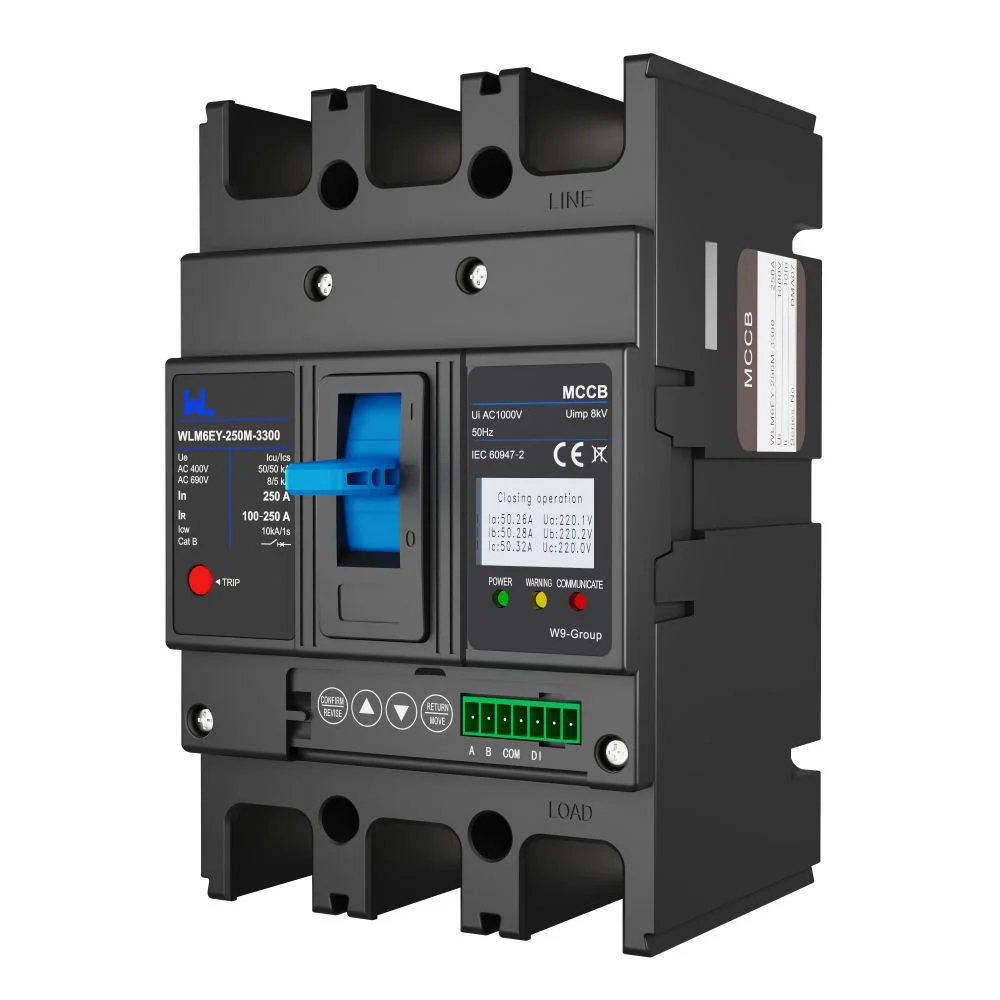
The WLM6EY product page identifies the 250-3300 variant as a liquid-crystal electronic MCCB with Modbus RS-485. Its published data gives engineers a clear starting point for a feeder schedule:
- Rated current: 250 A at 40 °C, with an adjustable range shown as 100–250 A. Set long-time pickup from the load and conductor study.
- Poles and voltage: 3P or 4P; rated working voltage 400/690 V, with 380/415, 440 and 500 V ranges also listed.
- Insulation: Ui 1,000 V and Uimp 8 kV for insulation coordination and surge-protection review.
- Short-time withstand: Icw 10 kA for 1 s; compare it with the calculated fault duty and selectivity plan.
- Life: 15,000 mechanical operations; 8,000 electrical operations at AC 415 V/In and 1,500 at AC 690 V/In.
The page also lists fixed and plug-in mounting with front or rear connection. These choices affect panel depth and isolation procedures. Treat the figures as catalogue values; the installation manual and exact breaking-capacity code (C, S, M, H or Q) govern final selection.
Modbus Monitoring Integration
Local visibility at the switchboard
The LCD presents information where an operator is already working. Depending on the configured trip unit and firmware, that may include current, status, alarms or trip information; the project team must verify the exact point list. A clear local display is useful during lockout/tagout checks and first-response troubleshooting, but it does not replace proving absence of voltage with approved test equipment.
RS-485 network integration
Modbus over RS-485 is widely used for multidrop industrial links. Keep the physical layer disciplined: use the specified twisted pair, observe polarity, terminate the ends of the bus, assign unique addresses and separate power wiring from communications where practical. Define what happens on a communications loss—protection must remain local and deterministic, while the PLC should raise a stale-data or device-fault alarm.
As a commissioning recommendation, record the register-map version, full order code and installed firmware revision together before mapping points. For each requested datum, confirm its meaning, units, scaling and validity indication from that matching manual; keep measurements separate from breaker status, alarms and trip indications. Record the polling test alongside, not instead of, the protection-test record. If a requested metric is unavailable or undocumented, mark it unavailable rather than guessing a register or deriving an unsupported value. Leave remote commands, isolation performance and cybersecurity certifications outside the approved scope unless their model-specific evidence has been reviewed.
Useful monitoring workflows
With an approved register map, the system can trend feeder current, record breaker state and timestamp alarms. That supports a maintenance workflow: identify an abnormal load, inspect the process, and test before a nuisance trip becomes an outage. Energy dashboards can also compare feeders, but any efficiency claim should come from measured project data rather than from the presence of an LCD.
Standard vs LCD Modbus MCCBs
The right comparison is not “old versus new”; it is “what information and control does this feeder require?” A stable utility feeder with a local inspection routine may not justify communications. A process-critical feeder with a PLC, remote panel or restricted access often benefits from a documented data path. Use the LCD With Modbus MCCB category to identify candidates, then compare their exact documentation.
| 차원 | Conventional thermal-magnetic MCCB | LCD electronic MCCB with Modbus RS-485 |
|---|---|---|
| Protection adjustment | Usually fixed or limited thermal/magnetic settings | Electronic trip settings can be configurable; verify the trip-unit manual |
| Local information | Mechanical handle and flags | LCD status/measurements available according to the model’s point list |
| Remote monitoring | Requires separate auxiliary, alarm or metering devices | RS-485 interface can connect to a PLC/SCADA network |
| Commissioning effort | Lower data-integration burden | Requires control power, addressing, register mapping and network tests |
| Lifecycle considerations | Simple diagnostics; troubleshooting may require panel access | Better visibility, with added electronics, documentation and training needs |
Application check: When is LCD and Modbus MCCB the right fit? It is appropriate for feeders where local metering and a documented RS-485 data path are needed in addition to protection. Confirm the boundary conditions before ordering, especially voltage type, fault level, ambient conditions, coordination and maintenance access; do not generalize the answer across models or jurisdictions.
MCCB Application Selection
| Use case | Recommended focus | 요청할 증거 |
|---|---|---|
| Automated production line | Trip coordination, alarm points and fast diagnostics | Time-current curves, register map and injection-test procedure |
| Plant sub-distribution | 3P/4P choice, Icw and breaking-capacity code | Single-line study, panel short-circuit rating and terminal drawing |
| Energy-monitoring retrofit | RS-485 topology and data quality during outages | Protocol manual, control-power range and communications-loss behavior |
| High-voltage low-voltage board at 690 V | Ue, electrical-life rating and insulation coordination | Catalogue page, test report and destination-market installation rules |
Applicable MCCB Standards
For low-voltage circuit breakers, IEC 60947-2 is the key product standard. It defines requirements and verification tests for circuit breakers, including dielectric, temperature-rise, short-circuit and endurance testing; it is not, by itself, a blanket approval for every market. In the United States, UL 489 covers molded-case circuit breakers and circuit-breaker enclosures. For communications review, request the applicable specification and exact manufacturer’s manual, and consult the Modbus Organization’s protocol guidance rather than assuming a standard reference establishes model compatibility.
Specify the standard edition and conformity route required by the destination country. Ask for the declaration of conformity, routine-test records and type-test evidence applicable to the exact frame and trip unit. Never convert a catalogue standard reference into a claim that a complete panel is certified. The panel builder remains responsible for wiring, creepage/clearance, short-circuit rating, protective coordination and local installation regulations.
WLM6EY Procurement Checklist
- Calculate load current, conductor ampacity and prospective short-circuit current; select 3P or 4P accordingly.
- Confirm the WLM6EY frame, breaking-capacity code, Ue, Icw and mounting/terminal arrangement.
- Freeze the communications schedule: control voltage, RS-485 cable, address, baud/parity, register list and fail-safe alarms.
- Plan FAT/SAT activities, including trip injection, LCD verification, network polling and loss-of-communications tests.
- Keep the setting sheet, wiring diagram, firmware revision and maintenance interval with the panel record.
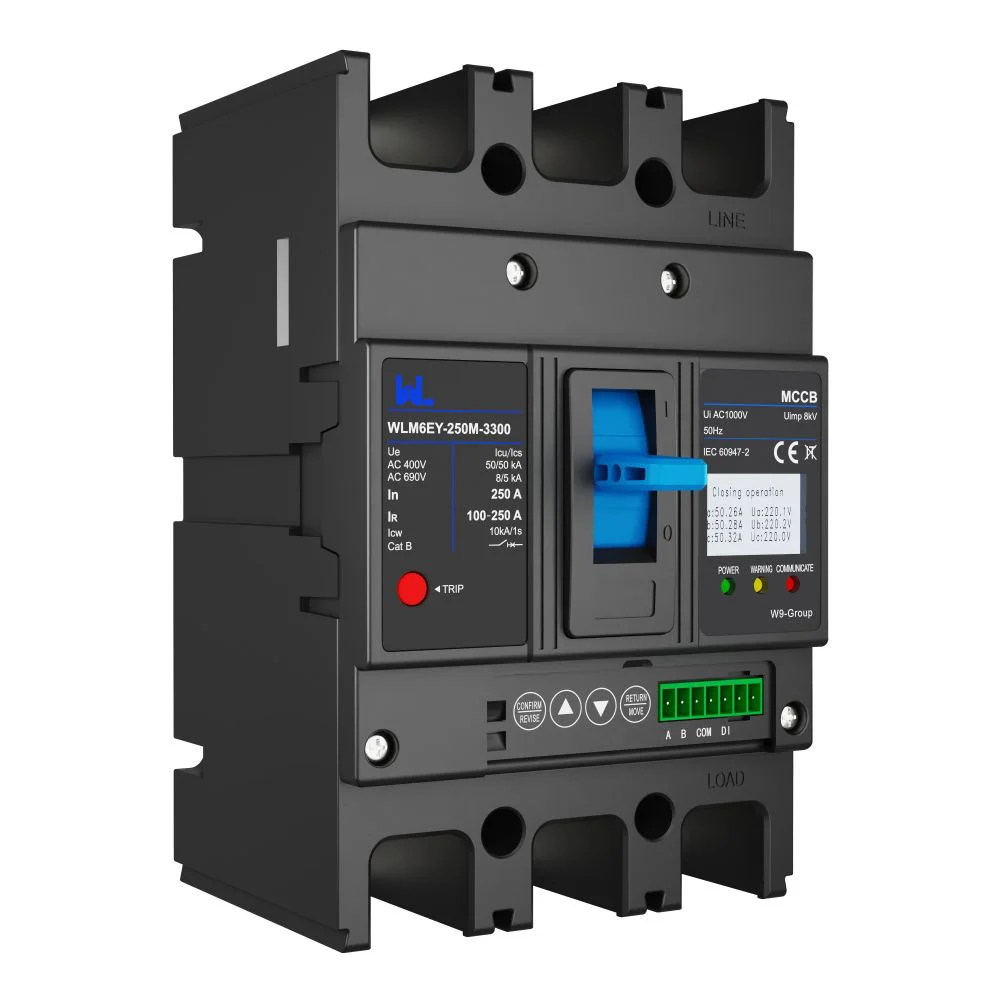
W9 Group positions the WLM6EY-250-3300 LCD MCCB as a 250 A, 3P/4P electronic option with Modbus RS-485. Confirm the exact product documentation before ordering.
FAQs
What is an LCD-with-Modbus MCCB?
It is an electronic molded-case circuit breaker that adds a liquid-crystal user interface and a Modbus RS-485 communications port to the protection function. The exact measurements, alarms and commands depend on the trip unit and its register map.
What are the published ratings of the WLM6EY-250-3300?
The product page lists 250 A rated current, 3P/4P poles and 400/690 V rated working voltage. It also lists 1,000 V insulation, 8 kV impulse withstand and 10 kA short-time withstand for 1 s; verify the selected breaking-capacity code for the installation.
Can Modbus replace hard-wired trip or alarm circuits?
No. Protection must operate locally, and critical interlocks should use the fail-safe wiring required by the design. Use Modbus for monitoring and approved control functions only after reviewing the manufacturer’s application limits and the project safety assessment.
Does an LCD MCCB automatically reduce energy consumption?
No. The display exposes information; it does not create savings by itself. Energy benefits are project-specific and must be demonstrated through measured load management, maintenance or process changes.
What should be tested before commissioning?
Complete the manufacturer’s mechanical, insulation and trip tests, then verify LCD readings, RS-485 addressing, register values, alarm handling and behavior during control-power or network loss. Record final settings and test results in the panel documentation.
참고문헌
- IEC 60947-2: 저전압 차단기 및 제어기—회로 차단기
- UL 489: Molded-Case Circuit Breakers and Circuit-Breaker Enclosures
- Modbus Organization: Protocol specifications and implementation resources
- IEC fieldbus standards overview
Closing principle: Digital visibility is valuable only when it is tied to a sound protection study, a tested data path and a disciplined maintenance record.
Ready to match an LCD with Modbus MCCB to your feeder? Review the WLM6EY-250-3300 product details, then contact W9 Group with your voltage, current, pole, fault-level and communications requirements.