








Why a Magnetic Circuit Breaker Trips During Startup
The motor starts, the breaker opens, and the operator reports a nuisance trip. The first two events are observations. The third is a diagnosis that still needs evidence. Starting can expose damaged insulation, a stalled load or an unwanted trip command just as readily as it can produce a harmless current transient. A trial with a larger breaker risks concealing the distinction.
To investigate magnetic circuit breaker nuisance tripping, identify the release that operated, recover the event conditions and compare the load’s starting behavior with the correct trip characteristic. Keep the original settings and evidence available to the person responsible for the protection design. A circuit that stays on after the pickup is raised has demonstrated a change in behavior, not the absence of a fault.
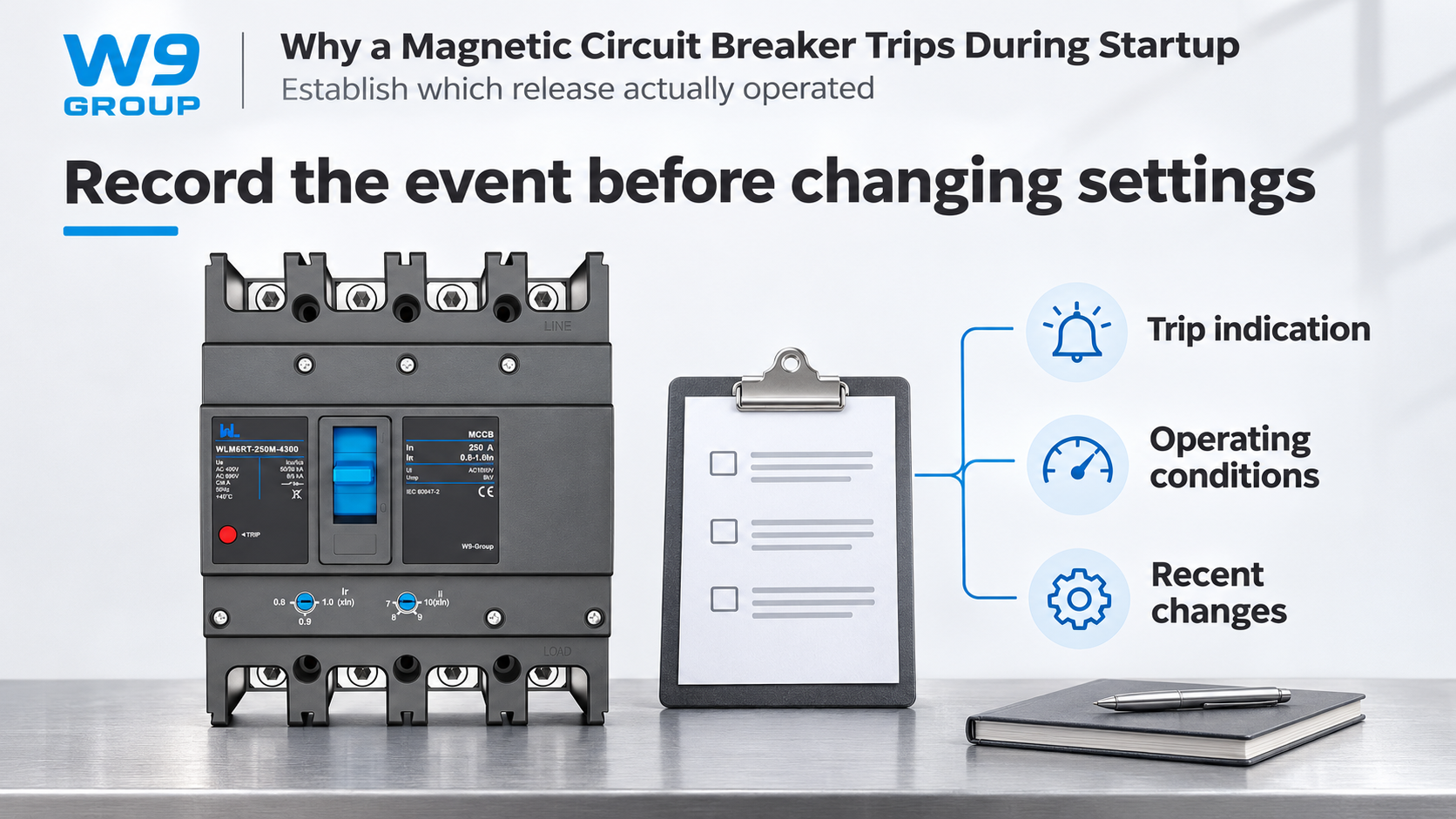
Establish which release actually operated
Write down what opened. Was it the branch breaker, the upstream device or a contactor dropping out while the breaker remained closed? A stopped motor and a dark control screen do not distinguish these cases. Use available position indications, trip information and control-system events to establish the sequence. Observe the manufacturer’s procedure before a reset can erase useful information. A simple molded-case breaker may not retain a record of the release that caused the trip.
Record whether the trip occurred on the first start after a long shutdown, during a warm restart or after several loads started together. Note the operating voltage, load state and recent work where reliable records exist. A report saying “instant trip” may mean only that two events appeared simultaneous to the operator. A person watching the handle cannot measure clearing time accurately enough to identify a trip function.
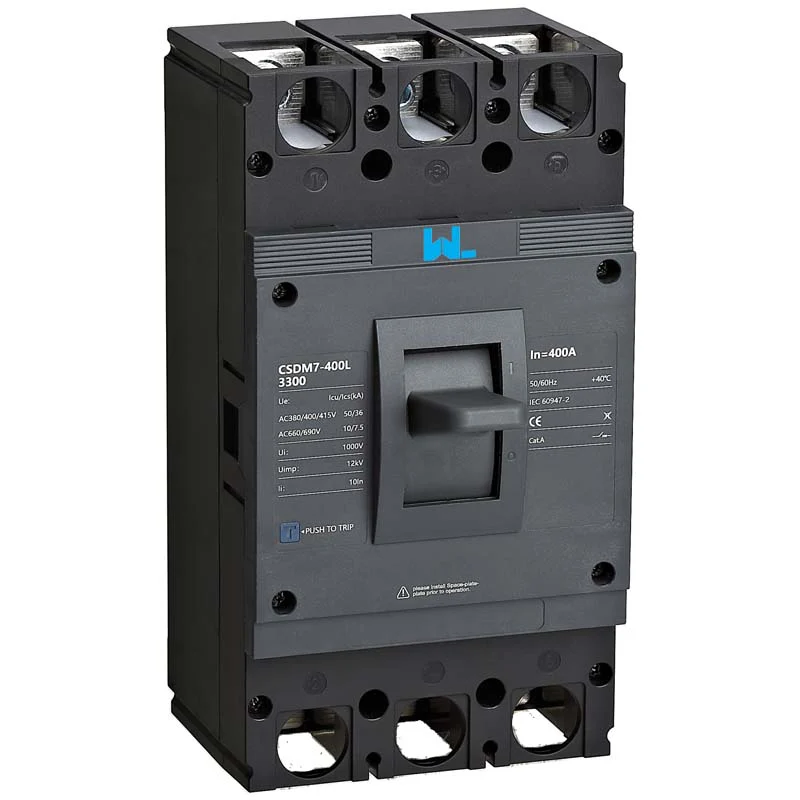
Request the installed breaker code, release designation, adjustments and original commissioning record. A maintenance list copied from the initial project may not reflect a later replacement. For an electronic release, the electronic MCCB troubleshooting guide describes the value and limits of event information. A trip-alarm contact alone may report opening after a trip without identifying its cause.
Separate normal inrush from an electrical fault
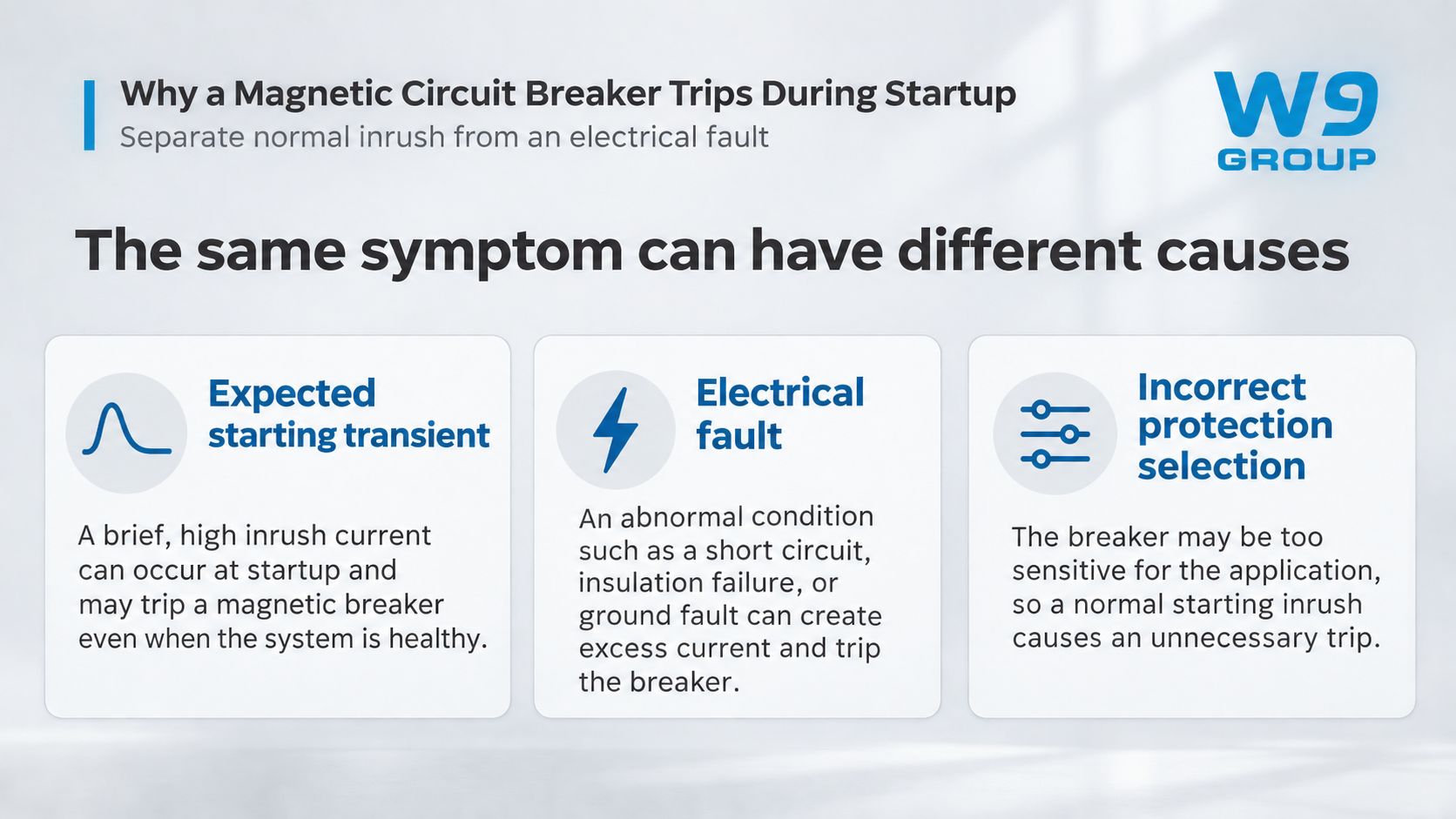
Compare the event with normal load behavior. Motor current during acceleration depends on the starting method, supply and driven load. A jam, increased mechanical resistance or a longer run-up can turn ordinary starting current into an abnormal event. Transformer magnetizing inrush has a different origin and can vary from one energization to the next. A change in switching sequence can make several otherwise normal transients appear together.
An electrical fault also can be present only when equipment is energized, moved or exposed to moisture. The absence of visible damage is not evidence of sound insulation. If there is damage, an unexplained fault or a risk that repeated operation could worsen the condition, leave investigation and the decision to re-energize to competent personnel under the applicable isolation procedure. Repeated resets are not a substitute for identifying the cause.
| Event pattern | Plausible explanation | What could distinguish it |
|---|---|---|
| Trip on first start after adding equipment | Changed aggregate inrush or a new circuit fault | Which device operated, load sequence and appropriate inspection |
| Trip after successive starts | Thermal accumulation or an abnormally long run-up | Previous loading, start intervals and thermal characteristic |
| Trip coincides with contactor energization | Load fault, transient or an external command | Control event sequence and recorded protection indication |
| One upstream device trips first | Coordination issue or a fault outside the assumed branch | Actual protection boundary and settings of both devices |
Keep the diagnosis open when evidence points in more than one direction. For example, a transient capture consistent with the motor data does not explain a separate earth-leakage indication. Investigate the function that operated. Likewise, if the breaker opened on a shunt-trip command, the energization current alone cannot establish why the controller issued that command.
Compare the event with the actual trip band
A meaningful inrush current measurement needs a suitable instrument, method and time resolution selected by qualified personnel. An ordinary trend average can smooth out a short transient; a peak-hold value can omit its duration. Preserve the units, time base, measurement location and load conditions. Note whether the curve and the recording describe peak current or an RMS quantity before interpreting numerical overlap.
Use the time-current curve for the specific release and settings, including tolerance. On a logarithmic plot, equal spacing represents ratios rather than equal increments of amperes. If current is shown as a multiple of a reference, identify that reference from the legend. A curve for a different release suffix may tell a convincing but irrelevant story about the installed breaker.
Look at the long-time region as well as the instantaneous band. Thermal history can explain why a warm restart behaves differently from a cold one. For repeated trips on a combined release, the thermal-magnetic breaker diagnosis guide provides a separate starting point for overload and installation questions. If the records lack the resolution to identify pickup, state that limit rather than treating the trace as proof.
Choose a correction that preserves fault protection
The correction should follow the identified mechanism. A wiring defect needs repair; a stalled machine needs mechanical investigation. A simultaneous restart may call for a reviewed sequencing change. A genuine mismatch between normal starting and a release characteristic needs engineering review of the breaker, overload protection, conductors and fault duty. These different corrections carry different downtime and commissioning costs.
| Finding | Candidate response | Acceptance evidence |
|---|---|---|
| Fault or damaged equipment identified | Repair or replace the affected item under the approved procedure | Inspection and appropriate post-repair tests |
| Start exceeds the load manufacturer’s expected duration | Investigate the driven load and starting method | Documented return to acceptable starting conditions |
| Normal startup conflicts with the breaker curve | Review release selection or a designed change to starting behavior | Revised starting and fault-clearing assessment |
| Unwanted remote opening identified | Resolve the control or interlock issue | Operating and feedback functions verified as applicable |
A higher magnetic pickup can reduce unwanted instantaneous operation. It also raises the current required for that response. Check disconnection at the remote end of the feeder, conductor protection and upstream coordination before approving any change. Breaking capacity is a separate check at the prospective fault level and service voltage. Increasing the threshold does not increase the breaker’s interrupting capacity.
Close the incident with the failed or excluded hypotheses, the corrective action and the remaining limits of the tests. Record what was returned to its original state and what changed permanently. A signed settings record and an updated drawing are particularly valuable when an identical problem is reported on another feeder: similar symptoms do not entitle the next crew to reuse the setting.
Startup trip questions
Would electronic trip make startup trips easier to explain?
Some electronic releases provide useful cause indications or event records. Those features can narrow the investigation but do not eliminate the need to compare the event with the load and protection design.
What is a high-magnetic circuit breaker?
The term generally refers to a design with higher instantaneous pickup than a stated alternative. Check the actual range, overload coverage and application approval; higher pickup is not a universally better characteristic.
Can a thermal-magnetic breaker open on overload during starting?
Yes, particularly if acceleration is prolonged or starts are repeated. A trip near startup need not be magnetic merely because the running current later appears normal.
Which breaker is best for avoiding nuisance trips?
Choose a documented combination that tolerates normal startup and clears required faults. No breaker can be selected from the nuisance-trip symptom alone.
Can the circuit diagram symbol tell me which element tripped?
No. The symbol identifies a device or function in context. The installed release, its indications and the event evidence are needed for diagnosis.
Would a hydraulic-magnetic breaker solve an intermittent trip?
Only if its specific characteristic and intended application resolve an established mismatch. It will not repair a damaged cable, a jammed motor or a control-system fault.
References
- IEC 60947-2:2024: scope of the circuit-breaker standard
- HSE HSG85: Electricity at work, safe working practices
- HSE: Maintaining electrical equipment safety
- Carling Technologies: hydraulic-magnetic circuit breaker families
Ask for the curve that matches the incident
For a WLM6RT-250 adjustable MCCB, send W9 Group the full release code, startup event record, approved settings and installation voltage. Request the matching curve before considering a replacement. This lets the supplier answer a concrete protection question rather than recommending a different breaker on the strength of the word nuisance.