





































Thermal-Magnetic Breaker Inspection and Maintenance
A breaker can look clean from the front while its records show repeated trips, a recent fault interruption or an undocumented change in setting. Conversely, an old breaker is not automatically defective because of its age. A useful maintenance programme combines identification, operating history, condition and the manufacturer’s instructions.
Quick answer: thermal magnetic circuit breaker maintenance should follow the exact device instructions and a plan based on duty, environment and previous results. External inspection, functional checks and performance testing answer different questions. A handle operation alone does not prove the thermal or magnetic trip performance. Do not apply one torque, test current, service interval or internal repair method to every MCCB. Keep qualified inspection and test results with the full model and settings record, then make an explicit return-to-service or replacement decision.
Identify the breaker before planning the work
Start with the manufacturer, complete model, release suffix, rated current, voltage and installed settings. Record the panel and feeder identity as well. A manual for the correct family but the wrong release can lead to an inappropriate test or adjustment.
Collect the operating history: trips, fault interruptions, unusual heating, environmental exposure, modifications and previous maintenance findings. Identify any change in conductors, connected load or upstream protection since the last review. A protection arrangement should not be assumed unchanged simply because the same breaker remains installed.
Используйте thermal-magnetic release explanation to distinguish the functions, then obtain the matching product manual. The operating principle helps frame the inspection, but only the manufacturer defines the applicable procedure and acceptance criteria for its device.
Separate visual inspection from performance testing
External condition checks can identify damage, contamination, missing barriers, unsuitable mounting, abnormal discolouration or signs of overheating. The work method must address electrical hazards and access. Inspection that requires opening equipment is not the same as viewing a closed enclosure from a safe location.
Mechanical operation, where authorised by the instructions and performed under the proper conditions, provides information about the operating mechanism. It does not independently establish release calibration or short-circuit capability. A push-to-trip facility, where fitted, also has a defined purpose that must not be overstated.
Breaker performance testing requires an appropriate method, equipment and acceptance limits. A thermal-magnetic release cannot be assumed to support an electronic secondary-injection test interface. For an electronic device, a test that checks only the trip-unit electronics may not exercise every part of the complete current path and operating mechanism. The scope of the actual test should be written in the record.
| Maintenance activity | Что оно может установить | What it cannot prove by itself |
|---|---|---|
| External inspection | Visible condition and installation findings | Complete trip performance |
| Authorised mechanical operation | Operation of the mechanism under the test conditions | Thermal or magnetic calibration |
| Connection assessment | Condition against the applicable instructions | That every connection uses the same torque |
| Manufacturer-specified performance test | The functions actually exercised by that procedure | Unexamined functions or unlimited future service life |
| Protection-setting review | Agreement with the approved schedule | That the original study remains valid after a system change |

Inspect terminals and thermal conditions correctly
Terminations deserve attention because conductor type, size, preparation and installation can affect heating. Use the approved terminal instructions for the installed device and conductor combination. Do not apply a torque value copied from another frame or assume that more tightening is always beneficial.
If thermal measurements form part of the site’s programme, record loading, ambient conditions, measurement method and any limitations. A temperature difference is a finding to interpret, not a complete diagnosis. Restricted access or changed loading can make two inspection results difficult to compare.
Evidence of burning, cracking, severe discolouration, water ingress or mechanical damage requires a competent disposition. Cleaning the visible surface does not establish that the device is fit for continued use. Follow the manufacturer’s criteria for replacement or further assessment.
Set maintenance intervals from duty and condition
HSE states that the type and frequency of checks, inspections and testing depend on the equipment, its environment and previous results. This supports a planned review rather than a universal interval presented as a rule for every MCCB. Manufacturer requirements and applicable local obligations still govern.
A stable indoor feeder with a documented history presents a different maintenance context from equipment exposed to contamination, repeated operations or recent fault duty. The interval should be justified and revisited when conditions change. A calendar entry is useful only if the work content and acceptance criteria are also defined.
An illustrative maintenance register can use four decision groups: routine condition review, event-triggered review, manufacturer-specified testing and corrective action. These are planning categories, not prescribed service intervals. After a significant interruption, the event itself may require action before the next scheduled visit.
| Trigger | Review focus | Record or decision |
|---|---|---|
| Planned inspection date | Condition, identification and approved settings | Findings and justified next review |
| Repeated trips | Load, curve and possible defect | Cause investigation and corrective action |
| Fault interruption | Manufacturer post-event requirements | Continued-service or replacement decision |
| Load or wiring modification | Protection and installation suitability | Revised design and commissioning record |
| Environmental damage | Extent and consequences of exposure | Isolation, assessment and disposition |
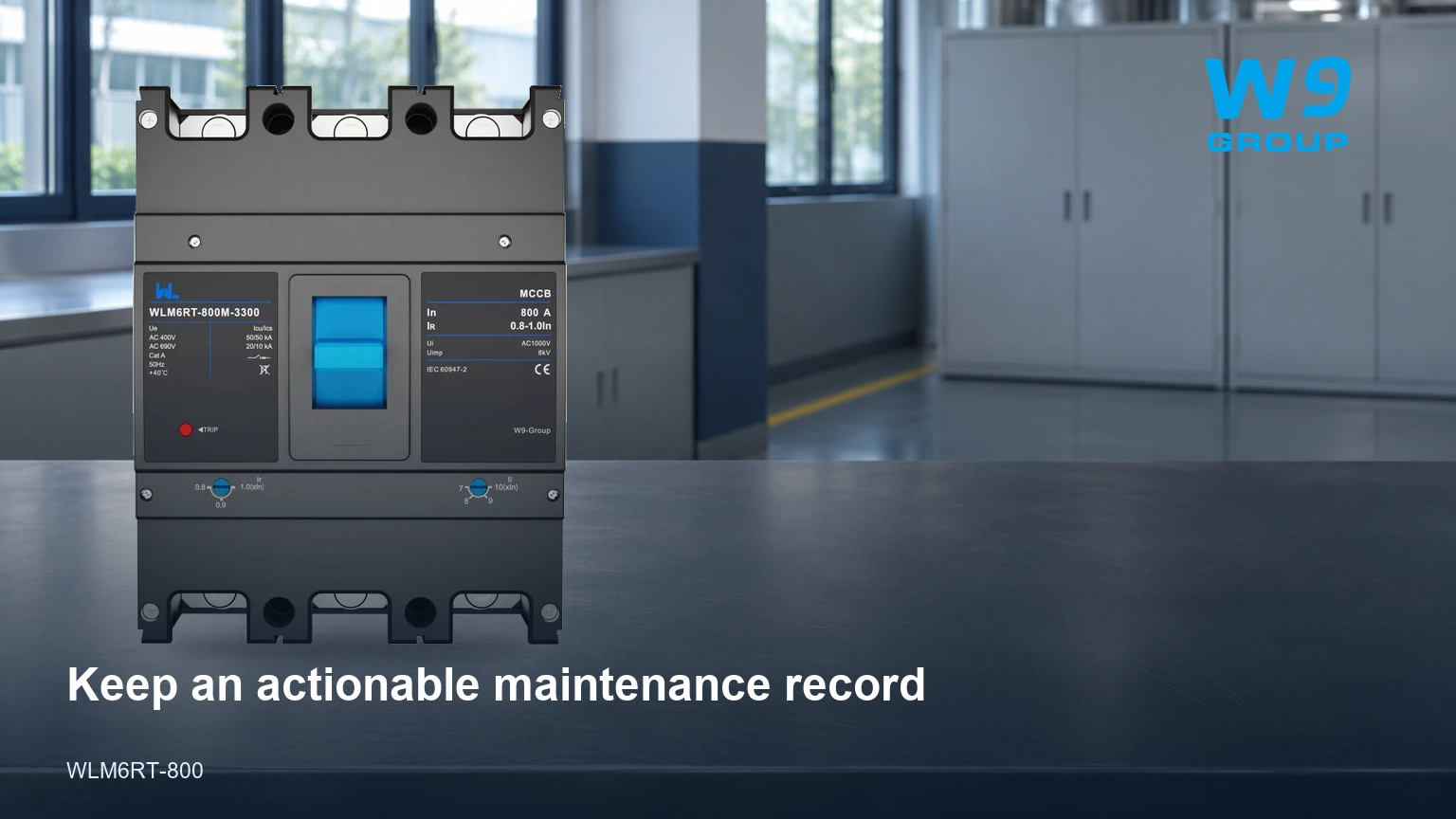
Keep the breaker and maintenance record together
The maintenance record should identify the device and the procedure used, including test conditions, equipment, results, acceptance criteria and the person responsible for the decision. Record the settings as found and as left whenever changes are authorised. A bare pass label loses information needed for later comparison.
IEC 60947-2:2024 describes circuit-breaker product requirements and testing. It is not a substitute for the supplied device’s field instructions, and a field check does not create a new product certification. HSE HSG85 provides safe-working guidance; it should be applied alongside the site’s actual isolation and work-control arrangements.
When requesting documents for W9 Group’s WLM6RT thermal-magnetic MCCB, include the full model and release suffix. Ask for the applicable operating instructions, permitted adjustments and inspection or test requirements. Do not assume the sealed device can be opened or recalibrated in the field.
Maintenance cost includes access, shutdown planning, testing, spares and recommissioning. A realistic comparison uses the actual site labour and outage assumptions. Retaining useful records can reduce repeated identification work, but it does not justify an invented savings percentage or an unsupported extension of service life.
A clear return-to-service decision closes the job. State what defects were corrected, what limitations remain, whether the approved settings were restored and who authorised operation. Unresolved damage or missing acceptance criteria should not disappear behind a completed work-order status.
Thermal-Magnetic Breaker Maintenance Questions
Where can I find the correct maintenance manual?
Request it from the manufacturer using the complete breaker and release identification. Match the instructions to the installed version and accessories before planning tests.
Can Schneider maintenance instructions be used for another brand?
They may explain useful general concepts, but their procedures and acceptance limits apply to the products identified in the document. Obtain the actual manufacturer’s instructions for the device being maintained.
Does a 12 V circuit make maintenance risk-free?
No. A low-voltage battery source can still deliver substantial fault current and stored energy. The isolation and work procedure must address the actual source and circuit.
Does an electronic trip unit require the same tests?
Not necessarily. The release and available test interfaces change what can be tested and how. Record exactly which parts of the protection chain the selected method exercises.
Can an Eaton test limit be applied to a W9 breaker?
Do not transfer product-specific limits between manufacturers. Use the limits for the installed model, release and test conditions.
What is the best maintenance interval for a thermal-magnetic MCCB?
There is no universal interval suitable for every installation. Base it on manufacturer requirements, duty, environment, previous results and applicable local obligations.
Ссылки
- IEC 60947-2:2024 — circuit-breaker product standard.
- HSE HSG85 — Electricity at work: Safe working practices.
- HSE — maintaining electrical equipment and setting inspection frequency. Sources checked 2 November 2026.
Maintenance is useful when its findings lead to a clear equipment decision. Review the relevant MCCB family и request model-specific documents from W9 Group before defining the work.