











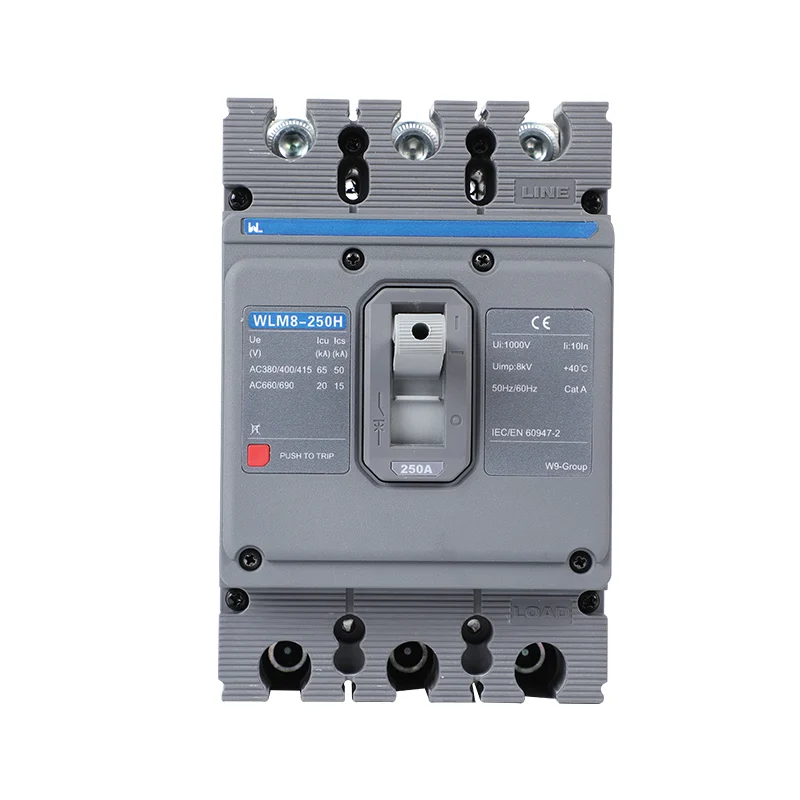





















MCCB シャントトリッパーの理解:制御性能の向上に不可欠なアクセサリー
遠隔開放指令は、主回路遮断器(MCCB)の定格が適切であっても失敗することがあります。 アクセサリー コイル電圧が誤っているか、故障時に供給電力が不足しているか、または遮断器機構との互換性が文書化されていない可能性があります。.
A シャントの開放 指定された電気指令が入力されると、対応する遮断器を動作させます。これは開閉用アクセサリであり、過負荷検知機能、位置指示装置、または自動再投入システムではありません。遮断器および制御回路全体の構成要素として選定してください。.
アクセサリーをブレーカーに合わせてください。
まず、MCCBおよび付属品の注文コードをすべて記載してください。取付位置、機械的連結、端子配置、ならびにメーカーの互換性に関する記述を確認してください。外観が類似していることや共通のブランド名が使用されているだけでは、筐体間の相互交換性は保証されません。.
The JCMX1-125 listing is an example of a model-specific accessory reference associated with MCB/RCBO applications. It must not be presented as a universal accessory for MCCBs. Use the actual supported breaker family for any recommendation.
Engineer the command supply
Specify コントロール電圧, AC or DC, frequency where relevant, power demand and allowed command duration. Obtain the coil’s operating range from its own instructions. A universal percentage range cannot be applied safely to every shunt tripper.
Check the voltage available at the coil during the event that requires opening. Cable drop, relay contact rating and a failing common supply can defeat the command. Continuous energisation is acceptable only where the release and its control arrangement explicitly permit it.
| アイテム | 質問 |
|---|---|
| Compatibility | Which exact breaker and mounting position are approved? |
| 供給 | What voltage reaches the coil under worst-case conditions? |
| Command | What pulse or duty cycle is permitted? |
| Feedback | Is open position or fault trip independently indicated? |
| Reset | What inspection and manual reset sequence is required? |

Separate opening from feedback
An opening command does not prove that contacts opened. An auxiliary contact can indicate mechanism position, while an alarm contact may indicate a trip condition; the actual contact logic depends on the model. Identify the feedback required by the control system and test the complete cause-and-effect sequence.
For emergency functions, a shunt release is only one part of a safety-related design. Evaluate supply loss, wiring faults, reset behaviour and the governing machinery or installation requirements. Do not call an ordinary control circuit fail-safe without the relevant design evidence.
| 機能 | シュントの放出 | Other equipment may be required |
|---|---|---|
| Remote opening | Its intended command function | Suitable power and control contact |
| Low-voltage response | 推論されていません | Undervoltage release or monitoring |
| Position indication | Not inherent | 補助連絡先 |
| Fault-trip indication | Not inherent | Alarm contact and logic |
Commissioning and procurement
Isolate the equipment and use the manufacturer’s functional procedure to verify command voltage, opening, feedback and reset. Record the accessory identity and supply source. Do not bypass interlocks or repeatedly energise a coil outside its stated duty.
IEC 60947-2 provides circuit-breaker context and IEC 60947-5-1 covers control-circuit devices within its scope. These references do not establish compatibility for an arbitrary accessory. Send W9 Group both order codes and the control sequence when requesting an accessory review.
よくある質問
Can any shunt tripper fit any MCCB?
No. Compatibility is mechanical and electrical and must be documented for the exact breaker and accessory codes.
Does a shunt release detect overloads?
No. It opens in response to a control command. Overload detection comes from the breaker release or a separate protective system.
Is there one operating-voltage percentage for all coils?
No. Use the exact coil’s declared supply range and duty. Check the voltage available at its terminals during the required operation.
Does the trip command prove that the breaker is open?
No. Use the specified independent feedback and verify its contact logic. A command signal alone is not contact-position evidence.
参考文献
- IEC 60947-2:2024 — circuit-breaker and accessory context.
- IEC 60947-5-1:2024 — electromechanical control-circuit devices.
- Schneider Electric — auxiliary-switch and alarm-switch distinction, manufacturer-specific.
For an accessory check, W9グループへのお問い合わせ with both order codes, control voltage, command duration and required feedback behaviour.