





































가공 케이스 차단기의 기본 가이드
Selecting an MCCB by the number on its handle leaves several engineering questions unanswered. The cable, load profile, fault current and required protection functions must agree before a replacement or new feeder is approved. This beginner’s guide separates those decisions so that a larger frame, an electronic display or a ground-fault label is not mistaken for complete protection.
Summary: A molded case circuit breaker (MCCB) is a low-voltage switching and protection device, but its ampere number is only one part of the specification. Under IEC 60947-2, the designer must match rated current, voltage, poles, utilization category and tested short-circuit ratings to the installation; UL 489 provides a separate North American conformity route. Start with a load and fault study, coordinate the trip curve with upstream devices, and retain test records before ordering. This basic guide explains how to do that without confusing an MCCB with an RCCB or assuming that every model has the same interruption or residual-current capability.
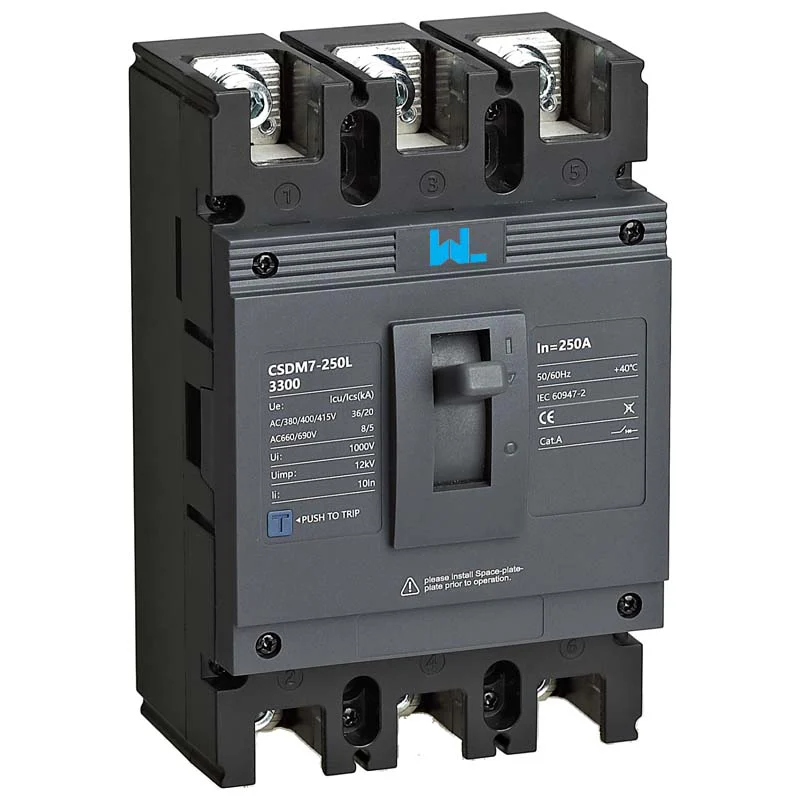
MCCB Protection Functions
The molded insulating case supports contacts, arc-control parts and the trip mechanism in an enclosed assembly. During an overload, a thermal element (or long-time electronic function) allows a delay so normal starting currents do not cause nuisance trips. During a short circuit, magnetic or instantaneous protection opens rapidly to limit stress.
Rated current (In) is the continuous current the breaker can carry at stated reference conditions—not a complete cable size or fault rating. In an IEC design, design current (Ib), device rating (In) and conductor permissible current (Iz) must remain coordinated after ambient, grouping and enclosure corrections. In U.S. work, continuous loads are commonly treated at 125% under NEC rules, subject to the exact article and authority having jurisdiction.
Overcurrent and Residual-Current Protection
An MCCB normally provides overload and short-circuit protection. An RCCB detects residual current and requires coordinated overcurrent protection; an RCBO combines residual-current and overcurrent functions. Some electronic MCCBs add ground-fault overcurrent protection, but that function is not automatically equivalent to an RCD intended for additional protection against electric shock. Check the sensing arrangement, pickup range, operating time and applicable standard for the actual function.
MCCB Rating Requirements
Begin with the system voltage and frequency, then select the number of poles. A three-pole MCCB switches three phases; a four-pole version also switches the neutral when the earthing arrangement and local rules require simultaneous isolation. Check rated insulation voltage (Ui), rated operational voltage (Ue), service frequency and the pollution or enclosure environment. A 125 A, 400 V device is not automatically suitable for a 690 V motor feeder or a direct-current circuit.
Verify short-circuit ratings next. Ultimate breaking capacity (Icu) is the maximum fault current tested for interruption; service breaking capacity (Ics) is a tested level tied to continued service expectations. Compare both with prospective short-circuit current at the installation point; a “10 kA” label cannot cover a 15 kA fault. Use only documented backup combinations.
| Marking or parameter | Question to answer | Evidence for the project file |
|---|---|---|
| In (rated current) | Does it coordinate with Ib, Iz, continuous load and derating? | Load schedule, cable ampacity calculation and nameplate. |
| Ue / Ui | Do operational and insulation voltages cover the system and transients? | One-line diagram and manufacturer datasheet. |
| Icu / Ics | How do the IEC breaking ratings compare with the fault study at the actual voltage? | IEC model rating table and fault study; use the separate marked rating for a UL 489 route. |
| Poles and neutral | Does switching match phase, neutral and earthing arrangements? | Wiring diagram, pole drawing and installation code check. |
| Trip unit | Will thermal-magnetic or electronic settings ride through inrush and clear faults? | Time-current curve, setting sheet and commissioning record. |
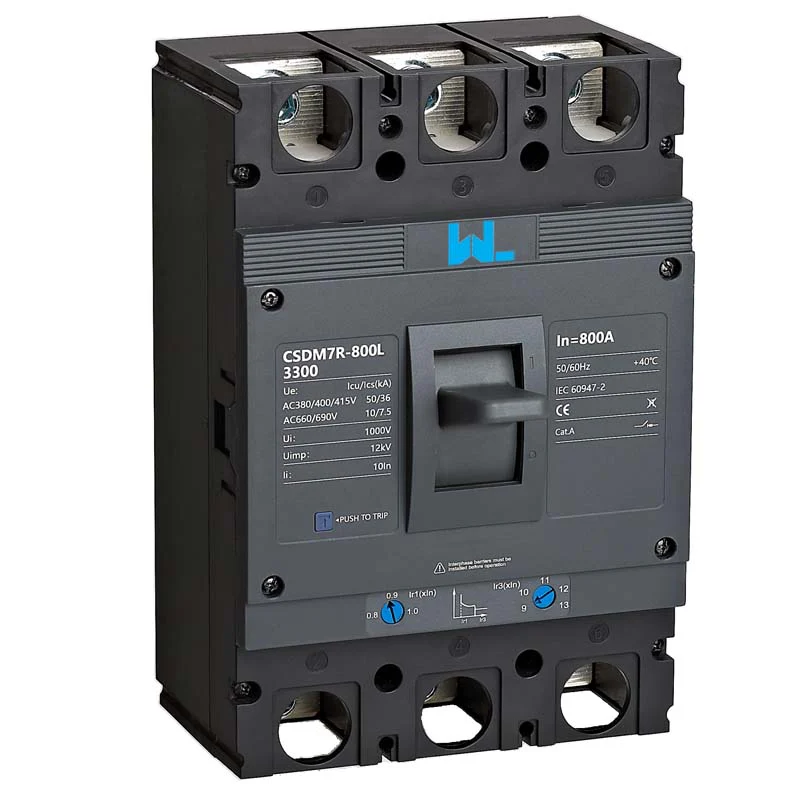
Separate the frame from the setting
The frame size describes a product platform’s capacity; the installed trip rating and its long-time setting can be different. Record all three fields with the cable calculation. Turning a setting upward does not increase cable ampacity, terminal capacity or the breaker’s short-circuit rating. After a load change, review the study and approval record before altering a dial or buying a larger device.
MCCB Trip Coordination
Thermal-magnetic MCCBs are straightforward for stable feeders: the thermal element handles sustained overload and the magnetic element clears high current faults. Electronic trip units use current transformers and a control circuit to provide repeatable thresholds, metering or LSIG functions. They can improve selectivity between feeder and main devices, but they also require a settings study and a commissioning method such as primary- or secondary-injection testing specified by the manufacturer.
Coordination is more than choosing the biggest interrupting rating. Plot the MCCB time-current curve with downstream fuses, MCBs, contactors and motor starters. The downstream device should clear a branch fault first where selective coordination is required, while the upstream MCCB protects the bus and feeder. Check short-time withstand, let-through energy and any interlocking claims in product documentation.
| MCCB option | Protection scope | Best-fit situation | Cost or risk driver |
|---|---|---|---|
| Fixed thermal-magnetic | 과부하 및 단락 | Stable feeders, distribution boards and small machinery | Lower setup effort; less flexibility if loads change. |
| Adjustable thermal-magnetic | Adjustable overload and magnetic thresholds | Feeders with known inrush or moderate future growth | Requires disciplined settings and tamper control. |
| Electronic LSIG | Long-time, short-time, instantaneous and ground-fault options | Generators, large motors and selective industrial systems | Higher engineering and test effort; needs auxiliary power in some designs. |
| MCCB plus coordinated residual-current protection | Overcurrent and separately specified residual-current functions | Circuits where the design requires residual-current protection | Verify the sensing, interruption and coordination of the complete combination. |
Total cost of ownership includes panel space, accessories, commissioning time, spares and the consequence of an avoidable trip. A fixed breaker can be economical for an unchanged load; an adjustable frame may avoid replacement when a documented load increase remains within the frame and cable limits. Compare lifecycle evidence rather than an unsupported unit-price claim. For deeper specification fields, see the site’s technical MCCB specifications article.
Read the whole time-current curve
A motor-start current can overlap one part of a curve while the minimum available fault current governs another. Check both maximum fault duty and minimum fault clearing, plus settings tolerances and conductor thermal limits. Selectivity and tested backup protection are separate assessments: a combination can have adequate interruption support without keeping the upstream breaker closed for every downstream fault.
MCCB Installation Compliance
IEC 60947-2 covers many industrial low-voltage circuit breakers, including characteristics and type tests. IEC 60364-4-43 addresses overcurrent protection in installations. UL 489 covers molded-case breakers in the North American certification system, while NFPA 70 (NEC) sets installation rules for covered U.S. work. Their scopes differ: a product test report is not an installation permit.
Unsupported claims can cause rejected submittals, certification delays, rework and liability. Ask for the declaration applicable to the destination market, exact catalog number, ratings, accessories and installation manual. Do not infer CE, UL, IEC or local approval from a logo; verify scope and model identifier in current documents.
Commissioning should cover visual condition, conductor identification, protective-conductor continuity, insulation resistance where appropriate, polarity, terminal torque and mechanical operation. Test residual-current functions with an instrument compatible with the RCCB or RCBO type. For electronic MCCBs, follow the manual’s injection-test procedure and record pickup, delay and trip results. Keep the circuit tag, instrument identity, date, as-left settings and any retest trigger after a modification.
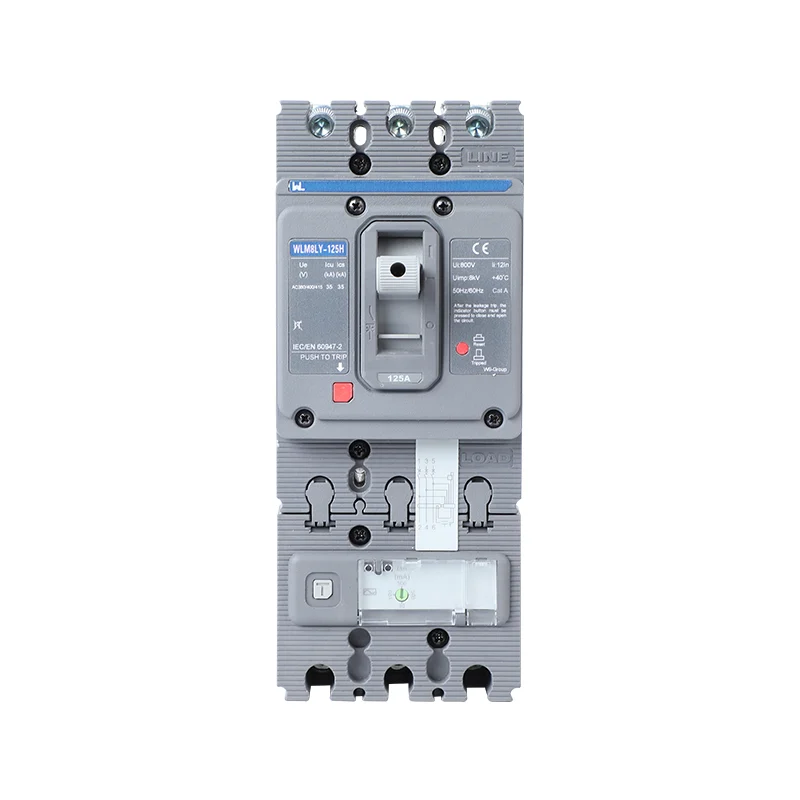
Keep an as-left record that names the circuit, catalogue number, trip-unit reference, settings, conductor details, test method and approving person. State what each test covered. Secondary injection does not automatically verify the complete primary path or every sensor, and an on/off operation does not establish breaking capacity. Retest affected functions after an approved configuration change rather than copying the old record to a new breaker.
MCCB Procurement Checks
- Calculate Ib, Iz after derating, voltage drop, duty cycle and motor or transformer inrush.
- Calculate prospective fault current at the mounting point and select Icu/Ics with documented backup combinations.
- Define Ue, Ui, frequency, poles, neutral switching, trip technology, enclosure and ambient conditions.
- Coordinate curves with upstream and downstream devices; approve and lock adjustable settings.
- Request drawings, declarations, test procedures, accessories and spare-part information for the exact catalog number.
W9 Group’s public site lists thermal-magnetic, electronic and residual-current product families, including adjustable MCCB options. Treat those pages as starting points for an RFQ, then confirm the final model and ratings against the project design. The guide to adjustable MCCB advantages can help your team decide whether flexibility justifies additional commissioning effort.
자주 묻는 질문
What is a molded case circuit breaker used for?
An MCCB protects and switches low-voltage feeders, distribution boards, motors and other equipment against overloads and short circuits. The useful current range, voltage, poles and trip functions depend on the specific frame and trip unit. Confirm the complete datasheet before substitution.
What is the difference between an MCCB and an MCB?
MCBs are generally compact, fixed-setting devices for lower-current final circuits, while MCCBs cover broader current and interrupting ranges and may offer adjustable or electronic trips. The boundary is product- and standard-dependent, so compare declared ratings rather than size alone. Selectivity and available accessories often influence the choice.
Does an MCCB provide earth-leakage protection?
A conventional thermal-magnetic MCCB does not by itself provide residual-current protection. A documented ground-fault overcurrent function may protect equipment or feeders but is not automatically a substitute for an RCD required for additional shock protection. Have the designer specify the required function, sensitivity, timing and sensor arrangement explicitly.
How do I choose the breaking capacity?
Calculate prospective short-circuit current at the mounting point and compare it with the declared breaking rating at the actual system voltage. For an IEC MCCB, review Icu and Ics as different ratings; for a UL 489 device, use the applicable marked interrupting rating and conditions. Use a lower standalone rating only within an approved, documented combination accepted for the project.
Can I replace an MCCB with a higher ampere model?
Not without checking conductor ampacity, busbar and enclosure limits, fault rating, coordination and settings. A higher In can leave the existing cable unprotected and may alter arc-flash or selective-coordination results. Recalculate and obtain engineering approval before changing the catalog number.
참고문헌
- IEC 60947-2:2024 — circuit-breakers and ground-fault overcurrent release context. 공개 범위 및 지침 확인 2026-10-19.
- OSHA 1910.303 — ratings, coordination and installation conditions. 공개 범위 및 지침 확인 2026-10-19.
- 슈나이더 일렉트릭 0600IB1201 — 현장 테스트 및 유지보수 가이드. 공개 범위 및 지침 확인 2026-10-19.
The dependable MCCB is the one whose cable, fault level, trip curve and test record agree—not merely the one with the largest number on its handle.
Review W9 Group’s circuit-protection products using the approved load and protection schedule.
For a model-document review, 팀에 연락하세요. with your one-line diagram, fault study and destination-market requirements.