





































MCCB의 셧다운 방지 기능: JCMX1-125 원격 트리프 솔루션
MCCB 션트 릴리즈를 지정하는 패널 구매자에게는, 원격 개방 요구 사항을 선택한 차단기에 실제로 맞는 액세서리와 매칭시키는 것이 조달상의 문제입니다. 코일 명령이 차단기가 개방되었음을 증명하는 것은 아닙니다. JCMX1-125는 호환되는 MCB 및 RCBO용 션트 트립 액세서리이며, 범용 MCCB 릴리즈가 아니며 보조 피드백 접점도 제공하지 않습니다. 유사한 이름이나 외관을 호환성의 근거로 간주하기보다는 주문을 승인하기 전에 호스트 장치 및 피드백 관련 문서를 검토하십시오.
요약: 션트 트립 장치는 코일에 지정된 제어 전압이 인가되면 차단기를 개방하며, 이는 차단기의 과부하 보호 기능을 대체하지 않습니다. 단락 보호. 공개 JCMX1-125 목록에는 전압이 인가되면 MCB/RCBO를 원격으로 개방하고, 기기의 왼쪽에 장착되며 보조 피드백이 없는 MX 션트 트립이 설명되어 있습니다. MCCB 프로젝트의 경우, 주문하기 전에 차단기 제조사의 문서와 IEC 60947-2 요구사항을 기준으로 프레임-패밀리 호환성, 코일 전압, 핀 형상 및 제어 회로 시험 순서를 확인하십시오.
What a shunt release actually does
A shunt release (also called a shunt trip) is an electrically actuated mechanism linked to a circuit breaker’s opening path. A remote signal—such as an emergency-stop relay, fire alarm interface, or process interlock—energizes the coil. The mechanism unlatches the breaker so its contacts open. The breaker then interrupts current using its own contact system and arc-control design.
The release initiates an opening command; it is not a current sensor and cannot detect overloads. Thermal-magnetic or electronic trip functions remain responsible for fault protection, so list the shunt signal separately from protective trips and “breaker open” indication.
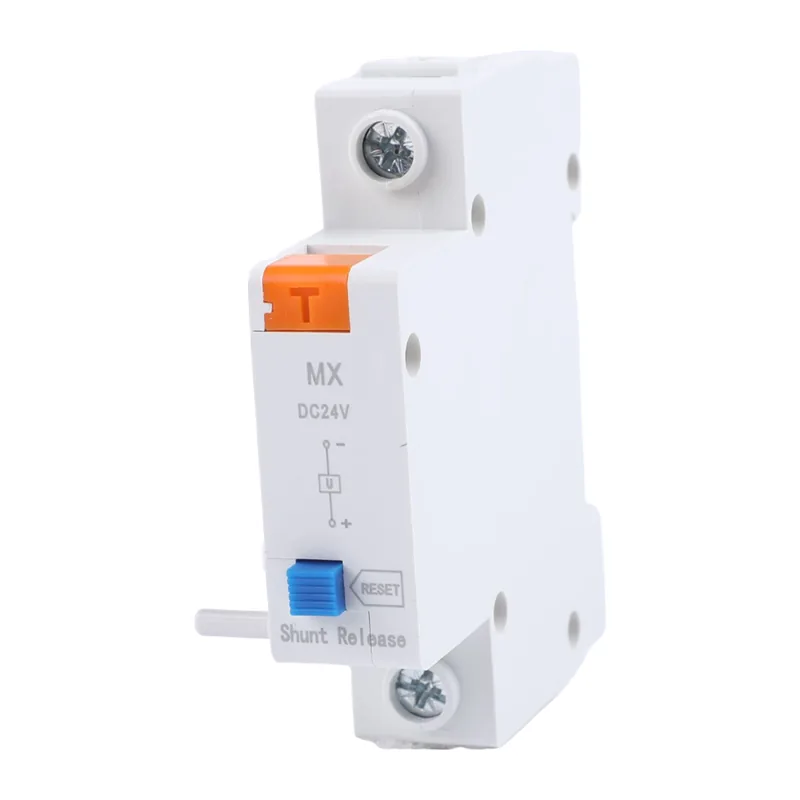
The JCMX1-125 product page uses the term “MX” and states “only Shunt Trip Release Function, no Auxiliary Feedback.” Treat that sentence as a functional boundary. If a PLC or fire panel must prove that the breaker opened, specify a separate auxiliary contact or a breaker model with an integrated status output.
JCMX1-125 Compatibility Requirements
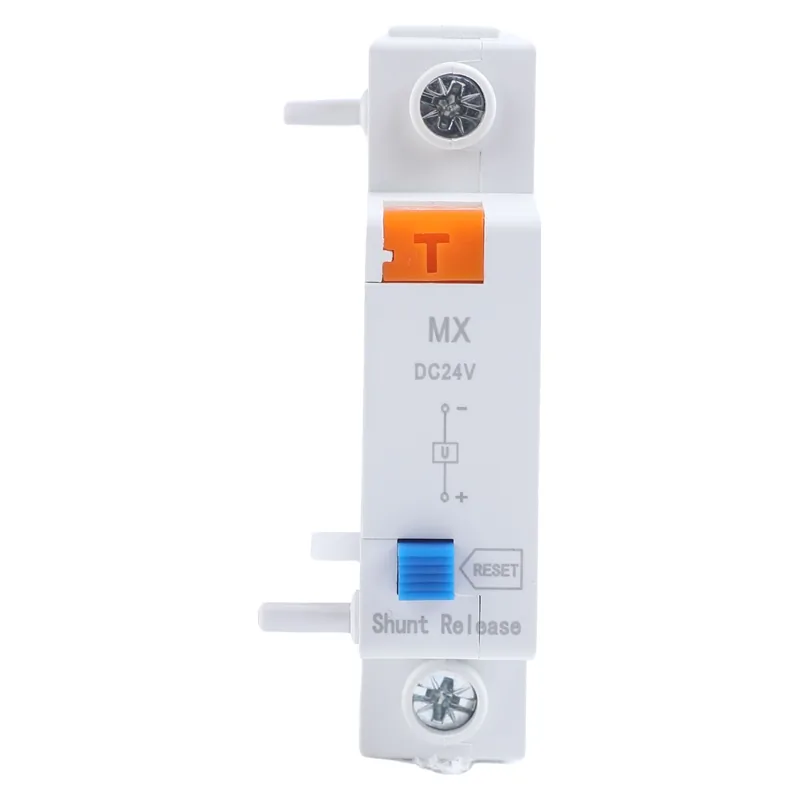
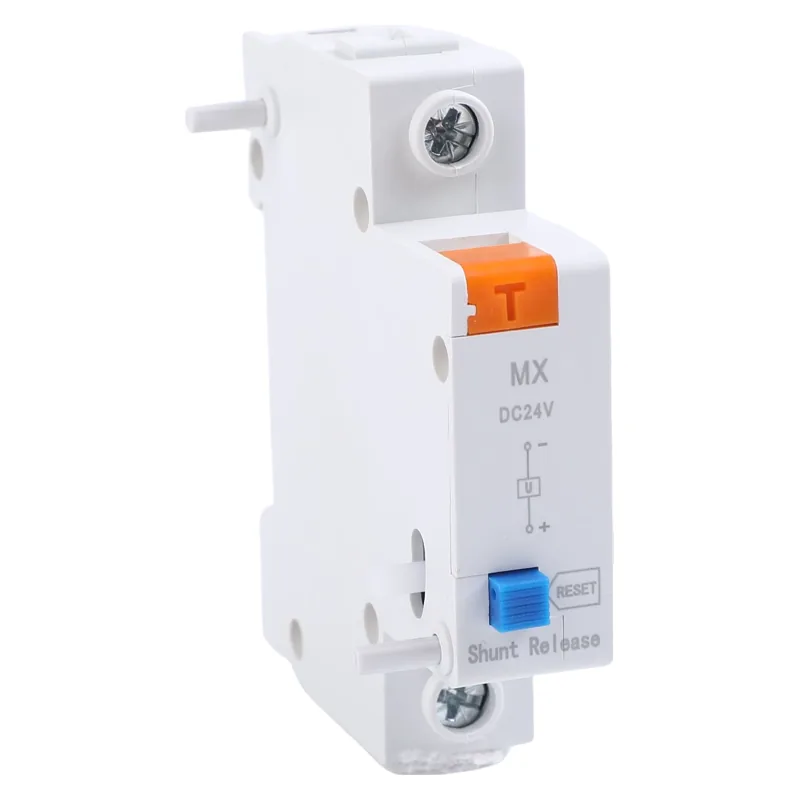
The published product name is “MCB Accessories JCMX1-125 Shunt trip release MX.” Its description says the device remotely opens an MCB/RCBO when voltage is applied and installs on the left side with a special pin arrangement. Those are the verified facts available for this model. The page does not publish a coil-voltage range, power draw, trip time, pole count, 파괴 능력, environmental rating, or certification list.
That missing data matters when a buyer searches for a “shunt release for MCCB.” MCCBs use different accessory chambers, latches and terminals from many MCB families. A similar-looking module may not engage the latch or may require a different coil voltage. Do not infer compatibility from the JCMX1-125 code or photograph; ask for the exact breaker series, frame, accessory position, control voltage and wiring diagram.
한 accessory RFQ should identify the complete orderable pairing: breaker family and frame, accessory order code, mounting arrangement and any separate feedback-contact code. Request the manufacturer’s current compatibility schedule and wiring sheet for that pairing, not a generic MX description. Record the requested control voltage and AC/DC type alongside the coil-current or power-draw information needed for control-circuit review; keep missing values pending supplier confirmation. Review the separate feedback contact’s documented voltage/current duty against the receiving circuit. These are document-review fields, not verified JCMX1-125 ratings. A standard reference alone does not establish the pairing.
Engineering the remote-trip circuit
Start with the control-voltage evidence
Never energize an accessory from a convenient supply until its nameplate or datasheet confirms the rated voltage and AC/DC type. A control circuit should include the 과전류 보호, isolation method, and terminal identification required by the panel design. If the public listing does not state the coil rating, record it as an open technical query rather than guessing.
Remote-Trip Control Sequence
Use one set of contacts to issue the trip command and a separate, verified device to report status. A shunt release generally opens the breaker; it does not automatically close it. Define whether operators reset locally, whether a remote close is permitted, and how a latched emergency stop is cleared. This prevents a “trip successful” assumption based only on a relay LED.
Test the complete chain
During FAT or commissioning, measure the 제어 전압 at the accessory terminals, operate the initiating device, and verify mechanical opening at the breaker. Repeat at the minimum and maximum supply conditions specified by the approved datasheet. Test continuity and insulation only with the accessory isolated as instructed by the breaker manufacturer; an insulation tester applied across an electronic or coil circuit can damage it.
Keep command and feedback as separate entries in the functional acceptance record: identify the initiating device and accessory order code, the approved drawing/manual revisions, the observed breaker position and the separate status-input result. Also identify the feedback-contact order code and its intended indication; do not assume every contact reports the same condition. Use the selected manufacturer’s instructions and project-approved procedure for the test method and acceptance criteria. A command relay indication alone leaves opening unproven; where no feedback device is fitted, record remote status confirmation as unavailable. This record does not establish overload protection, accessory interchangeability or a tested operating limit.
Remote-Opening Options Compared
The right solution depends on the host breaker and the required evidence. The table below is a procurement aid, not a performance ranking; values such as price and delivery vary by frame and region.
| 접근 방식 | Opening command | Status feedback | Compatibility check | Total-cost considerations |
|---|---|---|---|---|
| JCMX1-125 MX accessory | Voltage applied to shunt coil | None stated; product page says no auxiliary feedback | Left-side MCB/RCBO pin interface; confirm exact family | Low accessory count, but separate status contact may be needed |
| MCCB manufacturer shunt trip | Coil command defined by MCCB maker | Often optional auxiliary or alarm contacts | Matched to frame, trip unit and accessory cavity | Higher part cost can reduce retrofit and wiring risk |
| Undervoltage release | Breaker opens when control voltage is removed or falls | Depends on auxiliary package | Requires a compatible UVR module and maintained supply | Useful for fail-safe schemes; supply supervision adds cost |
| Motor operator plus trip accessory | Motor handles close/open; shunt or UVR trips | Usually paired with auxiliary contacts | Requires space, interlocks and duty-cycle review | Best for automation, with higher panel footprint and maintenance |
Selection matrix for an MCCB project
| 프로젝트 질문 | Evidence to collect | Decision gate |
|---|---|---|
| What must open? | One-line diagram, fault level, breaker series and frame | Accessory is listed for that exact breaker family |
| What initiates the trip? | Emergency stop, fire alarm, PLC or process relay logic | Contact arrangement, reset philosophy and fail-state are documented |
| What voltage is available? | Measured nominal voltage, tolerance and AC/DC source | Coil rating and inrush data are confirmed by the manufacturer |
| How is success proven? | Auxiliary contact, alarm contact or monitored input | Feedback is independent of the command relay indication |
| What records are required? | Wiring diagram, test sheet, labels and maintenance interval | As-built package identifies the accessory and test method |
Shunt Release Compliance Requirements
IEC 60947-2 covers circuit breakers for low-voltage switchgear and controlgear, including operating characteristics and verification tests for the breaker assembly. Use it to frame the host MCCB/MCB requirements; it is not evidence that the JCMX1-125 itself is certified. IEC 60947-1 provides general rules for low-voltage switchgear, while IEC 60947-5-1 addresses control-circuit devices and switching elements that may appear in the initiating circuit. The applicable edition and national adoption must be checked for the destination market.
In North America, UL 489 is commonly used for molded-case circuit breakers, and NFPA 70 (the National Electrical Code) governs installation practices. Neither reference allows a seller to imply a listing without a traceable certificate for the exact product and configuration. A specification that says “IEC compliant” without test reports, rated values, and a responsible manufacturer can create inspection delays, redesign cost, and warranty disputes.
For a project using the JCMX1-125, retain the product page, the host-breaker accessory schedule, control-voltage confirmation, and witnessed trip-test record. Mark any unverified parameter—especially coil voltage, endurance, temperature range, and certification—as “to be confirmed.” This is more defensible than filling gaps with typical values from another MX accessory.
Practical buying and installation checklist
- Match the host first. Send the breaker manufacturer, series, pole count, frame and mounting side with the inquiry. For alternatives, review the site’s 회로 보호 제품 category.
- Confirm the coil. Obtain rated control voltage, AC/DC designation, terminal diagram and allowable duty. Do not energize an unknown coil.
- Specify feedback separately. Because the JCMX1-125 listing states no auxiliary feedback, add a compatible auxiliary contact when the control system needs proof of opening. The guide to auxiliary contacts for MCCBs explains the distinction.
- Witness the trip path. Test from the real initiating device through the relay, accessory and breaker mechanism, then document reset and re-energization steps.
- Keep the evidence pack. Store drawings, photographs, serial or batch references, and the approved installation sheet with the panel records. For MCCB selection context, see the site’s MCCB의 특징 및 적용 분야 가이드.
When sourcing through J&Co (the brand shown on the test site), treat the JCMX1-125 as a configurable accessory request: provide the exact host device and control requirements so the supplier can return matching documentation. The public listing supports remote opening of compatible MCB/RCBO devices; it does not by itself approve an MCCB retrofit.
자주 묻는 질문
Can the JCMX1-125 be installed on any MCCB?
No. The verified listing identifies it as an MCB/RCBO accessory with a special left-side pin arrangement. An MCCB installation requires written confirmation that the exact frame and accessory cavity accept it.
What happens when voltage is applied to a shunt release?
The energized coil commands the breaker mechanism to open. The breaker’s own contacts and arc-control system interrupt the load; the shunt release does not provide overload protection.
Does JCMX1-125 provide breaker-open feedback?
The product excerpt explicitly says “no Auxiliary Feedback.” Add a compatible auxiliary or alarm contact when a PLC, fire panel or BMS must verify the open state.
어느 코일 전압을 주문해야 하나요?
The public page does not state a coil-voltage range. Confirm the rated AC/DC voltage and tolerance from the current datasheet or quotation against the control supply measured on site.
Is a shunt trip the same as an undervoltage release?
No. A shunt trip opens when its coil is energized, while an undervoltage release typically opens when its sustaining voltage is removed or drops below its operating threshold. Select according to the project’s fail-safe philosophy and applicable code.
참고문헌
- IEC 60947-2:2024 — 회로 차단기 및 부속품 관련 규격.
- IEC 60947-5-1:2024 — 전자기계 제어 회로 장치.
- 슈나이더 일렉트릭 — 보조 스위치 및 알람 스위치 구분, 제조사별.
Closing principle: A remote trip is only as dependable as the match between coil, mechanism, wiring and proof of operation.
Ready to verify a JCMX1-125 application or identify a true MCCB-compatible shunt release? Review the JCMX1-125 product page, then contact the J&Co team with your breaker model, frame, control voltage and feedback requirement for a documented recommendation.
부속품 확인을 위해, W9 그룹에 문의하기 두 가지 명령 코드로 제어 전압, 명령 지속 시간 및 필요한 피드백 동작을 설정할 수 있습니다.