























1000VDC vs 1500VDC MCCB: How to Select the Right DC Voltage Rating
A quotation marked “1000 V solar system” can conceal a higher cold open-circuit voltage. Another marked “1500 V MCCB” may depend on a pole connection that does not match the proposed cabinet. The buying decision therefore needs two answers: the maximum voltage the circuit can present and the voltage the exact device configuration is rated to handle.
Quick answer: choose between a 1000VDC MCCB and a 1500VDC option using the calculated maximum circuit voltage, not the nominal plant name or inverter operating point. Verify rated operational voltage for the offered order code, pole arrangement and earthing system, then check breaking capacity at that same voltage. A 1500 V family claim does not make every version suitable for every connection. Higher breaker voltage also does not upgrade cables, connectors or other equipment. For PV circuits, include the module’s cold open-circuit voltage in the review; for batteries, use the maximum source voltage and declared fault duty.
Calculate the cold open-circuit voltage
Module voltage at standard test conditions is a reference value, not a guaranteed maximum for all weather. A negative voltage temperature coefficient means that open-circuit voltage rises as module temperature falls. Use the module manufacturer’s coefficient, the number of modules in series and the minimum design temperature required by the project’s adopted method.
A simplified linear expression is Vstring,cold = N × Voc,STC × [1 + βVoc × (Tmin − 25°C)], when βVoc is expressed per degree Celsius and that method is appropriate for the module and design rules. Convert percentage coefficients into decimal form before using them. Some projects require additional factors or a different approved calculation method; retain those requirements rather than treating this expression as universal.

Illustrative calculation only: assume 20 modules, each with Voc of 50 V at standard test conditions, a coefficient of −0.28%/°C and a minimum design temperature of −10°C. The simplified result is 20 × 50 × [1 + (−0.0028 × −35)] = 1098 V. These are invented example inputs, not W9 or module specifications. They show why a string called “1000 V” cannot be checked using 20 × 50 alone.
The example would exceed a 1000 V operational limit. That does not automatically approve a particular 1500 V device or inverter. Recheck the complete DC equipment schedule and the applicable design method. If the module changes, repeat the calculation; a replacement module with the same power rating can have a different open-circuit voltage and temperature coefficient.
Systems using DC optimizers or other converters need their documented voltage-determination method. Do not apply a bare-module string calculation to a converter output without checking its instructions. The cited NEC educational overview discusses this boundary; it does not establish which code edition is adopted for a particular project.
Read the operational rating rather than the largest number
Rated operational DC voltage describes the intended operating duty. Insulation voltage and impulse withstand voltage have different purposes. A catalog may display all three near one another, so record the symbol and meaning with the number. Selecting from the largest figure on a nameplate can create an unsupported application.
Breaking capacity must be checked at the chosen operational voltage and configuration. The available Icu or Ics values can change across a product’s voltage table. A capacity quoted at a lower DC voltage is not automatically available at 1500 V. Compare the fault study with the matching table row and retain the manufacturer’s test or application conditions.
| Comparison | 1000 VDC option | 1500 VDC option |
|---|---|---|
| Maximum circuit voltage | Must remain within the documented 1000 V duty | Must remain within the documented 1500 V duty |
| Pole connection | Use the approved arrangement for this rating | May require a different approved arrangement or version |
| Breaking capacity | Verify at the intended DC voltage | Verify independently at the intended DC voltage |
| Other components | Check their individual voltage limits | Do not assume the breaker upgrades the system |
| Commercial comparison | Evaluate complete assembly and document scope | Evaluate complete assembly and document scope |
The MCCB technical requirements guide separates operational voltage from insulation and impulse ratings. The same evidence rule applies within a DC family: a broad voltage range is not a promise that every frame, trip unit and pole configuration covers its upper end.
Verify poles and earthing together
A 1500VDC MCCB may use a manufacturer-defined series-pole arrangement. The number of contact gaps, their allocation between conductors and the permitted links belong to the documented design. Do not calculate a rating by multiplying a presumed single-pole voltage. The complete device is tested and applied as a configuration.
Earthing changes which fault paths must be considered. An unearthed array, a grounded conductor and another declared network arrangement are not interchangeable inputs. Ask the designer and manufacturer to confirm the applicable drawing for the actual system. A diagram suitable for one network cannot be adapted merely because the cabinet has space for the same number of poles.
Also establish permitted line/load direction and whether reverse current is covered. This matters when converters, storage or parallel sources can change power flow. The voltage rating alone cannot settle polarity restrictions, bidirectional use or the trip unit’s DC measurement capability. Resolve those conditions before accepting an alternative part.
Check every component on the DC side
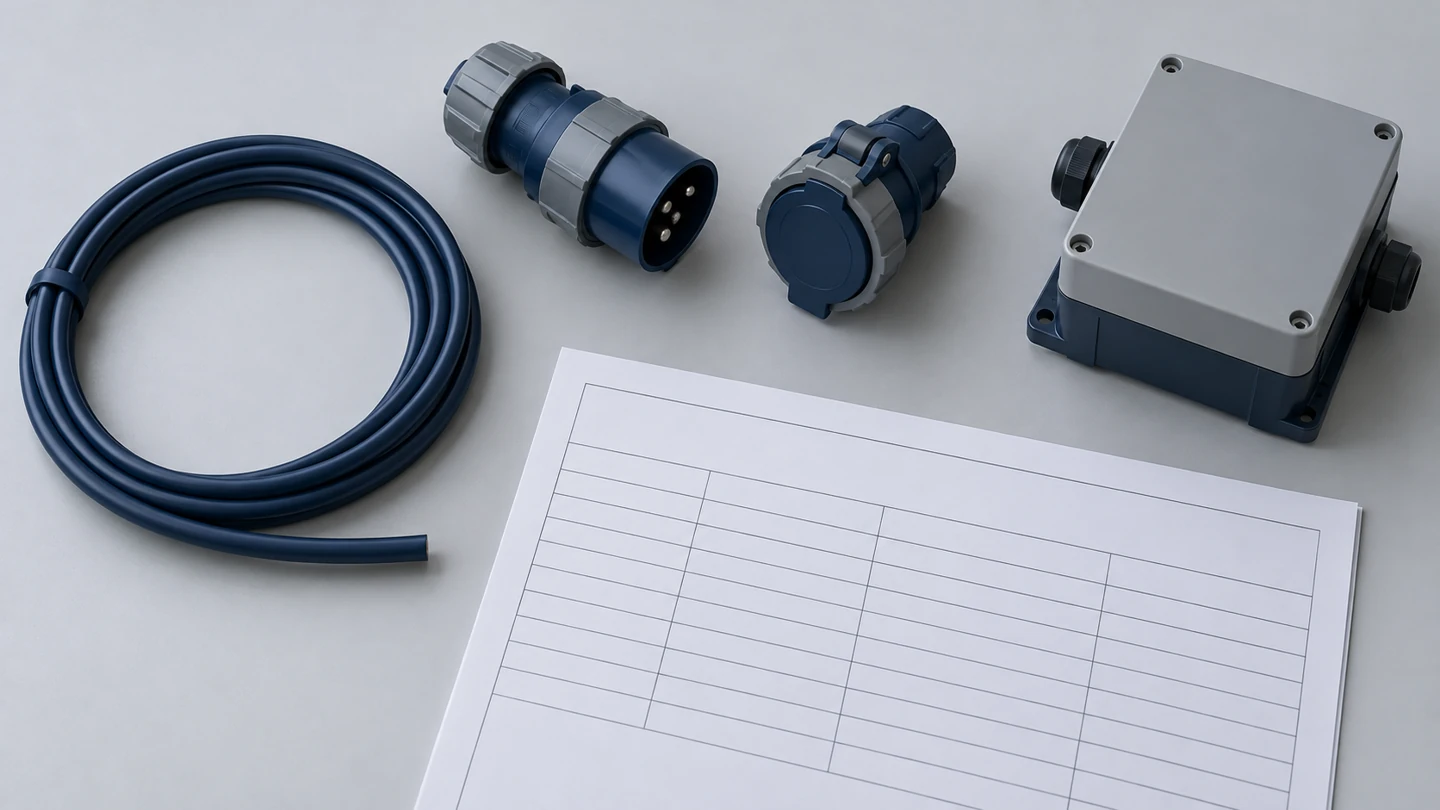
The breaker is only one item in the voltage chain. Module maximum system voltage, cable insulation, connectors, surge-protection devices, isolators, terminals, monitoring equipment and inverter inputs all need review. Their suitability depends on their own documents and installation conditions. A connector that physically mates is not automatically an approved combination.
Keep circuit-breaker and isolation requirements distinct. IEC 60947-2 is relevant to MCCB protection, while IEC 60947-3 addresses relevant switches and disconnectors. Product compliance, assembly verification and installation acceptance are separate responsibilities. Check the destination market’s adopted requirements and the exact offered model’s documents before using certification language in a tender.
| Document | Must agree with | Stop condition |
|---|---|---|
| Maximum-voltage calculation | Module version, string count and temperature basis | Unknown inputs or inconsistent module data |
| Operational rating table | Exact breaker order code and voltage | Only insulation or impulse voltage supplied |
| Connection drawing | Pole links, earthing and direction | Drawing belongs to another variant |
| Fault-duty evidence | Voltage-specific breaking capacity and conditions | Only an unrelated lower-voltage rating supplied |
| Equipment schedule | Every DC-side component limit | Any component below the required duty |
W9’s WLM7DC-400 product information specifically asks buyers to confirm the voltage, pole and capacity-code combination. Use that request as part of the quotation process rather than assuming a universal family limit. Ask for the breaker-versus-switch configuration and trip functions as well as the voltage.
For lifecycle cost, compare the device, approved links, terminal arrangement, cabinet clearances, assembly work and engineering review. A higher-voltage option is not automatically better value for a lower-voltage circuit, and a lower purchase price does not compensate for missing documentation. The W9 product directory supports model identification; the project specification remains the acceptance basis.
よくある質問
What is the difference between a molded-case circuit breaker and a circuit breaker?
Molded-case circuit breaker identifies a construction category within the broader circuit-breaker family. Its DC capability still depends on the documented model, trip unit and connection.
Are DC breakers different from AC breakers?
Yes, their interruption duties differ. Use a suitable declared DC rating; an AC voltage or capacity marking does not establish a DC application limit.
Can a 1000VDC MCCB protect a string above 1000 V?
Not on the basis of that 1000 V operational rating. Reassess the string design and select a documented configuration covering the calculated maximum voltage.
Can a 1500VDC MCCB be used in a lower-voltage system?
Potentially, if the manufacturer permits the intended voltage, current duty and connection. Check the trip unit, polarity, accessories and coordination rather than relying only on the upper voltage limit.
Do more poles automatically increase the DC voltage rating?
No. Only manufacturer-approved configurations establish the rating. Pole links and their allocation between conductors must follow the matching drawing.
Does cold weather affect PV breaker voltage selection?
It can, because module open-circuit voltage generally rises as temperature falls. Use the module data and the project’s required minimum-temperature calculation method.
参考文献
- ABB: SACE Tmax PV for Photovoltaic Applications, voltage tables and approved pole configurations, accessed 17 October 2026.
- ABB: Higher-Voltage Solar Power Plant Breakers, 20 June 2018, accessed 17 October 2026.
- Eaton: DC and PVGard Molded-Case Circuit Breakers, application overview, accessed 17 October 2026.
- Electrical License Renewal: NEC 2023 Section 690.7 Maximum Voltage, educational commentary on temperature correction and converter boundaries, accessed 17 October 2026.
Verify voltage across the whole system
The useful purchasing rule is to match the calculated maximum circuit voltage to a documented operational rating and then verify the rest of the application envelope. Neither a nominal system name nor the largest catalog number replaces that work. Keep the calculation, equipment schedule, approved connection and fault-duty evidence in the same revision-controlled package. If any source or component changes, check whether the earlier approval still applies. For a configuration-specific offer, send those inputs through the W9 Group enquiry page and request the matching rating table and drawing. Resolve missing evidence before procurement so a 1000 V versus 1500 V decision remains an engineering selection rather than a label comparison.