





































LSIG Trip Units: What Each Protection Function Does
A project specification calls for an LSIG trip unit, but the quotation names only an electronic MCCB family. The buyer assumes the two descriptions mean the same thing. At handover, the controller documentation does not establish the required ground-fault function. In this hypothetical purchasing example, the problem starts with an incomplete specification, not a setting that can simply be changed on site.
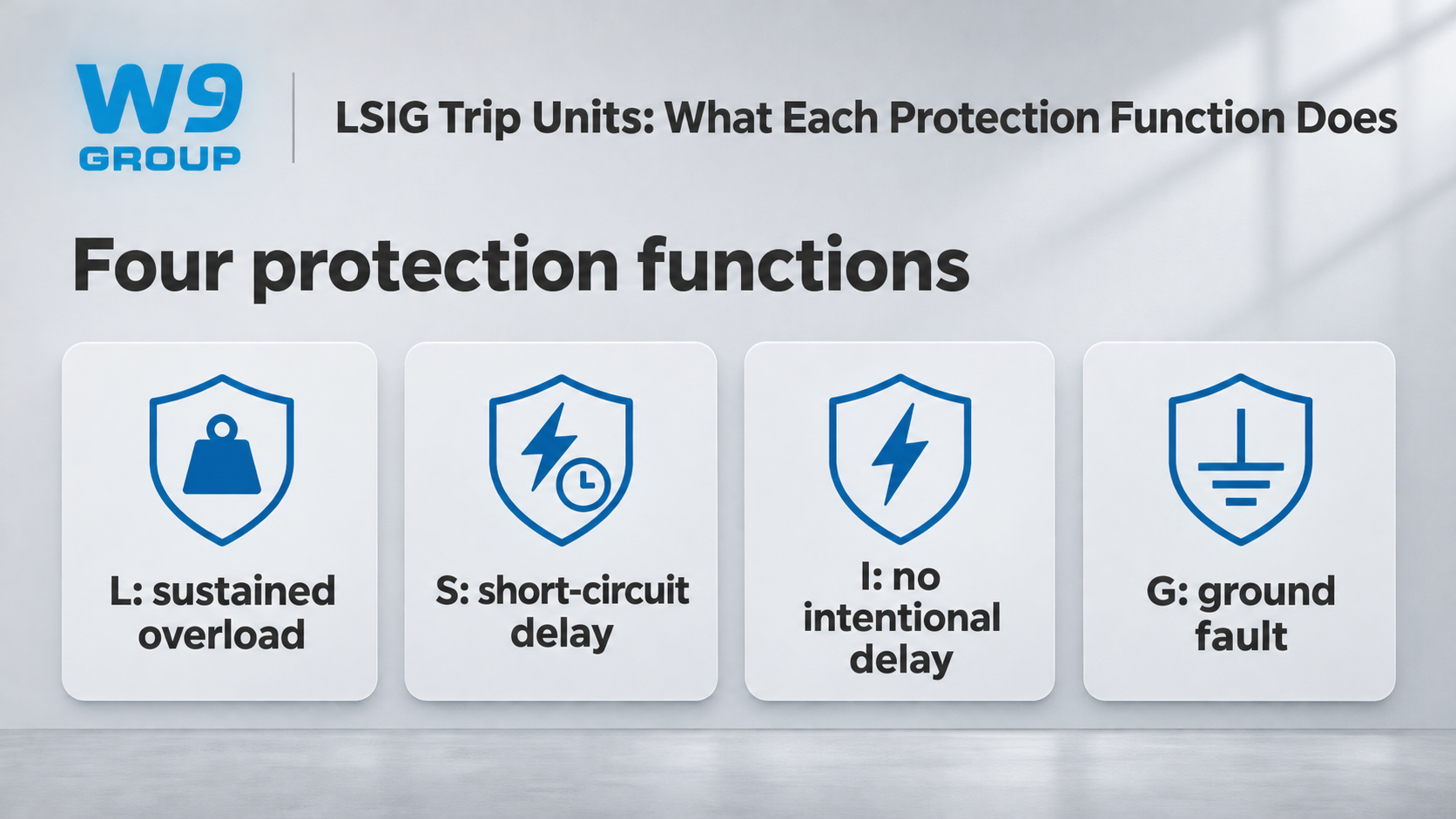
An LSIG trip unit combines four named protection functions: long-time, short-time, instantaneous and ground fault. Their availability, sensing arrangements and setting ranges depend on the exact controller. IEC 60947-2 covers industrial circuit breakers, but a reference to that standard does not prove that every electronic variant includes all four functions.
What the Four LSIG Functions Protect Against
Long-time protection addresses sustained overload. Its pickup and timing behavior must suit the protected circuit and the legitimate load profile. A motor starting event and a prolonged overload are different conditions, even when both produce current above normal running current. The curve and its reference conditions determine how the release distinguishes them.
Short-time protection addresses short-circuit conditions with a specified delay where the release provides that function. It can support coordination, but the delay must remain within the limits of the breaker, connected equipment and installation. The presence of an adjustable short-time function does not establish that every desired delay is acceptable.
Instantaneous protection operates without an intentional time delay at its specified threshold. That does not mean physically zero operating or clearing time. Sensing, release action and contact interruption still take time. Some devices also have nonadjustable protective limits or overrides that must be included in the coordination assessment.
Ground-fault protection detects the specified ground-fault quantity using the supported sensing method. Its pickup range and time behavior are not automatically suitable for sensitive residual-current protection. The neutral arrangement and the method used to measure or calculate the fault quantity can be critical.
| Функция | Main protection question | Selection check |
|---|---|---|
| L: long-time | How is sustained overload limited? | Load, conductor protection, pickup reference and curve |
| S: short-time | Can delayed short-circuit operation be used? | Coordination, timing characteristic and withstand limits |
| I: instantaneous | When is operation without intentional delay required? | Threshold, fault duty and any fixed override |
| G: ground fault | What ground-fault condition must be detected? | Sensing method, neutral arrangement, pickup and delay |
How LSIG Settings Affect Breaker Selectivity
Do not select four independent values and assume their combination is coordinated. The settings interact with the circuit’s available fault current and the operating characteristics of adjacent devices. A delay introduced at the upstream breaker may allow a downstream device to clear one fault range while an instantaneous function still governs another.
Selective coordination depends on the device combination. Compare the manufacturer curves and any tested coordination tables for the actual models, voltage and settings. A generic graph or a comparison at a single current is insufficient to establish selective operation throughout the required range.
The distinction between the release mechanism and the purchasing decision is discussed in the electronic MCCB selection guide. An electronic controller can offer useful setting flexibility, but the engineer still has to establish which functions are needed and whether the proposed combination delivers them.
Check the consequence of disabling a function as carefully as the consequence of enabling it. A selectable “off” position, where the manufacturer provides one, is not an instruction to use it. The installation design, fault study and approved settings schedule determine whether that choice is permissible.
Ground-Fault Protection vs Sensitive Earth-Leakage Protection
The term ground fault is often used loosely in enquiries. A requirement for equipment ground-fault protection and a requirement for additional protection against electric shock may involve different sensitivity and time criteria. The letter G alone does not resolve that difference.
HSE explains that an RCD rated at no more than 30 mA can limit energy in certain electric-shock situations, while also warning that it cannot protect against every type of shock. That guidance must not be read as a statement that any LSIG ground-fault setting supplies equivalent protection. Confirm the actual residual-current function and the applicable installation rules.
Specify whether a neutral is present, how it is switched and how it participates in the sensing arrangement. Do not copy a three-phase diagram to a different supply or add a sensor from another product family. The exact manufacturer’s connection and commissioning documents govern those details.
Which LSIG Functions Does the Supplied MCCB Include?
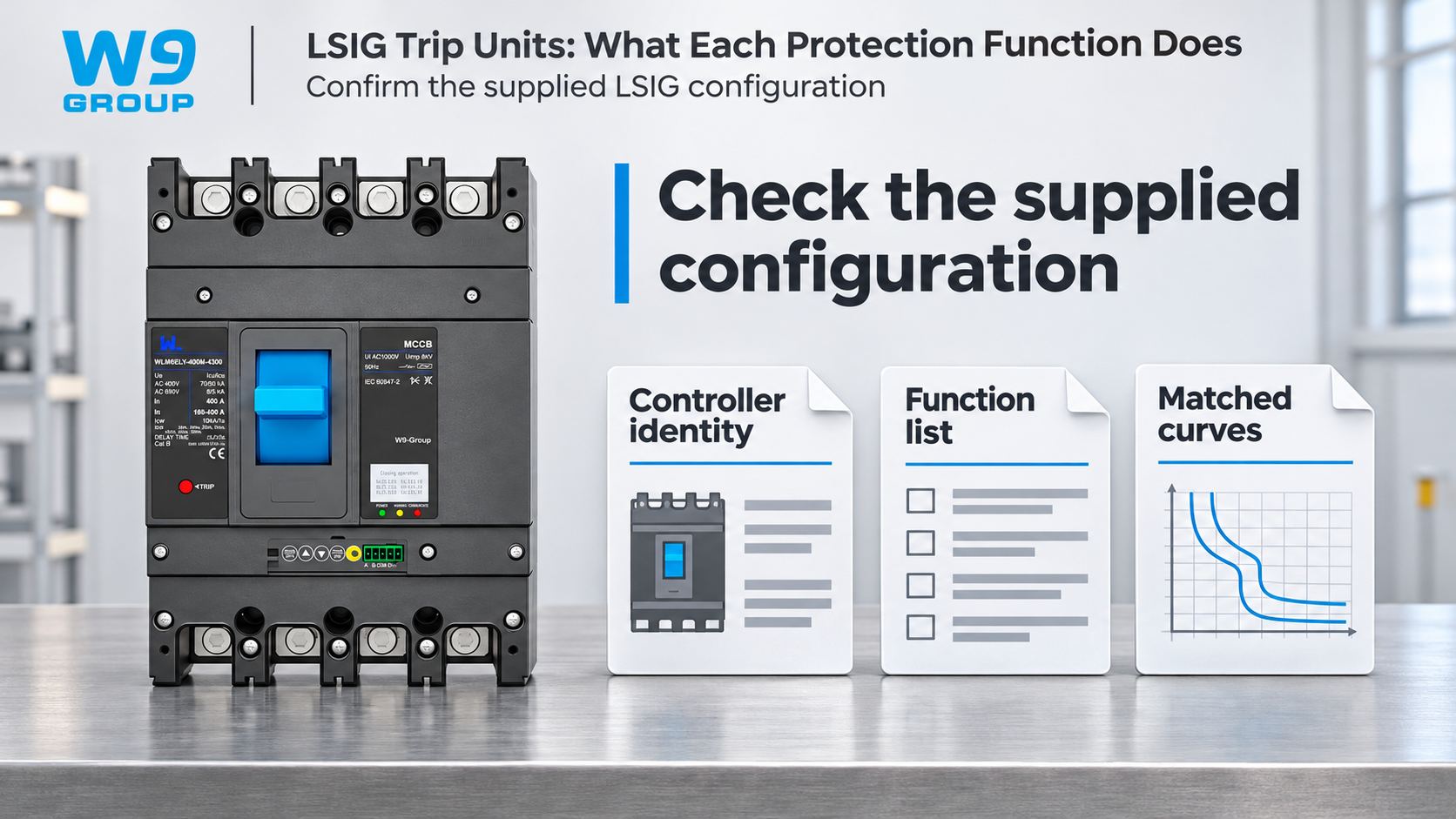
A controller-specific function list is more useful than a broad brochure claim. It should identify which functions are included, their reference currents, available delays, adjustment method and any fixed protective limits. Where a display or software tool is used, the manual should identify the applicable controller and software version.
For example, W9’s WLM6ELY-400 electronic MCCB listing explicitly asks buyers to reconcile mixed controller and release descriptions. Its family name and historical LSIG wording are not enough to verify every function for an order. Obtain the matching specification before committing the panel design.
| Procurement item | Required evidence | Consequence if missing |
|---|---|---|
| Release identity | Complete controller and breaker codes | A different functional variant may be supplied |
| Protection settings | Function list, ranges and reference quantities | The approved study may not be implementable |
| Fault performance | Voltage-specific ratings and coordination information | A family-level rating may be applied incorrectly |
| Ввод в эксплуатацию | Supported test method, equipment and acceptance criteria | Handover may be delayed or cover only part of the protection chain |
The IEC 60947-2 public scope describes the class of equipment and the intended skilled or instructed users. It is not a certificate for an individual product. Ask for the applicable declaration and supporting model documentation rather than describing a standard reference as independent certification.
- State the four functions individually in the enquiry.
- Match the release and sensing arrangement to the circuit.
- Agree the curves and coordination evidence before setting values.
- Include the setting schedule and commissioning records in the purchase scope.
Send unresolved requirements through W9 technical support enquiries. Specify the protection behavior, not just the acronym. That also makes quotations easier to compare without treating undocumented functions as included extras.
LSIG Trip-Unit FAQ
What Should Be Checked Before Resetting an MCCB?
Establish the fault or operating condition before resetting or replacing it. Inspection, adjustment and testing should follow the exact manufacturer’s instructions and be performed by someone competent for the equipment.
Does a Protection IC Prove That an MCCB Has LSIG Functions?
An IC may support part of a protection design, but that does not establish the functions or performance of a complete MCCB. Assess the assembled breaker and its documented controller configuration.
Can a 24 V DC Circuit Protector Replace an LSIG MCCB?
No general equivalence can be assumed. Many 24 V DC devices protect control-power circuits, while an MCCB has a different declared switching and fault duty. Select the documented product class for the application.
Which LSIG Features Affect the MCCB Price?
The release functions, frame, fault duty, accessories and required documentation affect the quotation. Include integration and commissioning costs when comparing a basic release with an LSIG configuration.
What LSIG Details Belong in a Breaker Schedule?
Use the project’s adopted drawing convention and identify the protection functions in the device schedule or legend. Include the controller code and settings reference; a breaker symbol alone is not a full specification.
Does Industrial LSIG Documentation Cover Aircraft Use?
Industrial circuit-breaker documentation does not establish aircraft qualification. Aviation applications require the applicable equipment and installation evidence, which must be assessed separately.
Ссылки
- IEC 60947-2:2024: circuit-breaker scope and technical revision summary
- HSE HSG85: safe working practices
- HSE electrical safety FAQ: RCD protection and competent electrical work
Four letters are a starting point for a specification, not the finished specification. Explore the W9 circuit-breaker range and contact the team with the required functions, circuit details and documentation scope.