











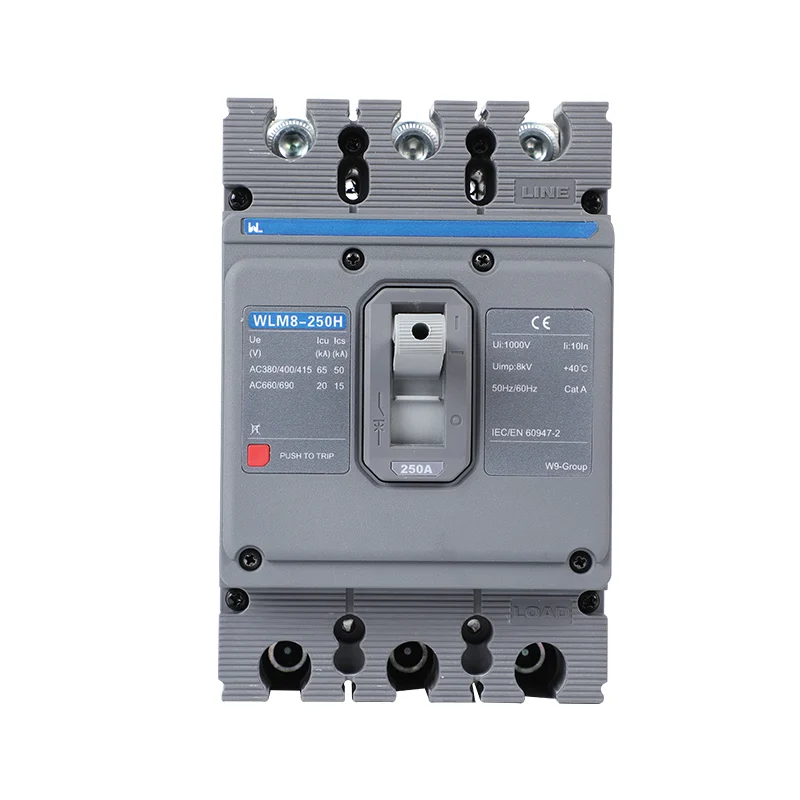





















Безопасные выключатели JC3RH RCD/RCCB защищают дома и предприятия
Иллюстративный сценарий, а не задокументированный случай клиента: Когда электрик службы эксплуатации в Манчестере повторно подал питание в небольшой офис после модернизации зарядного устройства для электромобиля, защитный выключатель сработал ещё до того, как первое транспортное средство успело начать зарядку. Заменённое устройство типа AC вело себя так же. Затем измерительные клещи зафиксировали постоянную составляющую напряжения от силовой электроники зарядного устройства. Быстрый отказ не был свидетельством неисправности автомата; это была несовместимость формы сигнала и технических характеристик. Выбор защитного выключателя JC3RH RCD/RCCB с подходящим типом чувствительности изменил ситуацию.
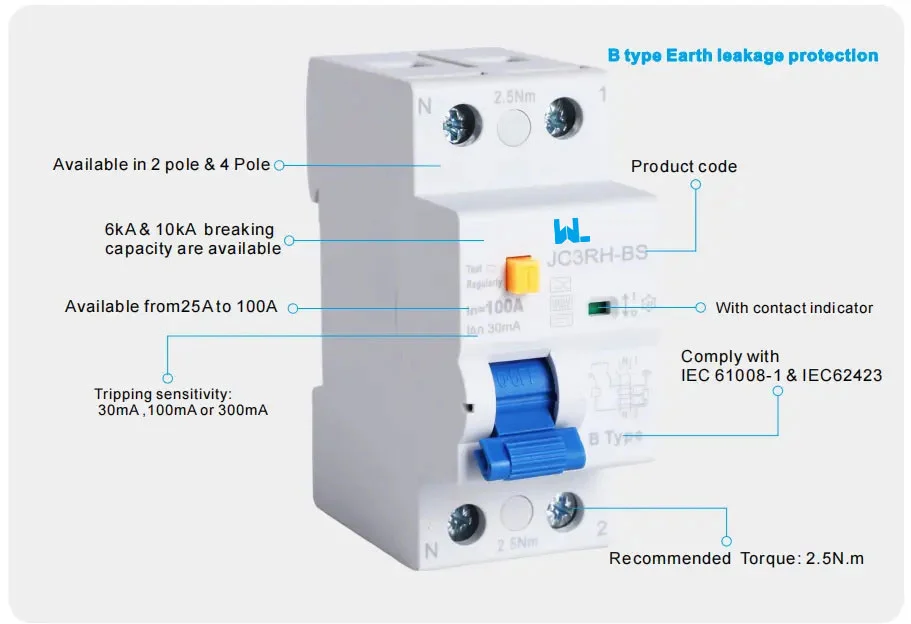
Краткое описание: Выключатели дифференциального тока (УЗО) JC3RH предназначены для отключения цепи при утечке тока через непреднамеренный заземляющий путь. Модель JC3RH-BS типа B, сертифицированная группой W9, обнаруживает синусоидальные переменные токи, пульсирующие постоянные токи, постоянные токи и переменные остаточные токи частотой до 1,000 Гц. В открытых данных указаны номинальные токи 25–100 А, чувствительность 30/100/300 мА, способность к отключению короткого замыкания 6 или 10 кА, а также соответствие стандартам IEC 61008-1 и IEC 62423. Для обеспечения безопасной установки необходимо согласовать форму сигнала утечки, количество полюсов, напряжение, чувствительность и параметры вышестоящего устройства защиты от сверхтока, после чего документально зафиксировать результаты испытаний при вводе в эксплуатацию.
В жилых домах устанавливаются тепловые насосы, солнечные инверторы, аккумуляторные системы и зарядные устройства для электромобилей; на предприятиях добавляются приводы, источники бесперебойного питания и системы автоматизации. Эти нелинейные нагрузки могут создавать постоянную или высокочастотную составляющие на защитном проводнике. Устройство, не рассчитанное на такие формы сигналов, может срабатывать ложных срабатываний или реагировать вне своих проектных условий. Выключатели JC3RH позволяют проектировщикам обеспечить охват по форме сигнала, в то время как остальная часть цепи защиты зависит от качественной проводки и координации.
How a JC3RH safety switch protects a circuit
An RCCB passes the live conductors through a toroidal sensor and compares the outgoing current with the returning current. In normal operation the vector sum is close to zero. Insulation damage, a person touching an energised part or an appliance leaking to earth creates an imbalance. When that residual current reaches the marked IΔn, the release opens the contacts. The device addresses earth-leakage risk; it is not a replacement for an overcurrent breaker.
Type B is a waveform classification. W9’s JC3RH-BS listing states tripping for sinusoidal AC, pulsed DC, alternating residual current up to 1,000 Hz, pulsating direct current and smooth direct current, whether applied suddenly or rising slowly. This breadth matters when a rectifier, inverter or variable-frequency drive can produce more than 6 mA of direct current.
A Type B label does not certify an entire installation. Protective-earth continuity, neutral segregation, conductor ampacity, enclosure conditions and a coordinated short-circuit protective device remain essential. The built-in test button checks a functional path, but it cannot prove trip time, polarity or the integrity of the site’s earthing system.
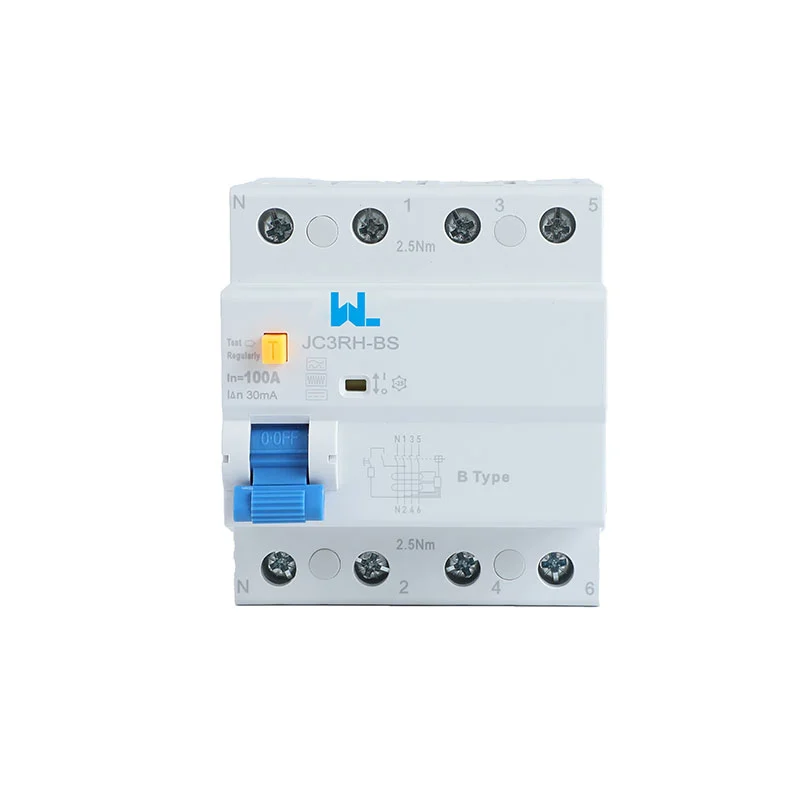
Ratings that matter in homes and commercial panels
Start a schedule with the actual load and потенциальный ток короткого замыкания, not with a preferred brand name. JC3RH-BS public data identifies 1P+N and 3P+N versions. The listed operating voltages are 230/240 V for 1P+N and 400/415 V for 3P+N, at 50 Hz. Rated current options are 25, 40, 63, 80 and 100 A. Residual sensitivities are 30 mA, 100 mA and 300 mA; the selected value should reflect protection purpose, standing leakage and selectivity.
| Schedule item | JC3RH-BS public value | Design check |
|---|---|---|
| Waveform and type | Type B; AC, pulsating DC, smooth DC and up to 1,000 Hz | Confirm the appliance or inverter can generate those residual currents. |
| Номинальный ток (In) | 25 A, 40 A, 63 A, 80 A or 100 A | Coordinate with continuous load, cable rating and enclosure temperature. |
| Poles and Ue | 1P+N at 230/240 V; 3P+N at 400/415 V | Switch the neutral as required and verify board busbar layout. |
| Residual sensitivity (IΔn) | 0.03 A, 0.1 A or 0.3 A | Use downstream additional protection and upstream selectivity together. |
| Fault and transient duty | 6 kA or 10 kA; Uimp 4,000 V | Compare with prospective fault current and surge environment at the panel. |
The product page lists a maximum break time of 0.1 s under IΔn, 500 V insulation voltage, IP20 protection and -25 °C to +40 °C ambient operation (daily average no more than 35 °C). Mechanical life is 10,000 operations and electrical life 2,000. These are ratings under stated conditions; enclosure derating, maintenance and local code compliance still apply.
Residential and Commercial Applications
In a dwelling, a 30 mA device is commonly used for additional shock protection on final circuits where local rules require it. Split circuits can limit the effect of one appliance fault on the rest of the home. Check heat pumps, induction equipment and EV chargers against the maker’s residual-current instructions before choosing Type A, Type B or another arrangement.
In a shop, hotel or office, continuity has a direct operating cost. One upstream RCCB can disconnect several branches when aggregate filter leakage rises. Branch-level protection, measured standing leakage and time/current selectivity can keep a single fault from closing an entire floor. Use the site’s RCD function guide to align terminology when reviewing contractor quotations.
RCCB protection is one layer. A line-to-neutral short circuit can produce little residual imbalance, so an MCB or fuse is still required. Series arcing may call for an arc-fault detection device. Loose terminals, damaged insulation and an absent protective earth are defects that no safety switch can compensate for.
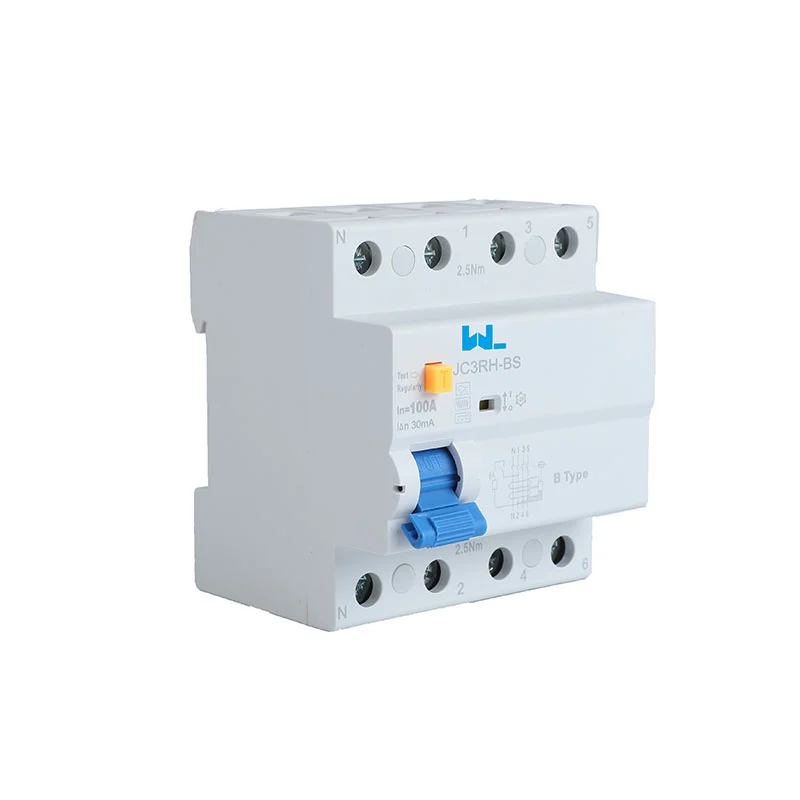
Residual-Current Protection Comparison
RCCB and RCBO describe device functions; Type A and Type B describe residual-current waveforms. Keeping those terms separate prevents over-specification in one area and dangerous gaps in another. An RCCB needs a separate overcurrent device. An RCBO combines residual and overcurrent protection for a branch, usually using more panel space and more coordination data.
| Вариант | Useful strength | Limit or procurement question | Typical setting |
|---|---|---|---|
| JC3RH-BS тип B УЗО | Broad waveform coverage; up to 100 A | Requires coordinated MCB or fuse; verify fault duty | EV, inverter, drive and mixed electronic loads |
| Type A RCCB | AC and pulsating-DC sensing | Use only when smooth-DC exposure is controlled or excluded | General electronic final circuits |
| Type AC RCCB | Sinusoidal AC protection | Not intended for smooth-DC conditions; local rules may restrict use | Conventional loads where permitted |
| RCBO | Residual and overcurrent protection per circuit | Higher device count and careful neutral/thermal coordination | Critical branches needing fault containment |
For broader context, the site’s RCCB safety article explains why защита от остаточного тока is distinct from overload protection. The circuit protection range can then be reviewed alongside the complete panel schedule.
Installation Compliance Evidence
IEC 61008-1 covers residual-current circuit-breakers without integral overcurrent protection. IEC 62423 adds requirements for Type F and Type B residual-current behaviour, including smooth-DC response. IEC 60364-4-41 addresses protection against electric shock at the installation level. A product reference to these standards is not a certification of the whole panel, wiring system or building; national rules determine where each requirement applies.
Before purchase, request the model data sheet, declaration of conformity, pole diagram, terminal limits and short-circuit coordination information. Check whether 6 kA or 10 kA exceeds the calculated prospective перебойный ток. At commissioning, verify polarity, neutral segregation and earth continuity, then use a tester capable of the required waveforms to record trip current and time. Keep results with the panel documentation.
Unsupported compliance claims can cause rejected submittals, rework, delayed energisation and warranty disputes. Record the destination market, standard edition, responsible verifier and manufacturer instructions.
JC3RH Procurement Checklist
- Map the waveform: obtain the load maker’s leakage-current statement, including any smooth-DC component above 6 mA.
- Define the boundary: decide where RCCB plus MCB/fuse is appropriate and where branch RCBOs improve continuity.
- Check fit: confirm poles, top or bottom connection, cable or busbar terminals, DIN-rail space and enclosure IP rating.
- Coordinate duty: match In, Ue, IΔn, Inc/IΔc, frequency and Uimp to design calculations.
- Plan records: retain test instruments, applied currents, trip times, neutral checks and signed acceptance data.
Группы W9 JC3RH-BS Type B product page предоставляет значения параметров модели, используемые в данной статье. Перед окончательным утверждением заказа запросите чертежи и документацию, соответствующую требованиям рынка сбыта.
Часто задаваемые вопросы
Что обнаруживает автоматический выключатель дифференциального тока (АВДТ) JC3RH?
It detects an imbalance between outgoing and returning current and opens when residual current reaches its rated sensitivity. The JC3RH-BS Type B listing includes AC, pulsating DC, smooth DC and alternating residual currents up to 1,000 Hz. Earthing and overcurrent protection are still required.
Может ли дифференциальный выключатель RCCB серии JC3RH заменить автоматический выключатель?
Нет. Стандарт IEC 61008-1 описывает УЗО без встроенной защиты от сверхтоков. Совместите его с автоматическим выключателем или предохранителем соответствующего номинала, либо используйте УЗО‑АВДТ, когда на одном ответвлении требуются обе функции.
Все ли зарядные устройства для электромобилей требуют установки устройства типа B?
Нет. Производитель зарядного устройства может обеспечивать контроль остаточного постоянного тока или предусматривать другую схему. Выбирайте тип B, когда этого требуют документально подтверждённая форма сигнала утечки и местные правила прокладки электропроводки, и проверьте селективность совместно с вышестоящими устройствами.
Является ли значение 30 мА подходящей уставкой для каждой цепи?
Thirty milliamperes is commonly associated with additional shock protection, but standing leakage, circuit purpose and local requirements govern the choice. A 100 mA or 300 mA setting may be used for upstream coordination only where permitted and where downstream people protection remains in place.
How should a Type B RCCB be tested?
Use an instrument that applies the waveform and test currents specified for the device and installation, and record polarity, trip current and time. Pressing the front test button is a functional check, not a substitute for a complete commissioning test.
Ссылки
- IEC 61008-1:2024 — RCCB без встроенной защиты от перегрузок.
- IET — Какой тип RCD?.
- IEC 60364-6:2016 — проверка установки.
The dependable safety switch responds to the real waveform while the protection chain remains coordinated. For JC3RH drawings, OEM/ODM documentation or an application review, contact W9 Group’s technical team before releasing your protection schedule.
Для выбора формы волны и полюсов, свяжитесь с W9 Group с топологией цепи, нагрузочным оборудованием и правилами целевого рынка.