











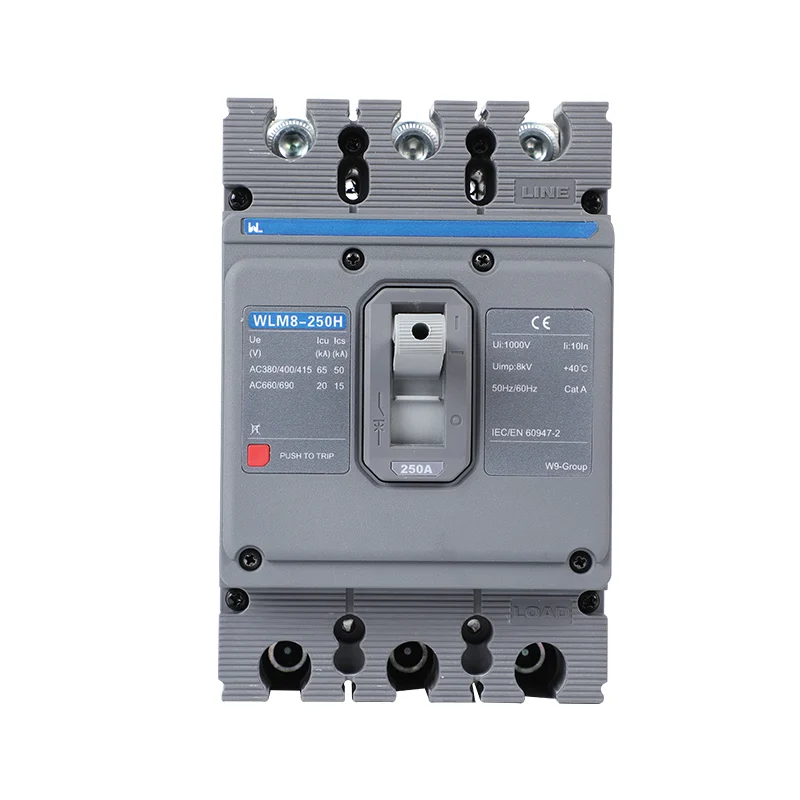





















Круги B, C и D в миниатюрных выключателях: специализированные защитники электрических цепей
A motor-start trip does not automatically justify replacing a B-curve MCB with a D-curve version. The replacement must tolerate permitted inrush while still operating correctly for the fault current available in that circuit.
B, C and D curves describe magnetic pickup characteristics of overcurrent circuit-breakers. They do not describe RCD waveform types. The device’s thermal response and the installation’s conductor protection still matter whichever curve is chosen.
Проверьте miniature circuit breaker range using the load duty, pole arrangement and fault-level study.
What the curve changes
The magnetic region responds to high current within a declared pickup range. Curves with a higher pickup threshold can tolerate different starting conditions, but may require more fault current for rapid operation. Use the exact manufacturer curve and applicable product declaration rather than a label alone.
The thermal overload region must also protect the conductor under the actual ambient and enclosure conditions. Changing a curve does not authorise a higher continuous load, correct a loose connection or add residual-current detection.
| Selection issue | Evidence |
|---|---|
| Permitted inrush | Load starting envelope |
| Rapid fault operation | Available fault current and required disconnection time |
| Sustained overload | Thermal curve and conductor limit |
| Upstream coordination | Exact devices and curves |
The MCB protection guide covers the limits of overcurrent protection and the need for complementary functions.
Match the curve to measured or documented load behaviour
Lighting, power supplies, transformers and motors can have different transient currents. Their category names alone do not specify a universal curve. Obtain the manufacturer’s starting information or appropriate site measurements and compare the complete current-time envelope.
Do not solve an insulation fault by increasing magnetic pickup. Identify which protection operated and investigate the cause. An RCBO can have a B or C overcurrent curve and a separate Type A residual-current designation at the same time.
Verify the fault path before replacement
A higher magnetic threshold can affect disconnection when fault current is limited by the circuit impedance or source. The responsible designer must check the fault-disconnection requirement and conductor protection before approving a substitution. Neither a motor label nor a higher current rating settles that review.
| Proposed change | Required check |
|---|---|
| B to C or D | Inrush and fault-disconnection calculation |
| Higher current | Conductor and equipment protection |
| Different brand | Exact curves, ratings and board compatibility |
| MCB to RCBO | Neutral routing and added residual-current requirements |
Закупки и ввод в эксплуатацию
Specify current, curve, poles, voltage, breaking capacity and terminal arrangement. IEC 60898-1 and IEC 60947-2 declarations have different scopes, and alternative columns in a table require model-specific confirmation. Keep the accepted curve and installation verification with the circuit record.
Ask W9 for the exact time-current curve rather than requesting a generic motor breaker. The right curve is the one that fits both normal starting and abnormal-current disconnection.
Часто задаваемые вопросы
What do B, C and D curves mean?
They identify magnetic overcurrent pickup characteristics within the applicable product declaration. Use the exact model curve and tolerances for selection.
Is D curve always best for motors?
No. Check motor starting and the available fault current needed for disconnection. A higher threshold can create an unsuitable protection response.
Is B curve the same as a Type B RCD?
No. The curve concerns overcurrent, while Type B RCD concerns residual-current waveforms. They are independent characteristics.
Can changing the curve increase load capacity?
No. Continuous loading and conductor ampacity remain separate limits. A curve change is not an uprating of the circuit.
Ссылки
- IEC 60898-1 consolidated edition — AC household and similar circuit-breakers.
- IEC 60947-2:2024 — industrial circuit-breaker scope.
- IEC 60364-6:2016 — проверка установки.
To confirm an MCB order code, свяжитесь с W9 Group with the curve, current, voltage, poles and потенциальный ток короткого замыкания.