








How to Choose an RCCB: Poles, Rated Current, Sensitivity, and Type
A common procurement problem begins with a short request: “Please quote an RCCB for this panel.” That wording leaves the supplier to guess the circuit arrangement, neutral treatment, rated current, residual-current sensitivity, waveform type, overcurrent coordination and destination-market rules. The first quotation may therefore be physically similar to the intended device but unusable in the approved design. The issue is not simply choosing a lower-priced breaker; it is closing the specification gaps before the panel drawing and bill of materials are frozen.
Summary: Choose an RCCB by starting with the circuit topology and protection boundary, then define poles, rated current, residual operating current and residual-current type from the approved design. A 2-pole RCCB is normally considered for a single-phase line-and-neutral circuit; a three-phase arrangement may require a 3-pole or 4-pole device, depending on whether the neutral must be switched and what the exact model permits. An RCCB under IEC 61008-1 is a residual-current circuit-breaker without integral overcurrent protection, so it normally needs a coordinated MCB, fuse or other overcurrent device. Verify the exact model data sheet, wiring diagram, coordination information and local installation rules before ordering.
RCCB Circuit Requirements
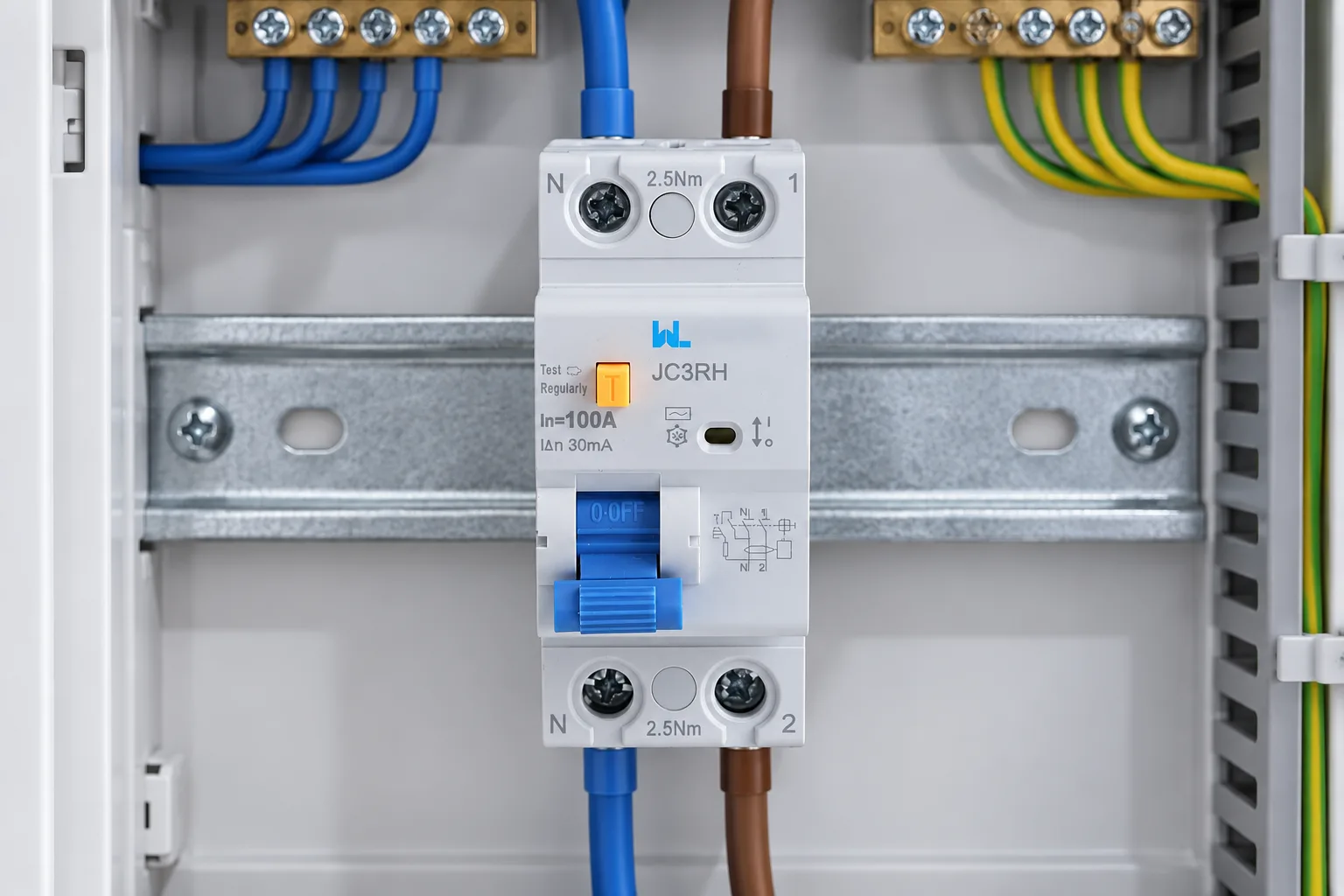
An RCCB measures the current in the live conductors passing through its sensing system. In normal operation, the current leaving on the phase conductors returns through the associated neutral, so the vector sum is close to zero. An unintended path to earth creates an imbalance; the device can open when the residual current reaches its declared operating characteristics.
That function is not the same as overload or short-circuit protection. An RCCB circuit breaker without integral overcurrent protection should be paired with an MCB, fuse or another suitable protective device. The design must also show what is protected upstream and downstream of the sensing point. A residual-current device cannot correct a poor earthing arrangement, protect a fault outside its zone, or guarantee detection of every arc or insulation condition.
Before requesting a quotation, record the supply system, phase and neutral arrangement, design current, conductor ampacity, prospective fault conditions, load technology, expected leakage contributors and the consequence of a trip. The W9 Group RCCB category can be a starting point for product-family discussions, but the category page is not a substitute for the exact order code and controlled technical documents.

RCCB Rating Selection
These four fields are related but not interchangeable. Pole count follows the circuit conductors and isolation philosophy. Rated current must fit the design current and conductor protection. Sensitivity is a residual-current setting selected for the protection objective and coordination. Type describes the residual-current waveform the device is designed to detect. The table is a screening aid; it does not replace the manufacturer’s model schedule or the project design.
| Selection field | How to screen the requirement | Caveat to record before purchase |
|---|---|---|
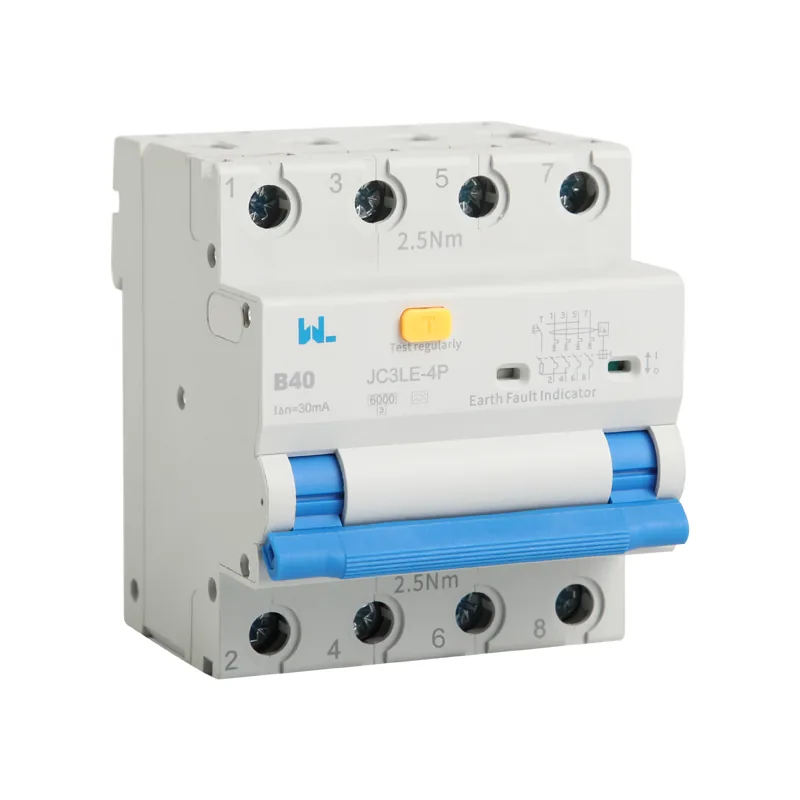
| Poles | For a single-phase line-and-neutral circuit, compare a 2-pole RCCB arrangement. For a three-phase circuit, compare a 3-pole or 4-pole arrangement according to the neutral and isolation design. | Do not infer that every 2-pole device suits every single-phase system or that every 3-phase RCCB can switch a neutral. Check terminal markings, neutral-pole behaviour, voltage, mounting and the local rule. |
| Rated current (In) | Choose a declared current at least compatible with the design load, upstream/downstream protection and the continuous current-carrying capacity of the conductors under the installation conditions. | Rated current is not a target operating current and is not a replacement for cable protection. Verify temperature derating, enclosure conditions, coordination and the exact model’s available values. |
| Sensitivity / residual operating current | Set the residual-current objective from the shock-protection, fire-risk, equipment and selectivity requirements. A low threshold may provide additional protection where the installation rules require it; higher settings may serve other protection or coordination objectives. | There is no universal setting for every circuit. Check unwanted-leakage accumulation, time delay or selectivity, test requirements and the local installation rules. Do not assume a commonly quoted value is automatically compliant. |
| Residual-current type | Match the device to the waveform that the load can produce. Conventional AC loads may be assessed differently from equipment containing rectifiers, variable-speed drives, inverters or other power electronics. | Confirm whether the model is Type AC, Type A, Type F or Type B (or another declared designation), and obtain the manufacturer’s compatibility statement. Additional requirements for Type F and Type B are addressed by IEC 62423; the load documentation still controls. |
Rated current and sensitivity should be specified separately. A device with a suitable ampere value can still be wrong if its residual-current type does not match the load. Conversely, a sensitive device can trip repeatedly if the panel has cumulative leakage, mixed neutrals, moisture or an unsuitable arrangement. Ask the supplier to identify assumptions rather than accepting a generic “standard RCCB” line item.
When is a 2-pole RCCB appropriate?
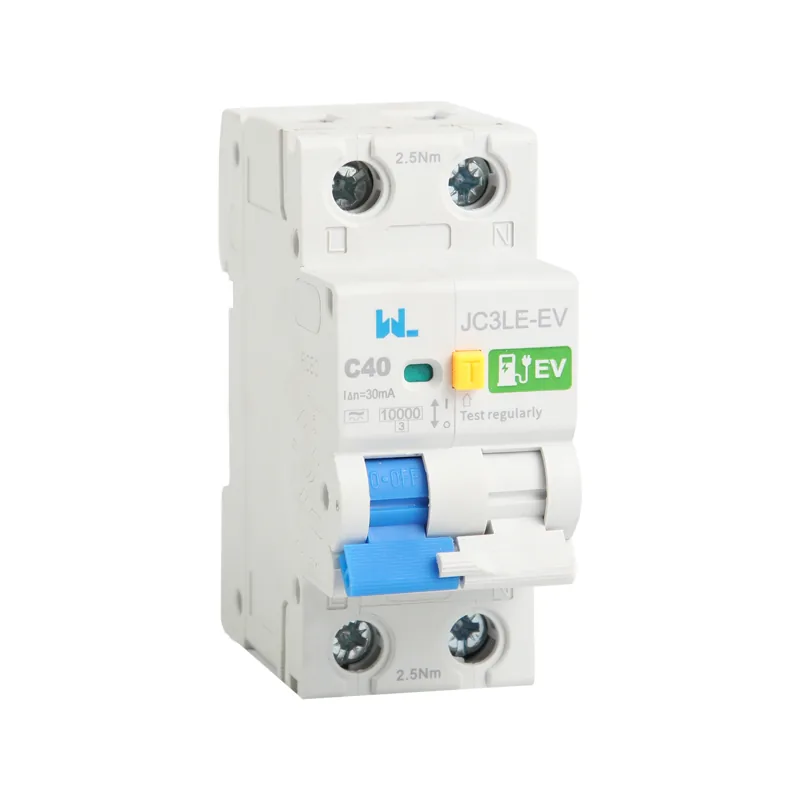
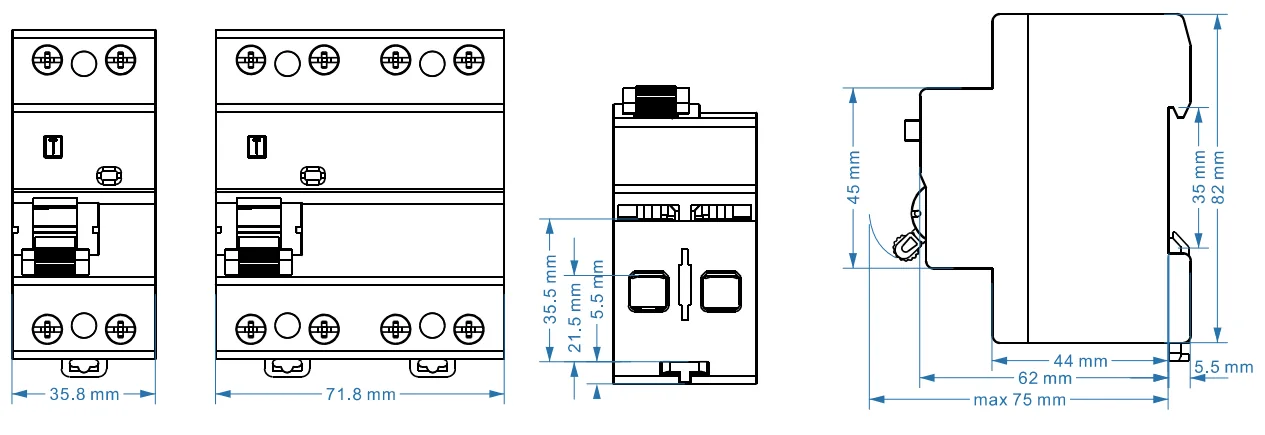
A 2-pole RCCB is commonly evaluated for a single-phase circuit where both line and neutral are routed through the device and the system design calls for their simultaneous disconnection. The phrase “2-pole” alone does not prove voltage compatibility, neutral switching, terminal orientation or suitability for the intended earthing arrangement. The product drawing and local rules must confirm those points.
What does “3-phase RCCB” mean in practice?
For three-phase supplies, the required arrangement may be three poles when the design treats the neutral separately, or four poles when the neutral is included in the device’s sensing and switching arrangement. The decision depends on the network, neutral requirements, disconnection philosophy and exact product construction. A buyer should provide the one-line diagram and ask the manufacturer to mark every protected conductor on the wiring diagram.
Project-Stage RCCB Verification
Many RCCB problems appear late because the device is selected as a catalogue item before the panel, load and installation evidence are complete. The following project-stage matrix gives each team a defined check and an escalation point.
| Project stage | Decision to close | Evidence to retain | Escalate when |
|---|---|---|---|
| Design | Identify supply phases, neutral treatment, load waveform, design current, fault duty and protection boundary. | Approved one-line diagram, load schedule, earthing information and installation-rule checklist. | The circuit topology or required residual-current function is still ambiguous. |
| RFQ | State poles, rated current, sensitivity, type, voltage, terminals, accessories and required documents. | Configuration schedule, model-specific data-sheet request and document register. | A quotation gives only a family name, a nominal ampere value or an unscoped certification claim. |
| Panel assembly | Check mechanical fit, conductor routing, neutral segregation, upstream overcurrent coordination and label information. | Approved panel drawing, wiring diagram, torque or assembly records and updated bill of materials. | Neutral conductors are mixed, a terminal arrangement differs, or the assembly instructions conflict. |
| Commissioning | Verify polarity, continuity, test-button operation and the applicable residual-current or disconnection tests. | Qualified-person test record, as-left settings, trip observations and defect log. | The device trips unexpectedly, will not test, or the measured arrangement does not match the approved design. |
| Handover | Give the operator the model identity, instructions, test interval and protection coordination assumptions. | Final schematic, manuals, declarations, test results and maintenance instructions. | Documents do not identify the supplied variant or local authority acceptance is incomplete. |
For technical review support, use the W9 Group technical support page to request model-specific documentation. The request should state the destination country and application; a generic catalogue cannot establish installation compliance.
RCCB Product and Installation Standards
IEC 61008-1 specifies requirements for residual-current circuit-breakers without integral overcurrent protection for household and similar uses. It helps define product characteristics and tests, but an IEC standard reference is not the same thing as a product certificate, a declaration for every model variant or approval of a complete panel.
Installation requirements are a separate question. The project’s national wiring rules, authority requirements, earthing system, disconnection times, additional-protection provisions and assembly instructions determine how an RCCB may be applied. IEC 60364-4-41 provides an installation-level reference for protection against electric shock; it does not remove the need to check the destination market. If Type F or Type B behaviour is relevant, review the additional requirements in IEC 62423 together with the load manufacturer’s information.
Keep product, assembly and installation evidence separate in the submittal. Request the exact model declaration, test evidence, instructions, marking, residual-current characteristics, coordination data and any destination-market documents. For background on the protection purpose, see the existing article Understanding the Importance of RCCBs in Electrical Safety, then return to the project documents for the final decision.
RCCB Lifecycle Cost
There is no responsible universal price for an RCCB. Total cost can include the device, coordinated overcurrent protection, panel space, neutral rewiring, drawings, document review, testing, troubleshooting and downtime if the first selection is wrong. An illustrative procurement comparison should therefore list the exact configuration and every excluded item. A lower unit price is not a lower project cost when a late change requires panel rework or a new approval cycle.
Ask each bidder to identify the model, pole arrangement, rated current, sensitivity, type, voltage, terminal layout, accessories, included documents, lead-time assumptions and exclusions. Compare like with like, and do not treat an unverified certification or a vague “compatible” statement as a price-equivalent feature.
Frequently asked questions about RCCB selection
What is the full form of RCCB?
RCCB stands for residual-current circuit-breaker. It detects an imbalance between the currents in the conductors passing through its sensing path and opens according to its declared residual-current characteristics. An RCCB without integral overcurrent protection still needs coordinated overload and short-circuit protection.
Is an RCCB more expensive than an MCB?
Unit prices vary by poles, rated current, residual-current type, sensitivity, accessories, documents and destination. More importantly, total cost includes coordination, panel work, testing and the consequence of nuisance trips or rejected submittals. Compare complete, model-specific configurations rather than isolated catalogue prices.
Can I use a 2-pole RCCB on a single-phase circuit?
Often, a 2-pole arrangement is evaluated for a single-phase line-and-neutral circuit, but suitability depends on the supply, neutral treatment, voltage, terminals and local rules. Confirm the exact model wiring diagram and ensure the associated live conductors pass through the intended sensing path.
Can an RCCB be used on a three-phase supply?
Yes, where the exact device and system design support it. A three-phase RCCB may be a 3-pole or 4-pole arrangement depending on neutral switching and sensing requirements. Provide the one-line diagram and verify the manufacturer’s declared application instead of relying on the phrase “3-phase RCCB.”
What is the difference between an RCD and an RCCB?
RCD is a broad term used in many markets for residual-current protection, while RCCB commonly identifies a residual-current circuit-breaker without integral overcurrent protection. Terminology varies by jurisdiction and catalogue, so the product standard, declared functions and model documentation should control the specification. An RCBO adds integral overcurrent protection within its declared characteristics.
How do you connect an RCCB?
Connection must follow the exact manufacturer wiring diagram and the applicable local installation rules; there is no universal terminal sequence. A qualified person should isolate and verify the circuit, route all relevant live conductors through the specified sensing path, keep protected neutrals separated from other circuits, and verify downstream overcurrent protection, polarity, continuity and testing. Never use a generic diagram to work on an energised installation or bypass an earth conductor.
References
- IEC 61008-1: Residual current operated circuit-breakers without integral overcurrent protection for household and similar uses
- IEC Webstore catalogue: IEC 60364-4-41, Low-voltage electrical installations—protection against electric shock
- IEC Webstore catalogue: IEC 62423, Type F and Type B residual current operated circuit-breakers
- IEC standards overview and publication information
The dependable choice is the one that can be traced from the one-line diagram to the model-specific document, the installed wiring and the commissioning record. W9 Group can discuss low-voltage protection options; contact the team with the circuit data, destination market and required documents before releasing the RCCB for production.