



















低電圧スイッチボードのACB設置および試運転チェックリスト
設置済みの遮断器と署名済みの試験記録だけでは、納入された構成が承認済みの設計と一致していることを示すものではありません。購入者および試運転チームにとっての引き渡し上の課題は、遮断器の識別情報、承認済みの設定値、適用される指示書、試験証拠、ならびに未解決の逸脱事項を整合させることです。不一致が生じた場合には、遮断器を交換すれば解決すると安易に判断するのではなく、エンジニアリングによる検討が必要です。.
要約: An Acbブレーカー 低圧配電盤全体の一環として検討されるべきです。IEC 60947-2は遮断器の製品要件を規定していますが、規格基準への適合のみでは、設置の設計、協調性、配線および検証を承認するものではありません。発注前に、想定短絡電流、連続電流、トリップユニットの設定値、機械的インターロック、二次回路、ならびに締め付けトルクの記録に関するプロジェクト仕様を必ず確認してください。 ACBブレーカー固定型, 他の設置形態が適切な試験位置または遮断位置を提供していると仮定するのではなく、文書化された遮断措置を確認してください。.
An 空気遮断器 これは、空気中で電流を遮断する低圧遮断器であり、受電用、母線連系用、発電機接続用、または大容量の供給回路用として選定可能です。具体的な構成、組立設計、および設置状況については、プロジェクトの使用条件に照らして検討・確認する必要があります。以下のチェックリストは、電気エンジニア、盤製作業者、調達担当チーム、販売代理店、システムインテグレーター向けの文書レビューの枠組みであり、特定機種に固有の試運転手順ではありません。.
ACBインストールの前提条件
承認済みの単線結線図および負荷スケジュールから始めます。電圧、周波数、接地方式、設計電流、導体断面積、周囲温度、外殻形式、想定短絡電流を記録してください。これらの仕様を、見積書に記載されたフレームサイズ、極数、トリップユニット、端子、付属品と厳密に照合してください。カタログに掲載されている製品群が、すべての構成において同一の遮断容量や調整範囲を有することを保証するものではありません。.
次に、保護に関する調査を実施してください。一般的な設定手順を前提とするのではなく、承認済みの設計に基づいて、有効化されている保護機能、設定、および相互連動関係を確認してください。地絡保護、ゾーン間連動、解放装置、接点、通信などの機能は、用途によって異なります。正確な型式コードに対応する時限特性曲線および配線図を、以下の経由でご請求ください。 ライブラリをダウンロード, 類似のパンフレットの画像ではなく。.
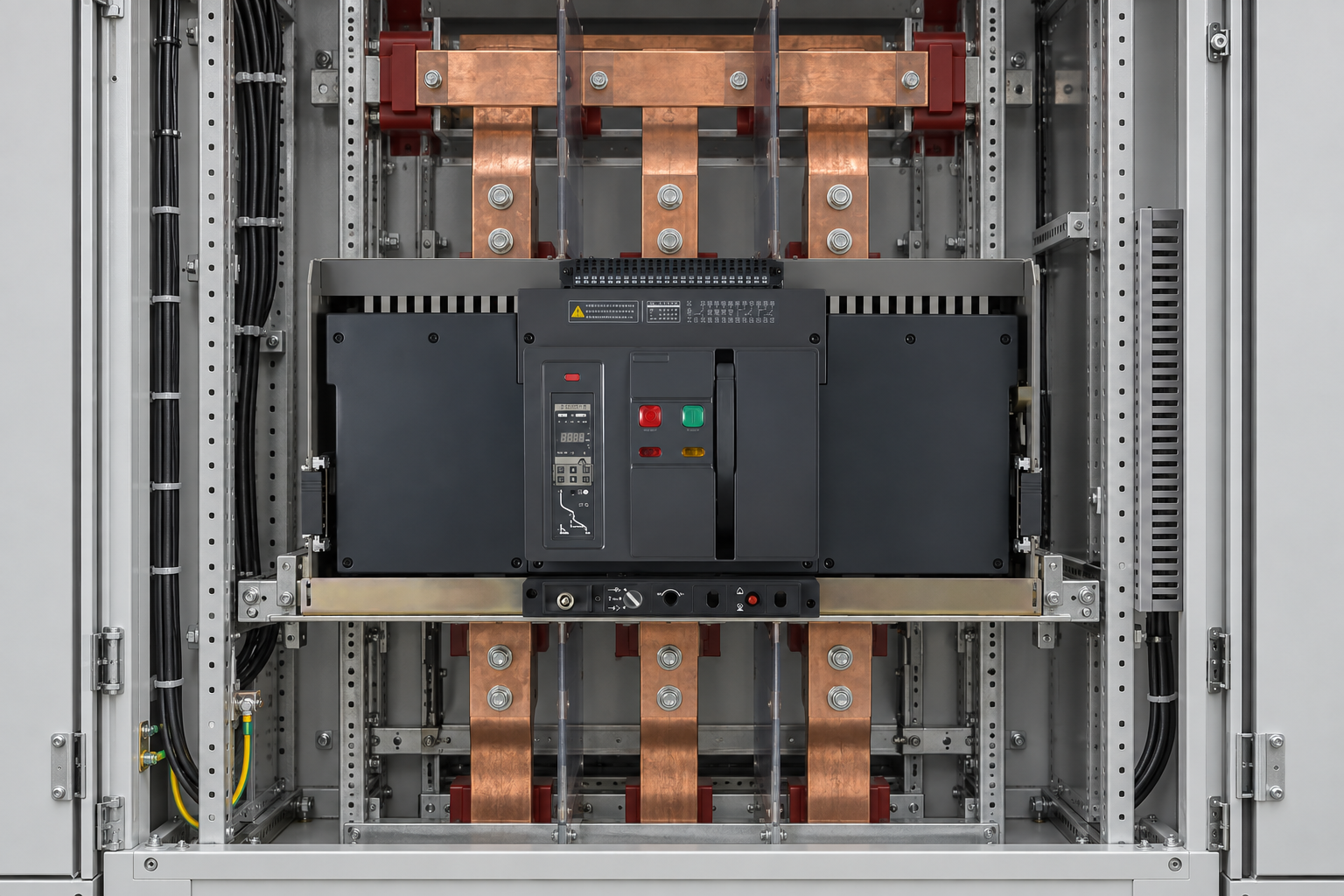
区画の寸法、端子、遮断壁、クリアランス、ドア開口部、吊り上げ用取手および保守点検用アクセスについて、承認済み図面および機種固有の指示書と照らし合わせて確認してください。固定式機器については、取り付けおよび絶縁に関する規定を確認し、引き出し式機器については、記録されたキャリッジの互換性、許可された位置、接点およびインターロックを確認してください。製品ファミリーに関する情報は文書作成の出発点ですが、最終的なスケジュールは承認済みのプロジェクトスケジュールに従います。.
事前準備およびインストールのチェックリスト
図面または指示書に紐付けられた署名済みの検査票を使用し、逸脱事項を記録してください。選定された機器の取扱説明書および承認済みのプロジェクト手順に基づき、資格を有する担当者が該当する確認項目および安全作業要件を定めなければなりません。.
事前インストールチェック
- 名称板の記載事項、フレーム、極数、絶縁および使用電圧、ならびに短絡定格を設計と照合して確認してください。.
- Inspect shipping protection, terminals, arc-control parts, mechanism, trip unit, and accessories for damage.
- Check that foundation, compartment, busbars, cable routes, barriers, ventilation, and lifting method match drawings.
- Verify control supply voltage and polarity for closing, tripping, indication, and communications.
- Confirm earthing, bonding, conductor sizing, phase identification, and the site’s safe work boundary.
Installation checks
- Review mounting and alignment against the manufacturer’s instructions; do not force busbars, cables, or secondary plugs into alignment.
- Verify the specified termination preparation, approved lugs, and recorded manufacturer torque values.
- Review control wiring against the approved design, including ferrules, segregation, shields, labels, and spare cores.
- For fixed units, review the isolation means and permitted test access; for draw-out units, verify the exact manufacturer’s documented positions and isolation provisions.
- Verify applicable barriers, shutters, covers, interlocks, and door hardware against the selected configuration and approved procedure.
Commissioning tests before energisation
Commissioning is a controlled sequence, not a single “close and see” event. Qualified personnel must use the approved isolation, lockout, verification, and test procedures for the equipment and site, recording instrument identity and calibration. Request the exact manufacturer’s instructions; methods, precautions, and acceptance values must be confirmed from those instructions and the approved project specification, not a generic checklist.
For an Acbブレーカー handover, we recommend a versioned as-left record: the documented configuration and settings accepted after commissioning, rather than the original proposed values. Include the board and circuit identifiers, breaker order code and serial number, trip-unit identity, enabled functions, recorded final settings, and approval reference. Link each entry to the applicable manual revision, drawing revision, coordination-study revision, and test-report identifier. Record the test date, responsible person, reviewer, and instrument reference where applicable. This is an editorial record-keeping recommendation, not a manufacturer test specification; the project team must confirm the required fields and acceptance criteria for the exact installed model.
Confirm the required visual, mechanical, indication, release, and interlock checks in the selected manufacturer’s instructions. For draw-out equipment, review only the permitted positions and operations documented for the installed breaker and cradle. Do not infer an isolation procedure or a safe work boundary from a generic position name.
Have the responsible engineer approve the applicable continuity, insulation-resistance, contact-resistance, and protection-function tests, including equipment precautions and acceptance criteria. Secondary injection or another trip-unit test must be assessed against the selected manufacturer’s procedure and enabled functions; a generic article cannot establish that one method verifies every configuration.
Review the documented checks for remote commands, permissives, alarms, metering, and communications where those functions are specified. Confirm final settings against the approved coordination study and review setting access controls where required. Any release for energisation remains subject to the authorised site procedure and documented engineering review.
Installation vs Commissioning Evidence
| ステージ | 収集すべき証拠 | Pass condition | Typical owner |
|---|---|---|---|
| Design freeze | Single-line diagram, load schedule, fault study, approved breaker schedule | Ratings and protection functions match the actual network | Electrical engineer |
| 入国審査 | Photos, packing list, nameplate record, damage report | Correct configuration arrives without unresolved damage | Panel builder or warehouse lead |
| Mechanical installation | Mounting check, torque sheet, clearance record, bonding test | Secure, accessible, correctly terminated, and bonded | Installation supervisor |
| Secondary wiring | Point-to-point test, insulation check, updated schematic | Every command, indication, alarm, and interlock behaves as designed | Controls technician |
| Protection test | Injection report, final settings, trip-time results | Enabled functions operate within the approved test tolerance | Commissioning engineer |
| 引き渡し | As-built drawings, manuals, certificates, spares list, training record | Owner can operate, isolate, maintain, and audit the board | Project manager |
Commissioning Approval Checklist
| Gate | 質問 | Stop the job when |
|---|---|---|
| Before mechanical work | Are drawings, isolation boundaries, lifting arrangements, and tools approved? | The breaker identity or work boundary is uncertain. |
| Before secondary power | Are polarity, fuses, control voltage, and interlocks checked? | A control circuit can close or trip unexpectedly. |
| Before primary energisation | Are torque records, insulation checks, phase identification, and settings complete? | Any protective cover, barrier, earth, or test record is incomplete. |
| After first energisation | Are voltage, indication, noise, temperature, and alarms normal under a controlled load? | There is unexplained heating, smell, chatter, alarm, or trip activity. |
| At handover | Can the owner locate settings, procedures, drawings, and spare parts? | As-built information does not match the installed breaker. |
ACB Safety and Compliance Requirements
IEC 60947-2 covers low-voltage circuit-breaker characteristics and verification expectations. It does not replace installation rules, the short-circuit study, risk assessment, or safe-work procedure. The completed switchboard may also fall under IEC 61439, while local codes govern installation and inspection. NFPA 70 and OSHA requirements may apply in the United States; the Low Voltage Directive can affect market placement in the European Economic Area.
Ask whether each document is a routine test record, type-test evidence, declaration of conformity, or third-party certificate; these scopes are not interchangeable. Unsupported certification language can delay approval or create liability. Confirm that drawings and instructions apply to the exact installed configuration and review destination-market applicability with the responsible engineer.
ACB Procurement and Commissioning Actions
- Buy the complete configuration: specify frame, poles, trip unit, releases, contacts, communications, terminals, mounting, and spares as one controlled line item.
- Freeze settings: attach approved coordination settings and test tolerances to the purchase and inspection plan.
- Require evidence: request the exact wiring diagram, manual, routine-test record, rating declarations, and serial record.
- Plan isolation: for an ACBブレーカー固定型, require qualified personnel to define the approved isolation and test-access procedure for the installed assembly.
- Make handover operational: train the owner on operation, trip investigation, reset limits, emergency isolation, and document control.
We recommend a discrepancy log linked to the as-left record before handover. For each mismatch between the installed configuration and approved documents, record the affected item, evidence reference, responsible owner, proposed correction, and closure status. A changed trip unit, accessory, wiring revision, or protection setting should return to the responsible reviewer for impact assessment and reapproval, with any required repeat verification documented. Retain superseded versions for traceability and identify the accepted revision in the handover pack. An unresolved discrepancy should remain an explicit approval hold, not disappear into a general “passed” signature.
For a documentation review, compare the WEW1 エア回路遮断器 information with the approved schedule and request any missing model-specific evidence. Project evidence, not a brand name, should decide acceptance.

よくある質問
What should a air circuit breaker diagram show?
An air circuit breaker diagram should show the power path, poles, terminals, trip functions, control supply, closing and opening circuits, contacts, interlocks, and earthing interfaces for the installed configuration. It should identify terminal numbers and protection-study references. Use the manufacturer’s exact schematic and approved switchboard drawing; a generic symbol sheet is not enough for commissioning.
What is the standard symbol for air circuit breaker?
There is no single worldwide symbol that replaces the project legend. IEC 60617 and local conventions commonly show a circuit-breaker as a switching contact with a designation such as “ACB.” Follow the standard and legend specified by the project or authority having jurisdiction.
エア回路遮断器の主な種類は何ですか?
The practical categories are fixed and draw-out constructions, with variations in frame size, poles, trip technology, and accessories. A draw-out ACB has connected, test, and isolated positions; a fixed ACB needs a separately engineered isolation method. Selection still depends on ratings, fault duty, coordination, space, maintenance, and control.
購入者はシュナイダーのエア回路遮断器についてどのようなことを知っておくべきですか?
“Air circuit breaker schneider” is a search phrase, not a complete specification. Compare any Schneider-referenced requirement with ratings, physical interface, trip functions, accessories, documentation, and local compliance obligations. A similar frame or brand substitution is not interchangeable without engineering approval and a coordination check.
エア回路ブレーカーはどのように交換しますか?
Isolate, lock out, prove dead, and verify the replacement against the original’s poles, voltage, current, fault ratings, trip unit, terminals, control circuits, dimensions, and interlocks. Install under the site procedure, then repeat required torque, insulation, contact, functional, and trip tests. Update drawings, settings, serial records, and maintenance history before service.
ACB 断路器はどのように機能しますか?
An ACB carries load current through closed main contacts. When its release detects an overload, short circuit, earth fault, or control command within enabled settings, the mechanism separates the contacts and the arc is extinguished in air. Functions, timing, and reset depend on the trip unit and accessories, so use the exact wiring and settings documentation.
参考文献と次のステップ
- IEC Webストア, for the current publication record of IEC 60947-2.
- IEC standards overview, for the applicable IEC 61439 assembly requirements.
- European Union, Directive 2014/35/EU (Low Voltage Directive).
- U.S. Occupational Safety and Health Administration, Electrical safety.
- National Fire Protection Association, NFPA 70.
A reliable result is a board whose ratings, settings, interfaces, tests, and records agree. For a configuration review, use the W9グループの連絡先ページ to send the one-line diagram, duty requirements, and commissioning questions.