





































MCCB solar vs MCCB estándar: ¿Cuál es la mejor opción?
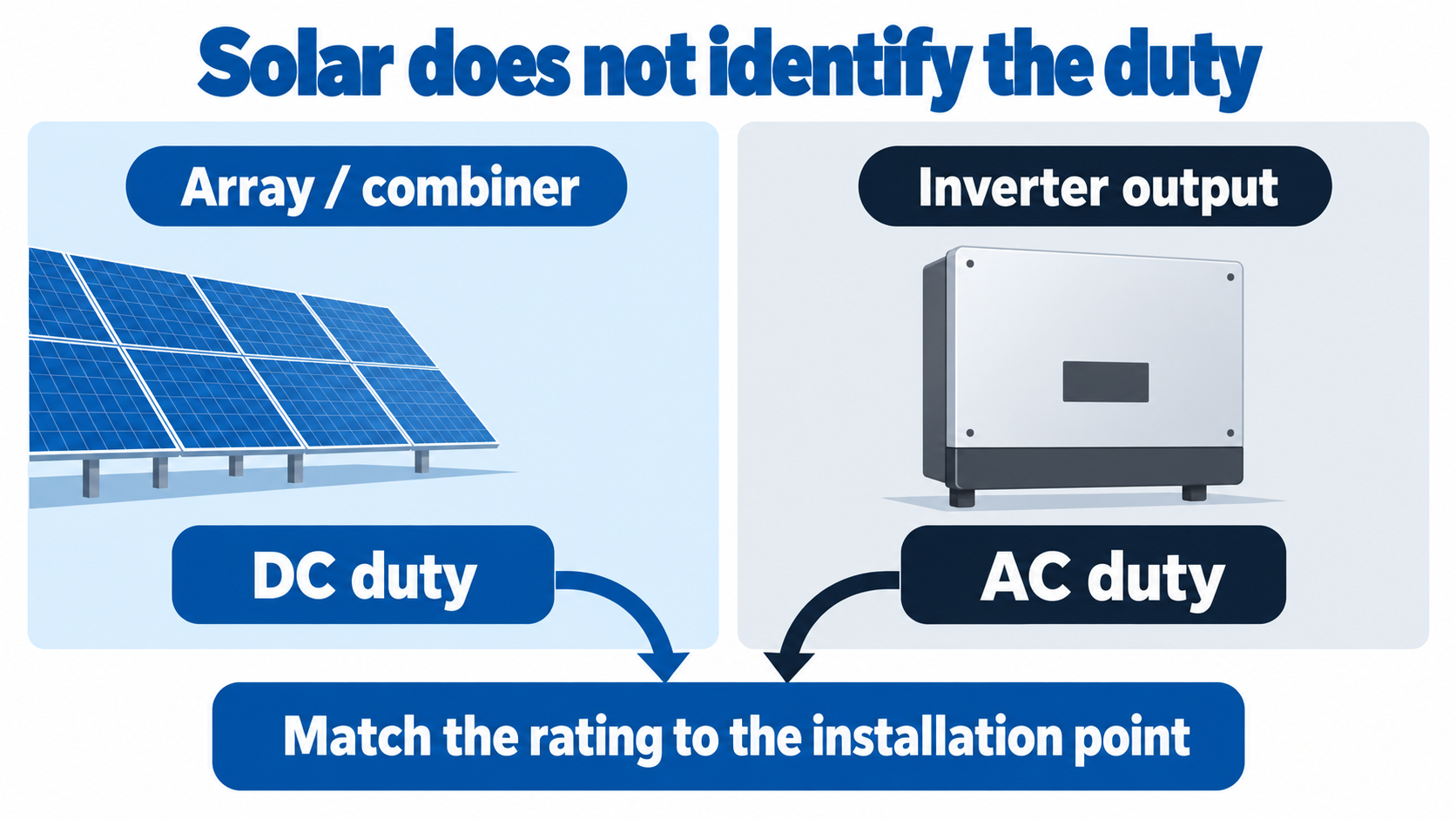
A solar installation needs protection on both sides of the inverter. The array and combiner circuits carry DC; the inverter feeder carries AC. That distinction is the first thing to establish when someone offers you a “solar MCCB.” The name alone leaves too much unanswered.
A solar MCCB is suitable only if its ratings and connections match the circuit it will protect. A general-purpose MCCB may also be suitable, provided its documentation covers that application. To compare the two, work through the supply type, maximum voltage, fault current, trip functions and installation requirements. IEC 60947-2 provides a relevant product framework; the exact model and destination-market requirements still determine acceptance.
AC and DC Breaker Requirements in PV Systems
The breaker on an array or combiner circuit faces a different duty from one on the inverter’s AC output. Identify the installation point on the single-line diagram, then read the device’s operational voltage and AC or DC rating. This avoids comparing products intended for different parts of the same plant.
ABB’s higher-voltage solar range includes both AC and DC products, which helps explain why the word “solar” can be ambiguous. Its 800 V AC and 1500 V DC applications use their own specified configurations. Those ratings describe the relevant ABB products and cannot be transferred to another breaker.
Our MCCB specification guide explains operational voltage, insulation ratings, impulse withstand and breaking capacity. Use those separate fields in your enquiry. The supplier should be able to identify the rating row that applies to your circuit before you compare prices.
| Offer description | What it may mean | What it does not prove |
|---|---|---|
| Solar MCCB | A product intended for some solar-plant duty | That it is DC-rated or fits every PV circuit |
| Standard MCCB | A general family or commercial description | That it lacks all DC capability |
| Disjuntor de CA MCCB | A documented DC circuit-breaker application | Suitability for every PV or battery fault duty |
| PV switch-disconnector | A switching/isolation product for stated PV duty | Integral overcurrent protection |
| AC solar breaker | A breaker for an AC section of a solar system | Approval for the array’s DC circuit |
Solar MCCB Voltage and Short-Circuit Ratings
For the PV array, calculate maximum voltage from the module data, number of modules in series and design-temperature correction. Nominal plant voltage is not enough. On the AC side, specify voltage, frequency, earthing and fault duty, taking care to use the same voltage reference throughout the comparison.
PV fault-current behaviour also needs attention. Parallel strings can feed a faulted path, while the modules and connected equipment affect the current available. The breaker must interrupt the maximum fault it may encounter and operate appropriately for the faults it is intended to clear. A high breaking-capacity figure answers only the first of those questions.
Select the current rating or trip setting with the cable capacity, design factors and installation conditions in mind. The frame designation may differ from the fitted trip rating. For electronic units, establish which measurement and protection functions are available for the intended AC or DC duty.
Steady DC has no periodic natural current zero, so an AC interruption rating does not establish DC capability. Some breakers carry both ratings, with different capacities or connection requirements. Read the applicable rating and drawing together.
DC MCCB Pole Connections and Cabinet Fit
A DC voltage rating may rely on poles connected in series using approved links. The manufacturer’s drawing must suit the network arrangement, including earthing and any polarity restrictions. Multiplying a presumed voltage per pole is not a valid way to design a new connection.
Mechanical fit takes more than matching the mounting holes. Terminal extensions, cable size and material, tightening instructions, clearances and heat dissipation can all affect the panel layout. A late substitution may require changes to the cabinet and another design review.
Apply installation derating to both solar and general-purpose products. Sun-heated enclosures, nearby equipment and limited ventilation can create conditions quite different from the catalogue reference. Use the manufacturer’s limits and the assembly designer’s assessment for the actual cabinet.
Solar MCCB Supplier Documentation
Give each supplier the same document request: the complete order code, operational ratings, breaking-capacity data, trip characteristic, connection drawing and installation instructions. Add the conformity documents required by the project. All of them should refer to the configuration being quoted.
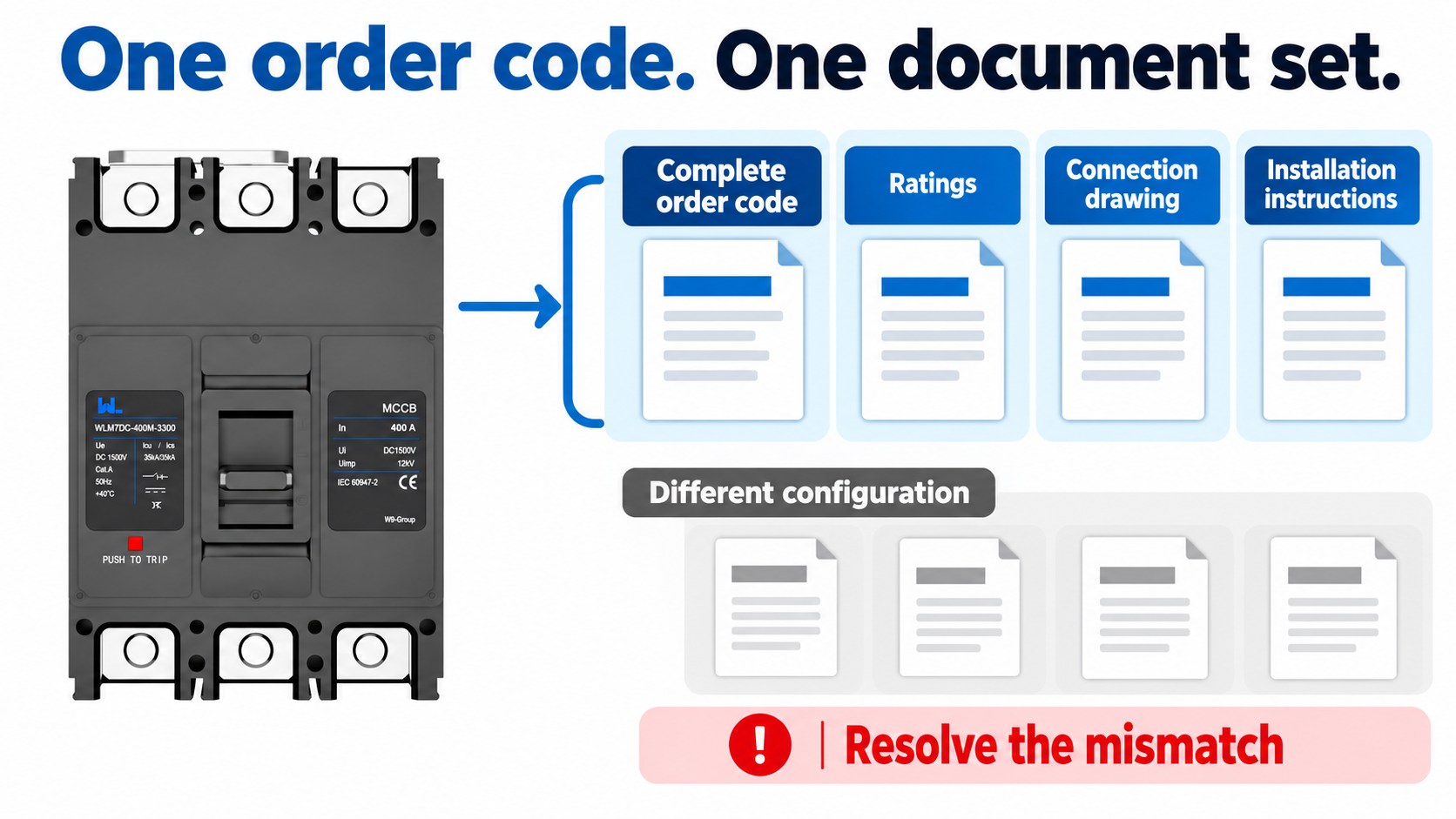
IEC 60947-2 covers circuit breakers; IEC 60947-3 covers relevant switches and disconnectors. A switch-disconnector should not be quoted as a direct replacement for an overcurrent-protective breaker. Also distinguish a standard reference, a CE declaration and third-party certification, and check what the destination market requires for both the device and completed assembly.
| Acceptance field | Evidence-led comparison | Reason to hold the offer |
|---|---|---|
| AC or DC duty | Matches the protected side of the inverter | Only the word solar is supplied |
| Voltage and fault capacity | Matching rating row at the actual duty | Unrelated AC or lower-voltage figures |
| Funciones de protección | Trip unit and characteristic cover the assigned task | Switch-disconnector offered as an equivalent breaker |
| Connections | Approved poles, links, direction and earthing | Generic drawing or improvised connection |
| Integration and documents | Terminals, derating, clearances and model evidence | Missing installation or configuration details |
El W9 WLM7DC-400 DC MCCB is one family to consider for a PV DC enquiry. Ask for the voltage, pole arrangement and breaking capacity of the proposed order code. That information allows the project designer to assess a particular offer without treating the whole range as interchangeable.
Compare the installed cost as well as the device price. Include links, terminals, cabinet work, engineering, commissioning and maintenance. Use actual quotes for those items so a bare breaker and a more complete package are compared on the same basis.
If you are replacing an existing breaker, give the designer the original requirements and a list of differences in the proposed alternative. Accessory voltages and mechanical interfaces belong in that review. The W9 product range provides options to investigate; each still needs to meet the requirements of the circuit.
Solar MCCB Selection FAQs
Can a standard MCCB be used in a solar installation?
Yes, if its documented AC or DC duty, voltage, current, fault rating and connections meet the project requirements. Being sold as a general-purpose MCCB does not, by itself, rule it out.
What makes a circuit breaker suitable for DC?
It must have a declared DC interruption capability at the required voltage and connection arrangement. Check its polarity restrictions and intended application as well, especially when comparing PV and battery circuits.
Is every solar MCCB a DC breaker?
No. Solar plants also have AC circuits after the inverter. A product marketed for solar use may be intended for either side, so look for the stated current type and operational voltage.
Does an MCCB also provide isolation?
Use it for isolation only where the exact product documentation and installation requirements permit that function. A separate PV switch-disconnector, meanwhile, does not necessarily provide overcurrent protection.
Can the same MCCB have AC and DC ratings?
Yes. A manufacturer may declare both, but the permitted voltages, breaking capacities and pole connections can differ. Follow the data for the supply type in use.
What should I check before changing to another MCCB?
Review electrical ratings, trip functions, connections, terminals, clearances and approvals with the responsible designer. Include accessory control voltages and any changes needed in the cabinet.
Solar MCCB Technical References
- ABB: Molded-Case Circuit Breakers for Higher-Voltage Solar Power Plants, AC and DC portfolio context, 20 June 2018, accessed 17 October 2026.
- ABB: SACE Tmax PV for Photovoltaic Applications, configuration-specific technical catalog, accessed 17 October 2026.
- Eaton: DC and PVGard Molded-Case Circuit Breakers, application overview, accessed 17 October 2026.
Solar MCCB Replacement Requirements
The deciding factor is suitability for the actual circuit. Put the AC/DC duty, voltage, fault requirements and permitted connections on one comparison sheet, then resolve any gaps with the supplier. For a W9 quotation, send that sheet and the installation details through our product enquiry form. The project designer can then assess the proposed model and any departures from the original specification.