
































MCCB Earth-Leakage Protection: When Is It Needed?
A distribution circuit carries less than its normal design load, yet an insulation problem creates current flowing outside the intended return path. The ordinary overload setting may not address that fault at the required level. This hypothetical example explains why choosing a breaker only by its load-current rating can leave an important protection requirement unresolved.
MCCB earth-leakage protection addresses a residual-current requirement in addition to the specified molded-case breaker’s overcurrent duties. It is needed when the installation design requires that function and the selected device provides the appropriate sensitivity, time behavior and waveform response. An electronic release or a large frame rating alone does not establish it.
Why Overcurrent Protection Does Not Cover Every Leakage Fault
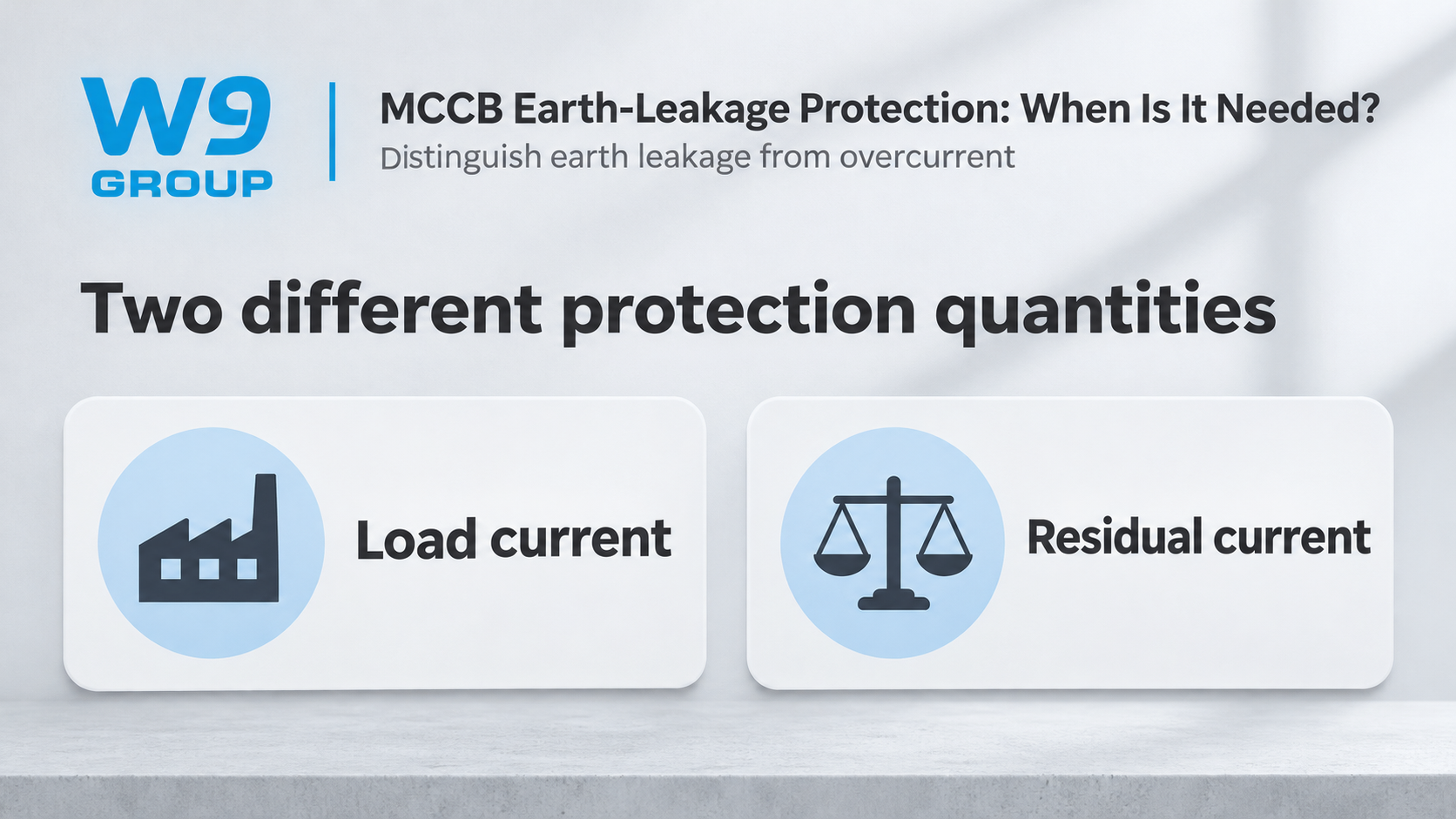
Overcurrent protection considers current exceeding the circuit’s permitted duty. Residual-current protection responds to the specified imbalance between currents in the conductors included in its sensing arrangement. The two functions ask different questions, so their ratings and settings must be selected separately.
A leakage fault can exist without enough total current to operate an ordinary overload release promptly. Conversely, an overload can exist without the residual imbalance required to operate a leakage function. A device described as an earth-leakage MCCB must therefore be assessed for both its overcurrent and residual-current functions rather than for a single headline rating.
Ground-fault protection in an electronic release is not automatically sensitive earth-leakage protection. The actual sensing method, pickup range and delay determine the application. The article on electronic MCCB trip-unit operation provides the broader release context, but the leakage function still needs its own specification.
| Quantity or function | What it describes | What it does not establish |
|---|---|---|
| Rated load current | The selected current-carrying or overcurrent duty | Residual-current sensitivity |
| Leakage pickup | The specified residual-current threshold | Permitted circuit load or fault breaking capacity |
| Leakage time behavior | The specified response or delay characteristic | Suitability for every disconnection requirement |
| Residual waveform response | The residual-current forms the device is designed to detect | Detection of every possible waveform |
When Does a Circuit Need Earth-Leakage Protection?
The objective may concern automatic disconnection under the applicable installation rules, additional protection against electric shock, or a particular equipment-protection requirement. Those objectives are not interchangeable. Establish the earthing arrangement, circuit use and required disconnection criteria before choosing the device or its settings.
HSE advises using suitable RCD protection, particularly in wet or damp locations, and explains the role of a device rated at no more than 30 mA in limiting certain electric-shock risks. It also states that an RCD cannot protect against every kind of shock. This is not a universal instruction to set every industrial feeder to 30 mA, nor evidence that any particular MCCB offers that sensitivity.
Additional protection does not replace safe isolation. Earthing, protective conductors, insulation and the rest of the installation design remain necessary. A residual-current device also cannot be assumed to detect a contact situation that produces no relevant imbalance through its sensing arrangement.
Where the project needs only an alarm for a particular monitoring purpose, identify that explicitly. An alarm-only mode does not provide automatic disconnection. Do not accept a non-tripping option as a substitute where the design requires the protective device to open the circuit.
Leakage Waveforms from Electronic Loads
The connected equipment influences the residual-current waveform and normal leakage behavior. Electronic power supplies, drives and filters can make a simple load-current description inadequate. Obtain the equipment manufacturer’s protective-device requirements and compare them with the exact leakage-release specification.
Electronic construction does not prove waveform coverage. A device with an electronic leakage release may still have a limited declared response type. Do not infer support for smooth DC or other waveforms simply because a controller contains electronics, a display or programmable settings.
Normal leakage also matters. Several loads can contribute leakage to one upstream device, while a deteriorating component can change that pattern over time. A competent assessment should distinguish expected operating behavior from an insulation fault before anyone raises a pickup to prevent trips.
| Application question | Information to obtain | Selection consequence |
|---|---|---|
| What is the protection objective? | Applicable installation requirements and disconnection criteria | Determines the required function and time behavior |
| What loads are connected? | Equipment type and residual-waveform requirements | Determines the suitable response type |
| What leakage is present normally? | Appropriate measurements and operating conditions | Informs the design without excusing an unsafe fault |
| What devices are upstream and downstream? | Exact device details and coordination data | Determines whether the intended selectivity is supported |
WLM6LY Leakage Sensitivity and Pole Selection
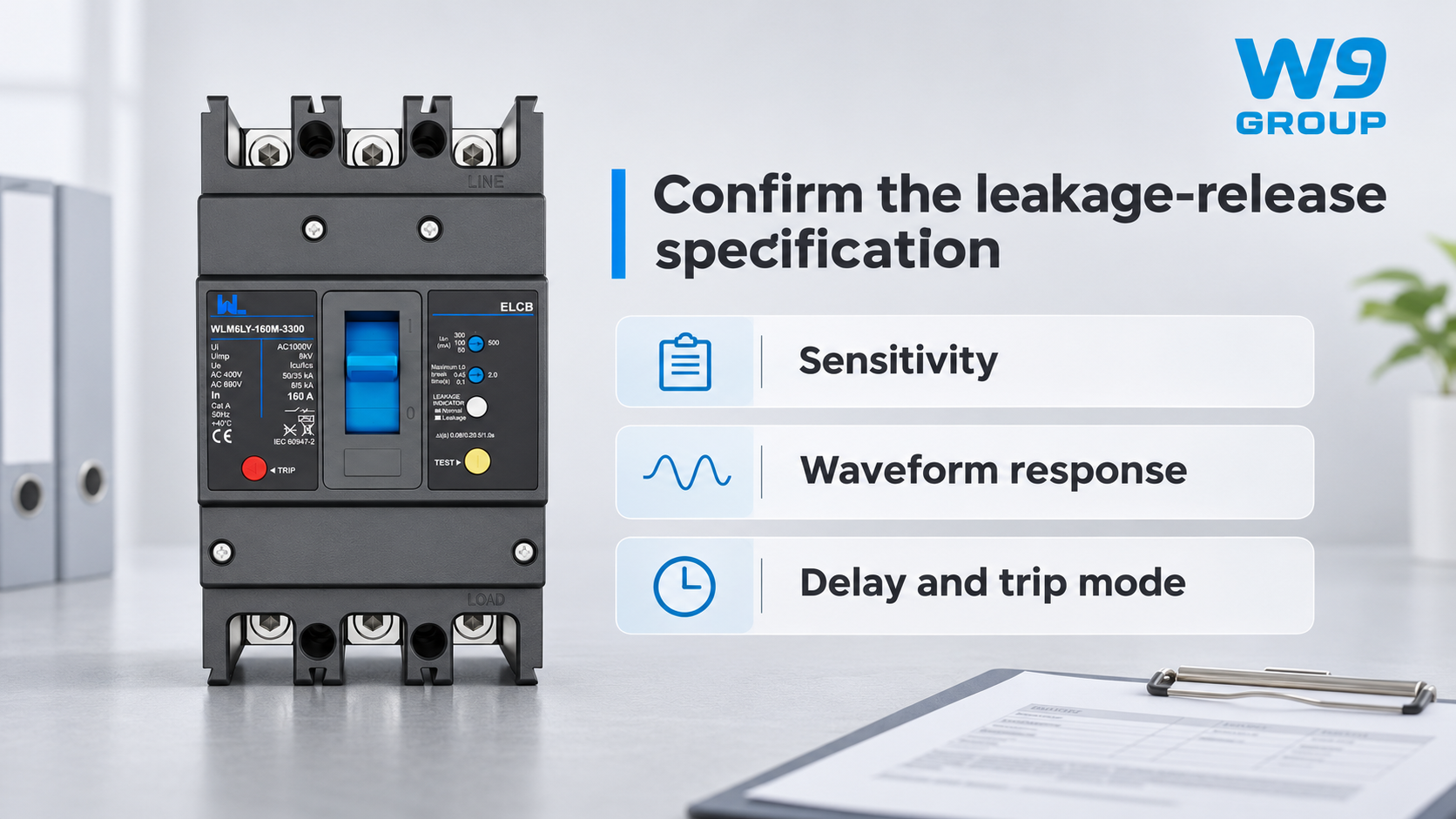
W9’s WLM6LY-160 earth-leakage MCCB page identifies a molded-case device with thermal overcurrent and electronic leakage releases. The source table lists AC residual-current response. Those details support a model-specific enquiry, not a claim that every leakage waveform or sensitivity is covered.
The same page contains different pole references between the summary and table. Confirm the supplied pole configuration and its connection diagram instead of transferring a family-level description to the order. Where a neutral is present, its switching and sensing requirements must be resolved in the actual manufacturer’s arrangement.
Residual breaking capacity is not leakage sensitivity. A making or breaking value expressed in amperes or kiloamperes must not be copied into the pickup field. Request the actual residual operating-current schedule, permitted delays, test instructions and alarm or trip mode.
- State the circuit duty, earthing arrangement and protection objective.
- Confirm sensitivity, waveform response and time behavior for the exact version.
- Request the pole, neutral and test-circuit drawings.
- Check voltage-specific fault ratings and coordinated overcurrent protection.
- Agree the commissioning records and ongoing test instructions.
IEC 60947-2 provides the industrial circuit-breaker standard context. It is not evidence that a listed product has been certified for every proposed application. Ask W9 technical support for the declaration and documents matching the offered configuration, including any unresolved source-table details.
Compare total cost on that same scope. Accessories, panel space, shutdown arrangements and testing can affect the installed cost as much as the breaker quotation. A lower-priced device is not a saving if it lacks the response type or documentation required for acceptance.
MCCB Earth-Leakage Protection FAQ
Which Circuits Can Use a Two-Pole Earth-Leakage MCCB?
A suitable two-pole version may be selected for a circuit whose supply and switching requirements match its documented configuration. Confirm voltage, neutral treatment and the test-circuit diagram; do not infer suitability from pole count alone.
What Happens During an Earth-Leakage Fault?
It is unwanted current flowing through a path outside the intended circuit return arrangement, often associated with insulation deterioration or another fault. The cause and severity require investigation; the term is not a complete diagnosis.
Does an Earth-Leakage Protector Always Trip the Circuit?
It is a broad description for equipment that detects the specified leakage condition and performs its declared action. Identify whether the actual product trips a circuit, signals an alarm or performs another function.
Does the ELCB Name Identify Its Protection Function?
The answer depends on the actual device because ELCB is used for different operating principles. Confirm whether it is voltage-operated or residual-current-operated and what other protection, if any, is included.
Is There a Universal Acceptable Earth-Leakage Value?
There is no single acceptable value for every installation. The equipment limits, circuit design, applicable rules and selected protective function must be assessed together; a trip threshold is not permission for a fault.
Which Wiring Instructions Apply to an Earth-Leakage MCCB?
Use the exact manufacturer’s connection, neutral, mounting and test instructions. Installation and verification should be performed by a competent person under appropriate isolation and safe-working arrangements.
References
- IEC 60947-2:2024: circuit-breaker scope
- HSE electrical safety FAQ: residual-current protection and its limits
- HSE HSG85: safe working practices
Choose the leakage function by the fault it must address, then verify the complete device. Browse the W9 protection-product range and contact the team with your circuit and residual-current requirements.